- Animals
- ›Chordates
- ›Vertebrates
- ›Birds
- ›Perching Birds
- ›Woodswallows, Butcherbirds, and Currawongs
- ›Artamus
On eBird ↗
Dusky Woodswallow
Live sightings near you, the range map, bar charts of when it is seen, and Macaulay Library photos and recordings.
Dusky Woodswallow
Artamus cyanopterus
The dusky woodswallow (Artamus cyanopterus) is a bird species of forests and woodlands in temperate and subtropical regions, extending into tropical areas around the Atherton Tableland, in eastern and southern Australia.
The global population of the species has as yet not been formally confirmed, but it has been officially rated in the range of 'Least Concern', according to the BirdLife International in 2004. As such, the bird could be described as common in its local habitat.
From the article Dusky woodswallow on Wikipedia (CC BY-SA), quoted section by section
Description
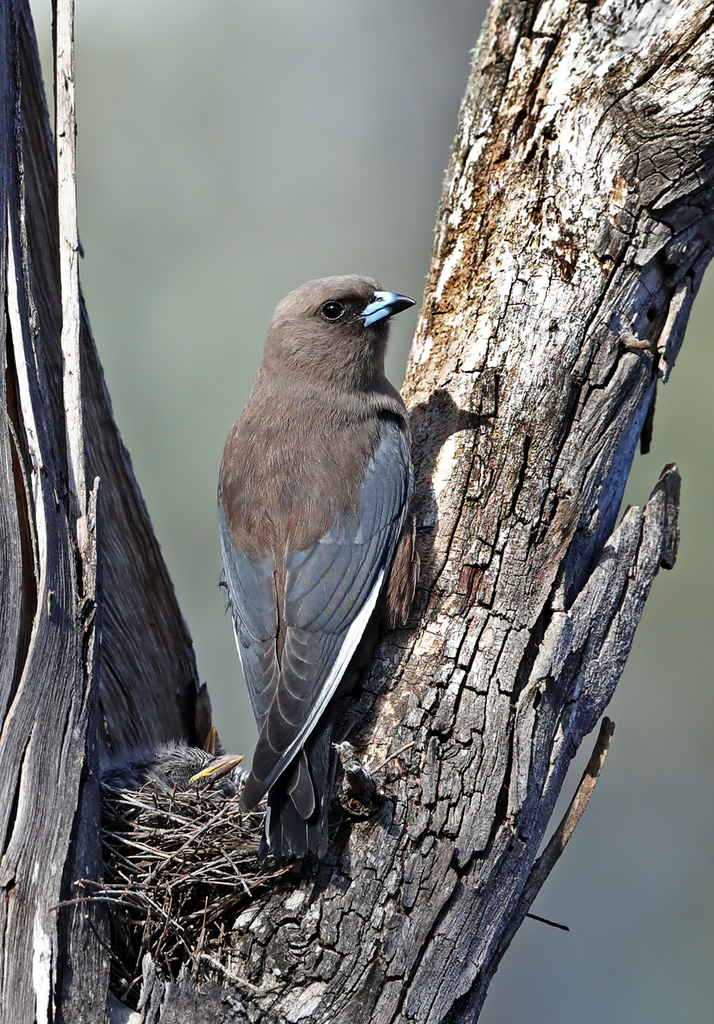
The dusky woodswallow is medium-sized and swallow-like, with a dark brown hue, but there have been instances where the bird has appeared grey. The birds have a black patch in front of the eyes, and grey (sometimes also black) wings with white streaks on them. The dusky woodswallow has a black, white-tipped tail with a silver underwing. The birds have a blue-grey bill capped with black. Dusky woodswallows are known to spontaneously 'wag' or swivel their tails fervently, a trait which is common among many other species of woodswallow.
Relations to other woodswallows. In a significant difference from other woodswallows, dusky woodswallows have a distinctive white patch on the outer wing. Dusky woodswallows also seem to typically be more smoky brown than other species of woodswallow. The little woodswallow, a smaller, darker woodswallow is also slightly more smoky brown that other woodswallows, but that is the only similarity that the latter has with the dusky woodswallow; the little woodswallow does not share a white patch on the outer wing.
Range & habitat
The birds live primarily in open eucalyptus forests and woodlands. They range mostly from Atherton Tableland, Queensland, down to Tasmania and west to Eyre Peninsula, in South Australia. They roost communally, usually nocturnally. During the breeding season, they nest in large flocks to make sure to keep predators away from young. These flocks can be 20–30 dusky woodswallows in size. Dusky woodswallows adhere to seasonal migration and movements. The birds are a nomadic species, and tend to move quite spontaneously. However, one certain change of habitat occurs for the south-eastern birds, who migrate northward for Autumn. Communally roosting birds, the dusky woodswallow has a variety of chattering calls which are used in certain situations. The most distinctive of these calls is perhaps the one which is used when a predator or intruder approaches, which consists of a harsh mobbing call to warn others.
Wikipedia: “Distribution and habitat”
What it does
The diet of the bird can be varied. They eat various forms of foliage and other grassy material that they find on the ground on in trees and shrubs. Dusky woodswallows have been seen eating termites, butterflies and other insects. They also eat nectar from flowers. One notable aspect of their feeding habits is the way they hunt flying insects, which is done by picking them up on their wing. They do, however, also eat their prey from the ground, and they often find inconspicuous places to perch while waiting for prey, such as utility lines and the like. They have also been observed engaging in kleptoparasitism, working as a group to rob a restless flycatcher of its prey.
Wikipedia: “Feeding and diet”
Listen
Looking for field recordings…
Where it lives
Recorded sightings
—
geo-referenced records in GBIF, from museums, herbaria and field observers.
Drag the globe to turn it. Dots are where records exist, not a range map; darker means more records.
In the stacks
Searching the stacks…
Every page naming Artamus cyanopterus in the Biodiversity Heritage Library →
This page is assembled live from iNaturalist, GBIF, Wikipedia, the Source Library and the Internet Archive. It is not yet part of the hand-edited codex. iNaturalist taxon 8083.