- Animals
- ›Chordates
- ›Vertebrates
- ›Birds
- ›Perching Birds
- ›Woodswallows, Butcherbirds, and Currawongs
- ›Artamus
On eBird ↗
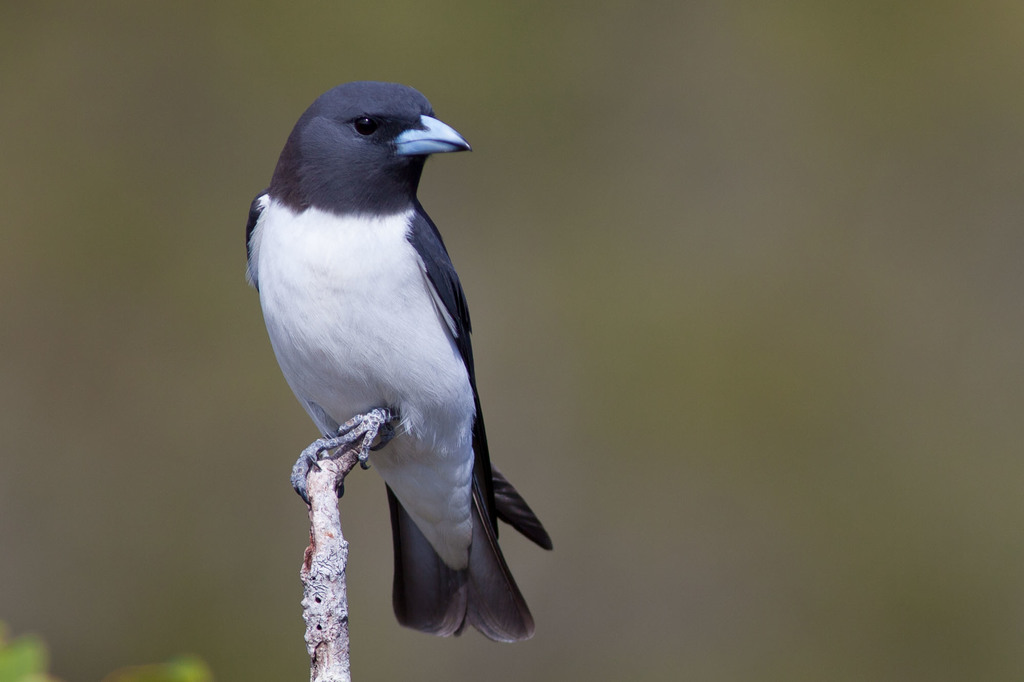
White-breasted Woodswallow
Live sightings near you, the range map, bar charts of when it is seen, and Macaulay Library photos and recordings.
White-breasted Woodswallow
Artamus leucorynchus
The white-breasted woodswallow (Artamus leucorynchus) is a medium-sized passerine bird which breeds from the Andaman Islands east through Indonesia and northern Australia. The name "woodswallow" is a misnomer as they are not closely related to true swallows. Instead, they belong to the family Artamidae, which also includes butcherbirds, currawongs and the Australian magpie.
From the article White-breasted woodswallow on Wikipedia (CC BY-SA), quoted section by section
Description
The white-breasted woodswallow's plumage is dark grey on the head and neck, with white underparts, giving the species its common and scientific names, in contrast to the related great woodswallow whose upper side is a more glossy black. The stout bill is bluish-grey with a black tip. They can also be identified by their short, black tail and grey feet. Their completely black tail makes them the only woodswallow lacking white on the tail. Males and females are identical in appearance. Juveniles have a more brownish plumage around their head and mantle that is usually heavily striated. They have a buff tint on their chest and a brownish bill with a dark tip. White-breasted woodswallows can grow to a maximum known size of 18 centimetres (7.1 in) and weigh between 35 and 45 grams (1.2 and 1.6 oz). The nine subspecies can be separated by small differences in color, overall size, wing length and bill size.
Range & habitat
Throughout their vast distribution across Australasia, white breasted woodswallows can be found in forests, open woodlands and semi-arid plains, with a mixture of vegetation including shrubs, mangroves, forest clearings and grasses, often near watercourses. They are found at elevations from sea level to 1,500 m (4,900 ft). They are partially migratory, with southern flocks moving north during Autumn and returning south in the spring.
Wikipedia: “Distribution and habitat”
What it does
The white-breasted woodswallow has large, pointed wings and is very agile in powered and gliding flight. It is fast-flying and is one of few passerines that can soar. Even with their small statue, they can be aggressive birds whom are quite territorial with groups mobbing larger birds as a form of defense. Out of breeding season, woodswallows are quite nomadic, chasing flying insects and roosting in large flocks. They are generally seen in flocks of 10-50 birds, sometimes up to 100 to a flock. Flocks tend to cluster together in the evening to roost. They are social birds, well known for their habit of huddling up together tightly in flocks, usually along a branch or powerline. This behaviour enables the birds to maintain heat and conserve energy.
Breeding. The breeding season of the white-breasted woodswallow varies throughout its range. In northern areas breeding usually occurs between March and May and in the southern ranges occurring between August and January, pre and during the wet season. The female sexual display to invite copulation includes extending the wings over the back in a V, whilst trembling toward a male/s, then waggling the tail and quietly making an 'eep' call. They are cooperative breeders, with birds other than parents assisting with care for offspring. Both sexes participate in building nests, incubating eggs and feeding young birds. …
Wikipedia: “Behaviour”
Listen
Looking for field recordings…
Where it lives
Recorded sightings
—
geo-referenced records in GBIF, from museums, herbaria and field observers.
Drag the globe to turn it. Dots are where records exist, not a range map; darker means more records.
In the stacks
Searching the stacks…
Every page naming Artamus leucorynchus in the Biodiversity Heritage Library →
This page is assembled live from iNaturalist, GBIF, Wikipedia, the Source Library and the Internet Archive. It is not yet part of the hand-edited codex. iNaturalist taxon 8078.