- Animals
- ›Arthropods
- ›Hexapods
- ›Insects
- ›Winged and Once-winged Insects
- ›Butterflies and Moths
- ›Curved-horn Moths
- ›Flat-bodied moths
- ›Depressariinae
- ›Depressaria
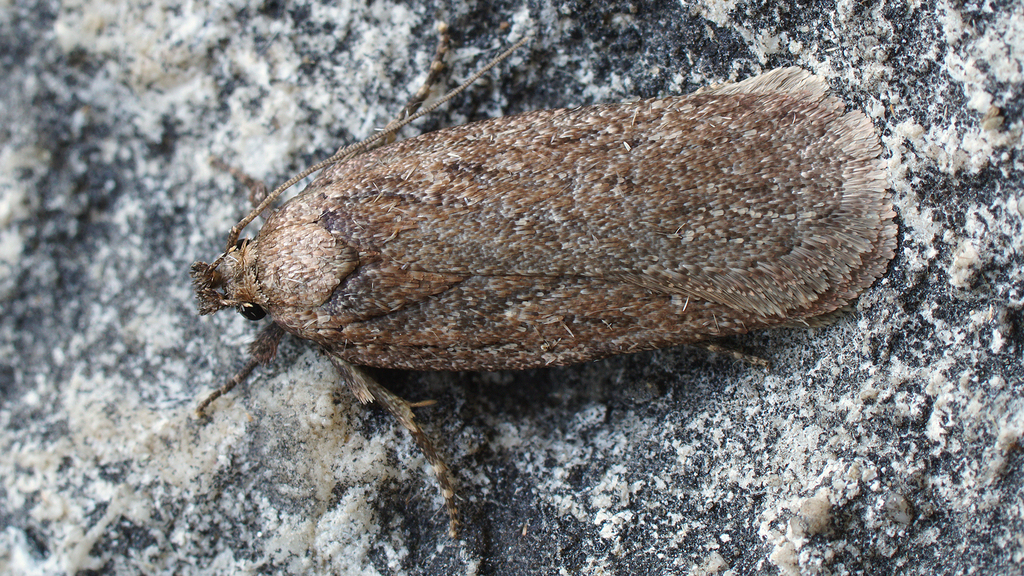
Depressaria badiella
Depressaria badiella is a moth of the family Depressariidae. It is found in most of Europe, Libya, the Caucasus and Mongolia.
From the article Depressaria badiella on Wikipedia (CC BY-SA), quoted section by section
Description
The wingspan is 20–25 mm. The terminal joint of palpi with two black bands. Forewings are rather dark fuscous, somewhat whitish-sprinkled; a dark suffusion above dorsal dash; first discal stigma sometimes represented by an obscure dark fuscous dash, second cloudy, dark fuscous. Hindwings whitish-fuscous, becoming fuscous terminally. The larva is dull olive-green, often suffused with dark red; head dark red-brown; plate of 2 black, bisected, edged with pale yellowish anteriorly. Adults are on wing from July to October in one generation per year and come to light. The larvae feed on cat's ear (Hypochaeris radicata), perennial sow-thistle (Sonchus arvensis) and dandelion (Taraxacum species). They initially feed between spun leaves, but later amongst the roots of their host plant. Larvae can be found from May to July.
Listen
Looking for field recordings…
Where it lives
Recorded sightings
—
geo-referenced records in GBIF, from museums, herbaria and field observers.
Drag the globe to turn it. Dots are where records exist, not a range map; darker means more records.
In the stacks
Searching the stacks…
Every page naming Depressaria badiella in the Biodiversity Heritage Library →
This page is assembled live from iNaturalist, GBIF, Wikipedia, the Source Library and the Internet Archive. It is not yet part of the hand-edited codex. iNaturalist taxon 805602.