On eBird ↗
Forest Raven
Live sightings near you, the range map, bar charts of when it is seen, and Macaulay Library photos and recordings.
Forest Raven
Corvus tasmanicus
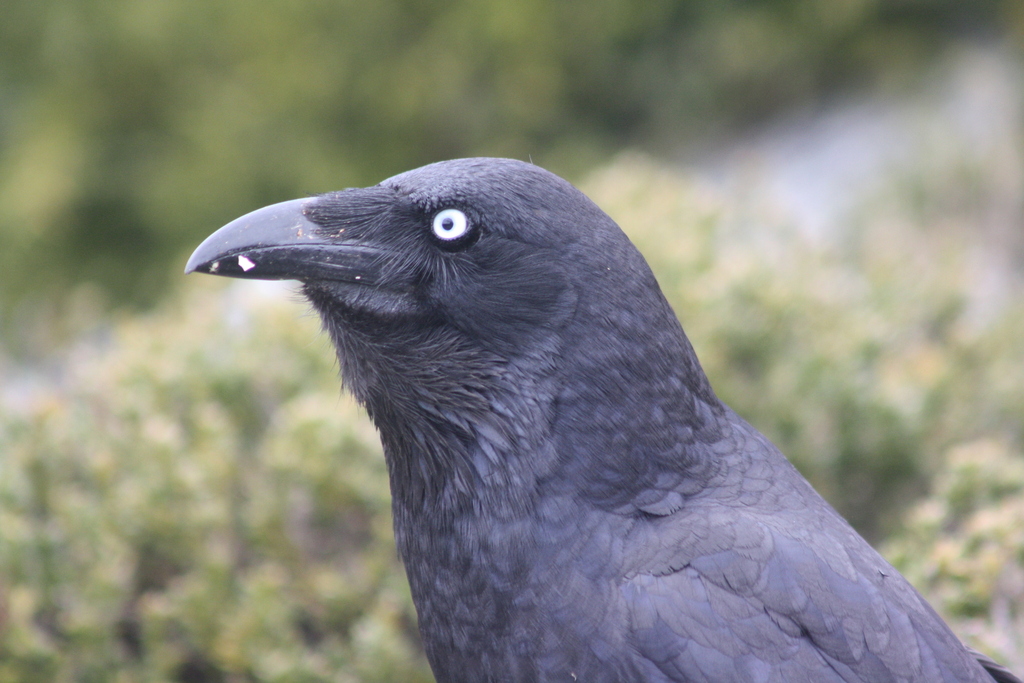
The forest raven (Corvus tasmanicus), also commonly known as the Tasmanian raven, is a passerine bird in the family Corvidae native to Tasmania and parts of southern Victoria, such as Wilsons Promontory and Portland. Populations are also found in parts of New South Wales, including Dorrigo and Armidale. Measuring 50–53 cm (20–21 in) in length, it has all-black plumage, beak and legs. As with the other two species of raven in Australia, its black feathers have grey bases. Adults have white irises; younger birds have dark brown and then hazel irises with an inner blue rim. New South Wales populations are recognised as a separate subspecies C. tasmanicus boreus, but appear to be nested within the Tasmanian subspecies genetically.
The forest raven lives in a wide variety of habitats in Tasmania but is restricted to more closed forest on mainland Australia. Breeding takes place in spring and summer, occurring later in Tasmania than in New South Wales. The nest is a bowl-shaped structure of sticks sited high in a tree. An omnivorous and opportunistic feeder, the forest raven eats a wide variety of plant and animal material, as well as food waste from urban areas and roadkill. It has been blamed for killing lambs and poultry and raiding orchards in Tasmania, and is unprotected under Tasmanian legislation. The forest raven is sedentary, with pairs generally bonding for life and establishing permanent territories.
From the article Forest raven on Wikipedia (CC BY-SA), quoted section by section
Description
The largest of the Australian corvids, the adult forest raven is 50–53 cm (20–21 in) long with a wingspan of 91–113 cm (36–44 in) and weighing approximately 650 g (1.43 lb). There is no seasonal variation in plumage, which is entirely glossy black with a blue or green sheen visible on the upperparts. The wings are long and broad, with the largest of its ten primary feathers (usually the seventh but occasionally the eighth) almost reaching the end of the tail when at rest. The tail is rounded or wedge-shaped. It is quite short in Tasmanian populations but longer in northern New South Wales. The beak is a similar shape to that of the little raven, though more massive and heavy-set. The upper mandible, including the nares and nasal groove, is covered with bristles. The mouth and tongue are black, as are the powerful legs and feet. The tibia is fully feathered and the tarsus is long. Sexes have identical plumage; the male is generally larger, but there is considerable overlap in size between individuals. The forest raven can be distinguished from the two species of crow occurring in Australia by the grey base of the feathers, which is white in the latter species. The demarcation between pale and black regions on the feather is gradual in the ravens and sharply delineated in the crows. …
Range & habitat
The only member of the corvid family that has a permanent population in Tasmania, the forest raven is the most widely distributed bird species in the state. There are three populations in southern Victoria: from the vicinity of Lakes Entrance west across Gippsland to Wilsons Promontory, the Otway Ranges from 10 km (6.2 mi) west of Torquay to Port Campbell, and lastly in the Grampians and Millicent Plain extending into south-east South Australia. Isolated records suggest the latter two populations may actually be continuous. There are two disjunct populations in northern New South Wales. A coastal population is found from Tea Gardens north to Yuraygir National Park, while a more montane population is found along the Great Dividing Range and New England Tableland from Gloucester Tops in the south to Tenterfield in the north. The gap between the two populations is around 70 km (43 mi), shrinking to 30 km (19 mi) at Dorrigo. The forest raven inhabits a wide range of habitat within Tasmania such as woods, open interrupted forest, mountains, coastal areas, farmland and town and city fringes. A survey of Mount Wellington found it to be one of the few birds that remained in open and marshland habitat at higher elevations over the winter. …
Wikipedia: “Distribution and habitat”
What it does
Sedentary and territorial, the forest raven is similar in breeding and feeding habits to the Australian raven. A single breeding pair and their brood occupy a territory of variable size – areas of 40 to 400 ha (99 to 988 acres) have been recorded – and remains there year-round, though groups of ravens may enter this area to forage. In northern New South Wales, forest ravens have been recorded nesting near Australian ravens and Torresian crows. They were observed warding off the Australian ravens but to a degree permitting the crows to pass through their territories. Forest ravens will defend their territory by chasing and mobbing intruding birds of prey as large as wedge-tailed eagles and white-bellied sea eagles. Agonistic displays to ward off potential intruders include flying to a high perch and calling loudly with head extended and hackles raised. Forest ravens will give their wings a flick on the upward wingbeat when flying to the perch and may continue flicking their wings after landing. Subadult and nonbreeding forest ravens form flocks that move around, though they may use the same roosting site for a few months at a time. Forest ravens generally walk when moving around on the ground, though do hop when hurrying, such as when trying to avoid an oncoming car on a road.
Breeding. Forest ravens breed after at least three years and form monogamous pairs. …
Wikipedia: “Behaviour”
Listen
Looking for field recordings…
Where it lives
Recorded sightings
—
geo-referenced records in GBIF, from museums, herbaria and field observers.
Drag the globe to turn it. Dots are where records exist, not a range map; darker means more records.
In the stacks
Searching the stacks…
Every page naming Corvus tasmanicus in the Biodiversity Heritage Library →
This page is assembled live from iNaturalist, GBIF, Wikipedia, the Source Library and the Internet Archive. It is not yet part of the hand-edited codex. iNaturalist taxon 8043.