On eBird ↗
Pied Crow
Live sightings near you, the range map, bar charts of when it is seen, and Macaulay Library photos and recordings.
Pied Crow
Corvus albus
The pied crow (Corvus albus) is a widely distributed African bird species in the crow genus of the family Corvidae.
Structurally, the pied crow is better thought of as a small crow-sized raven, especially as it can hybridise with the Somali crow (dwarf raven) where their ranges meet in the Horn of Africa. Its behaviour, though, is more typical of the Eurasian carrion crows, and it may be a modern link (along with the Somali crow) between the Eurasian crows and the common raven.
From the article Pied crow on Wikipedia (CC BY-SA), quoted section by section
Description
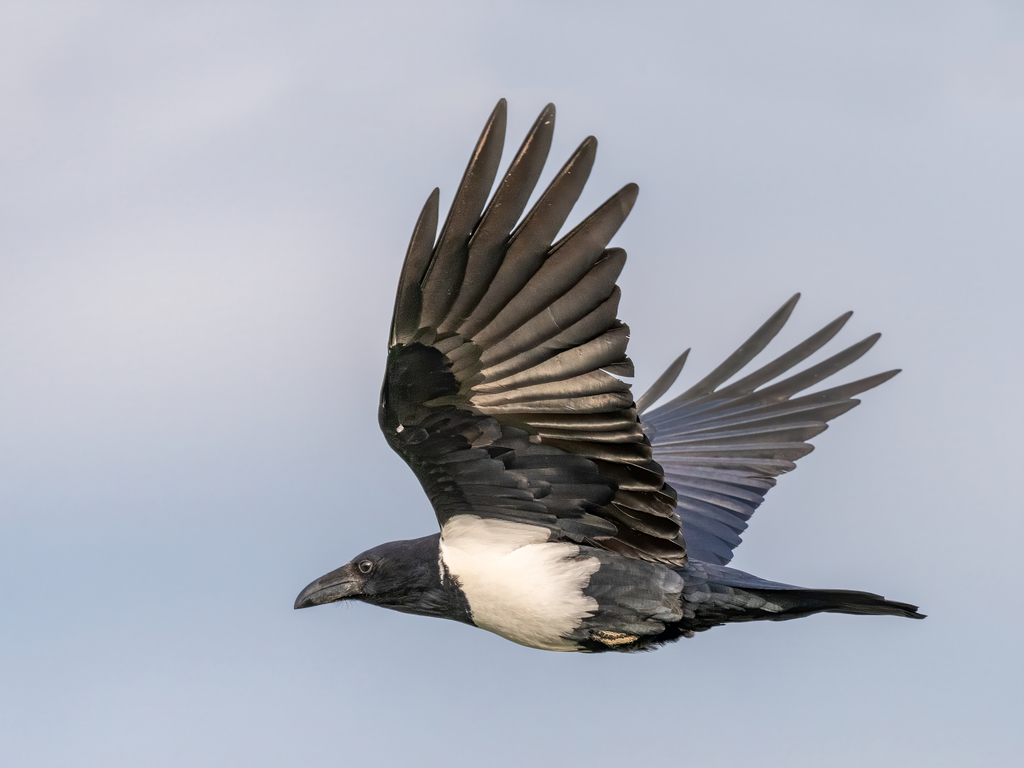
It is about the size of the European carrion crow or a little larger (46–50 cm in length), but has a proportionately larger bill, slightly longer tail and wings, and longer legs. As its name suggests, its glossy black head and neck are interrupted by a large area of white feathering from the shoulders down to the lower breast. The tail, bill, and wings are black, too. Its eyes are dark brown. The white plumage of immature birds is often mixed with black. It resembles the white-necked and thick-billed ravens, but has a much smaller bill.
Measurements. Length 46 – 52 cm Wing 328 to 388 mm (17 unsexed birds) Weight 520 g
Identification. In southern Africa, its range overlaps with the white-necked raven. The pied crow is slightly smaller and has a white chest and belly with a black, more delicate beak compared to the black chest and belly of the larger white-necked raven, which also has a white-tipped and weightier beak. It is larger than the black crow.
Voice. The voice is often described as a harsh ar-ar-ar-ar or karh-karh-karh.
Range & habitat
This species, Africa's most widespread member of the genus Corvus, can be found in sub-Saharan Africa, specifically Nigeria, Ghana, Senegal, Sudan, Somalia, Eritrea, Zambia, Botswana, Mozambique and Zimbabwe, South Africa and on the large island of Madagascar, the Comoros Islands, Aldabra, Assumption Island, Cosmoledo, Astove Island, Zanzibar, Pemba, and Fernando Po. It does not occur in the equatorial rainforest region. It inhabits mainly open country with villages and towns nearby. This bird is rarely seen very far from human habitation, though it is not as tied to the urban way of life as the house crow (Corvus splendens) of Asia, and may be encountered far from human habitation in Eritrea.
Wikipedia: “Distribution and habitat”
What it does
Pied crows are generally encountered in pairs or small groups, although an abundant source of food may bring together large numbers of birds. The species behaves in a similar manner to the hooded and carrion crows. In Dakar, birds have been observed mobbing passing ospreys and snake eagles, but avoiding black kites.
Diet. All of its food is obtained from the ground, trees, etc., including injured wildlife such as insects and other small invertebrates, small reptiles, small mammals, young birds and eggs, grain, peanuts, carrion, and any scraps of human food and fruit. It has been recorded killing and eating roosting fruit bats, and is frequently seen (sometimes in huge numbers) scavenging around slaughterhouses.
Digestion in the small intestine. The small intestines within the African pied crows include duodena, jejuna, and ilea, which are vital components for nutrient absorption, such as fats, proteins, and carbohydrates consumed by the crow. Pancreatic ducts and two bile ducts make up the duodenum, so provide greater support for nutrient digestion. The wall of the small intestine is lined with four main tunics - tunica mucosa, tunica submucosa, tunica musclaris, and tunica serosa. …
Wikipedia: “Behaviour”
Listen
Looking for field recordings…
Where it lives
Recorded sightings
—
geo-referenced records in GBIF, from museums, herbaria and field observers.
Drag the globe to turn it. Dots are where records exist, not a range map; darker means more records.
In the stacks
Searching the stacks…
Every page naming Corvus albus in the Biodiversity Heritage Library →
This page is assembled live from iNaturalist, GBIF, Wikipedia, the Source Library and the Internet Archive. It is not yet part of the hand-edited codex. iNaturalist taxon 8038.