On eBird ↗
Large-billed Crow
Live sightings near you, the range map, bar charts of when it is seen, and Macaulay Library photos and recordings.
Large-billed Crow
Corvus macrorhynchos
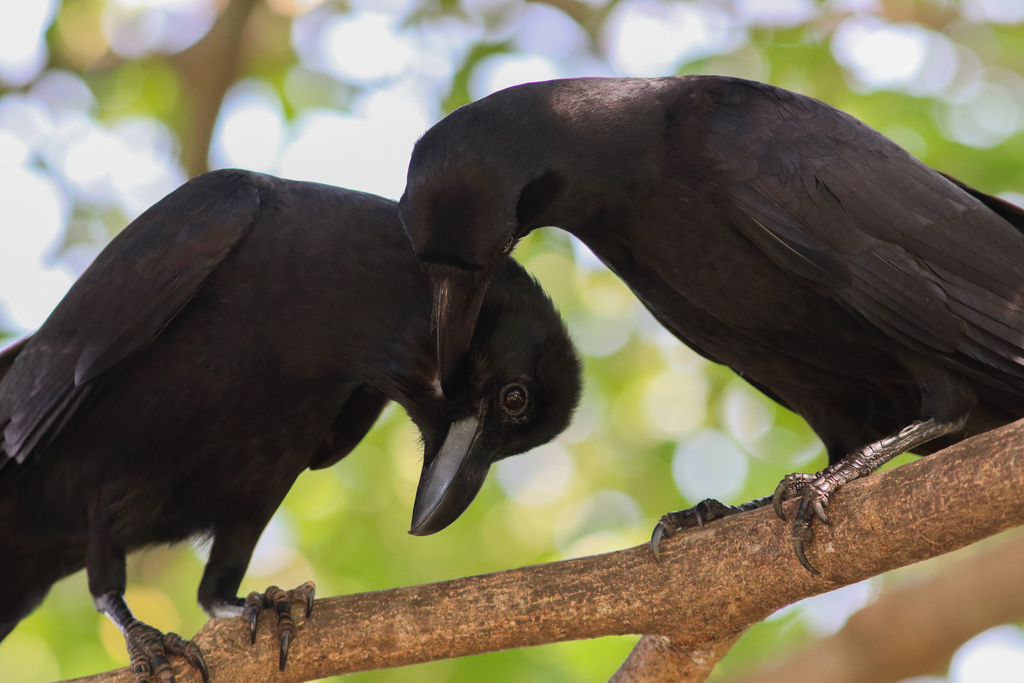
The large-billed crow (Corvus macrorhynchos), formerly referred to widely as the jungle crow, is a widespread Asian species of crow. It is very adaptable and is able to survive on a wide range of food sources, making it capable of colonizing new areas, due to which it is often considered a nuisance, especially on islands. It has a large bill, which is the source of its scientific name macrorhynchos (Ancient Greek for "long-billed") and it is sometimes known by the common name thick-billed crow. It can also be mistaken for a common raven. The eastern jungle crow and Indian jungle crow were once considered conspecific and together called the jungle crow.
From the article Large-billed crow on Wikipedia (CC BY-SA), quoted section by section
Description
The large-billed crow is relatively large all-black corvid. It is 46–59 cm (18–23 in) in length and 450–1,000 g (16–35 oz) in weight. It has a large black bill with an arched culmen. The base of the culmen is hidden by a layer of overlapping black rictal bristles. The glossy black plumage has a purple sheen. The bases of the neck feathers are pale grey. The throat has elongated hackle feathers. The irises are dark brown and the legs are black. The sexes are similar in plumage but the female, on average, is smaller than the male and has a less arched culmen. The juvenile has less glossy plumage and has smoky blue rather than brown irises. The subspecies differ in overall size, the bill size and the degree of gloss on the plumage. The largest subspecies is C. m. japonensis which has a bill measuring 70–80 mm (2.8–3.1 in) in length. The smallest subspecies is C. m. culminatus with a bill measuring 52–67 mm (2.0–2.6 in). The calls are complex and difficult to compare but in Nepal, the smaller C. m. culminatus has a higher pitched voice than the larger C. m. intermedius.
Range & habitat
The range of this species is extensive and stretches from the northeastern Asian seaboard to Afghanistan and eastern Iran in the west, through South to India and Sri Lanka [1][2] and Southeast Asia, to the Lesser Sundas and Cambodia in the southeast. It occurs in woodland, parks and gardens, cultivated regions with at least some trees, but is a bird of more open country in the south of its range where it is not in competition with the common raven and carrion crow of the North.
Wikipedia: “Distribution and habitat”
What it does
Extremely versatile in its feeding, it will take food from the ground or in trees. They feed on a wide range of items and will attempt to feed on anything appearing edible, alive or dead, plant or animal. It is also one of the most persistent species and is quite bold, especially in urban areas. In Japan, crows are considered to be a pest, as they rip open garbage bags and take wire coat hangers for their nests. The Japanese subspecies of Large-billed crow are also known for their regular, unprovoked attacks on humans, especially when passing through near their nesting areas. In Sri Lanka, the jungle crow might is an important predator of local small animals; jungle crows are highly experienced at catching lizards, taking only 45 minutes to find, catch and consume four critically endangered endemic lizards in Horton Plains National Park. Hoarding behaviour has been noted in ssp. culminatus.
Wikipedia: “Diet”
Listen
Looking for field recordings…
Where it lives
Recorded sightings
—
geo-referenced records in GBIF, from museums, herbaria and field observers.
Drag the globe to turn it. Dots are where records exist, not a range map; darker means more records.
In the stacks
Searching the stacks…
Every page naming Corvus macrorhynchos in the Biodiversity Heritage Library →
This page is assembled live from iNaturalist, GBIF, Wikipedia, the Source Library and the Internet Archive. It is not yet part of the hand-edited codex. iNaturalist taxon 8026.