On eBird ↗
Hawaiian Crow
Live sightings near you, the range map, bar charts of when it is seen, and Macaulay Library photos and recordings.
Hawaiian Crow
Corvus hawaiiensis
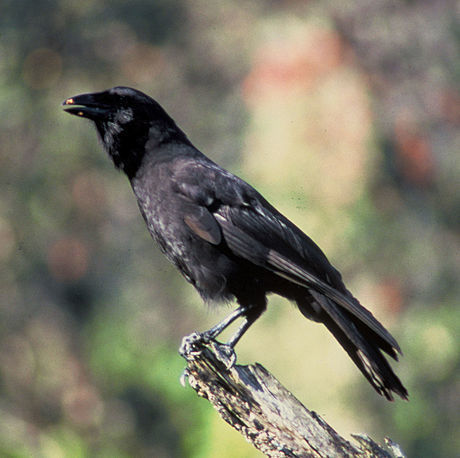
The Hawaiian crow or ʻalalā (Corvus hawaiiensis) is a species of bird in the crow family, Corvidae, that is currently extinct in the wild, though reintroduction programs are underway. It is about the size of the carrion crow at 48–50 cm (19–20 in) in length, but with more rounded wings and a much thicker bill. It has soft, brownish-black plumage and long, bristly throat feathers; the feet, legs, and bill are black. Today, the Hawaiian crow is considered the most endangered of the family Corvidae. They are recorded to have lived up to 18 years in the wild, and 28 years in captivity. Some Native Hawaiians consider the Hawaiian crow an ʻaumakua (family god).
The species is known for its strong flying ability and resourcefulness, and the reasons for its various extirpations are not fully understood. It is thought that introduced diseases, introduced predators, and habitat loss were probably significant factors in the species' decline.
From the article Hawaiian crow on Wikipedia (CC BY-SA), quoted section by section
Range & habitat
Before the Hawaiian crow became extinct in the wild, the species was found only in the western and southeastern parts of Hawaii. It inhabited dry and mesic forests on the slopes of Mauna Loa and Hualālai at elevations of 3,000 to 6,000 feet. Ōhiʻa lehua (Metrosideros polymorpha) and koa (Acacia koa) were important tree species in its wild habitat. Extensive understory cover was necessary to protect the ʻalalā from predation by the Hawaiian hawk, or ʻio (Buteo solitarius). Nesting sites of the ʻalalā received 600–2,500 millimetres (24–98 in) of annual rainfall. Fossil remains indicate that the Hawaiian crow used to be relatively abundant on all the main islands of Hawaii, along with four other now-extinct crow species. The Hawaiian crow was also preyed on by rats and the small Asian mongooses (Urva auropunctata). Feral cats that introduced Toxoplasma gondii to the birds can also prey on chicks that are unable to fly. As of 2012, the Hawaiian crow's current population is 114 birds, the vast majority of which are in Hawaiian reserves.
Wikipedia: “Distribution and habitat”
What it does
The omnivorous Hawaiian crow is a generalist species, eating various foods as they become available. The main portion of their diet and 50% of their feeding activity is spent foraging on trunks, branches, and foliage for invertebrates such as isopods, land snails, and arachnids. They feed in a woodpecker fashion, flaking bark and moss from trunks or branches to expose hidden insects, foraging mostly on ohia and koa, the tallest and most dominant trees in their habitats. Fruits are the second most dominant component in the Hawaiian crow's diet. The crows often collect kepau and olapa fruit clusters. Although hoawa and alani fruits have hard outer coverings, crows continue to exert energy prying them open. Passerine Nestlings and eggs are consumed most frequently in April and May, during their breeding season. Other prey include red-billed leiothrix, Japanese white-eye, Hawaiʻi ʻamakihi, ʻIʻiwi, ʻelepaio, and ʻapapane. The ʻalalā also commonly forages on flowers, especially from February through May. Nectar to feed the young is obtained from the ohia flower, oha kepau, and purple poka during the nestling period. Crows also foraged various plant parts, including the flower petals of kolea, koa, and mamane. The palila is the only other Hawaiian bird known to eat flower petals. …
Wikipedia: “Diet”
In human culture
The Hawaiian crow is a significant symbol in Hawaiian mythology. It is said to lead souls to their final resting place on the cliffs of Ka Lae, the southernmost tip on the Big Island of Hawaii. Native priests named the ʻalalā so during prayer and chants due to its distinctive call.
== References ==
Wikipedia: “Cultural significance”
Listen
Looking for field recordings…
Where it lives
Recorded sightings
—
geo-referenced records in GBIF, from museums, herbaria and field observers.
Drag the globe to turn it. Dots are where records exist, not a range map; darker means more records.
In the stacks
Searching the stacks…
Every page naming Corvus hawaiiensis in the Biodiversity Heritage Library →
This page is assembled live from iNaturalist, GBIF, Wikipedia, the Source Library and the Internet Archive. It is not yet part of the hand-edited codex. iNaturalist taxon 8015.