- Plants
- ›Vascular Plants
- ›flowering plants
- ›Dicots
- ›Sunflowers, Bellflowers, Fanflowers, and Allies
- ›Sunflowers, Daisies, Asters, and Allies
- ›Asteroideae
- ›asters and allies
- ›Celmisiinae
- ›Olearia
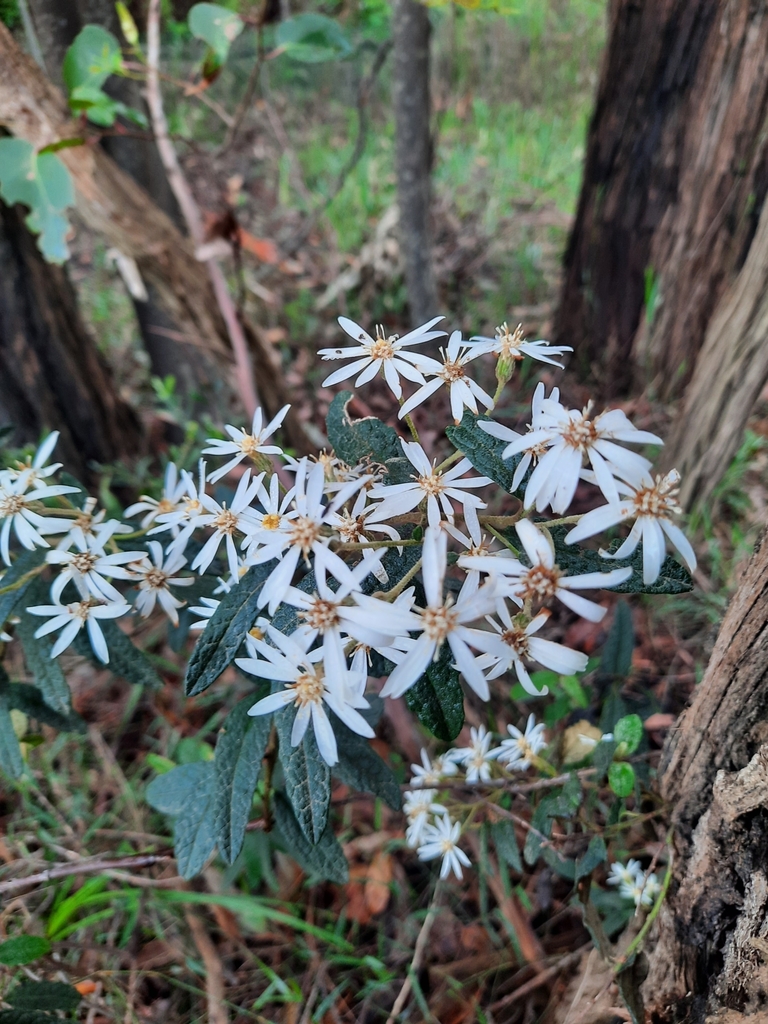
Wrinkled Daisy-bush
Olearia rugosa
Olearia rugosa, commonly known as wrinkled daisy-bush, is a species of flowering plant in the family Asteraceae. It has alternate, wrinkled leaves and white daisy-like flowers and is endemic to south-eastern Australia.
From the article Olearia rugosa on Wikipedia (CC BY-SA), quoted section by section
Description
Olearia rugosa is sometimes a spindly shrub to 2.5 m (8 ft 2 in) high with branchlets densely covered in star-shaped, short matted hairs. The leaves are arranged alternately, almost sessile or with a petiole, broadly elliptic, oblong or egg-shaped, 7–80 mm (0.28–3.15 in) long, usually 7–25 mm (0.28–0.98 in) wide, green on the upper surface, veined, wrinkled, warty, some with finer occasional star-shaped hairs and densely covered in grey-brown, soft hairs on the under surface. The leaf margins are broadly toothed to scalloped, flat or curved under, rarely smooth. The flower head is 20–25 mm (0.79–0.98 in) in diameter, borne in upper leaf axils or at the end of branches singly or in corymbs on a peduncle 0.5–5 cm (0.20–1.97 in) long. The white flowers are in groups of 8-13, ligules 7–10 mm (0.28–0.39 in) long, centres yellow or purplish. The bracts toothed, margins sometimes purple coloured, densely covered with short, matted, star-shaped hairs or only near the apex. The dry fruit is cylindrical, one-seeded, ribbed, 2–2.5 mm (0.079–0.098 in) long, smooth or with a moderate covering of silky hairs.
Range & habitat
Subspecies allenderae grows in swampy areas or on gully slopes in forest and is restricted to Wilsons Promontory National Park and subsp. angustifolia usually grows in streams or swamps in near-coastal areas of East Gippsland in Victoria. Subspecies distaliloba grows in mountain forest, often in gullies and depressions, from far south-eastern New South Wales and east of the Snowy River in Victoria. Subspecies intermedia is restricted to some Bass Strait Islands and north-eastern Tasmania and subsp. rugosa is found in moist forests, mostly on the Great Dividing Range between Mount Macedon and Drouin in central southern Victoria.
Wikipedia: “Distribution and habitat”
Where it lives
Recorded sightings
—
geo-referenced records in GBIF, from museums, herbaria and field observers.
Drag the globe to turn it. Dots are where records exist, not a range map; darker means more records.
In the stacks
Searching the stacks…
Every page naming Olearia rugosa in the Biodiversity Heritage Library →
This page is assembled live from iNaturalist, GBIF, Wikipedia, the Source Library and the Internet Archive. It is not yet part of the hand-edited codex. iNaturalist taxon 801170.