- Animals
- ›Chordates
- ›Vertebrates
- ›Reptiles
- ›Snakes and Lizards
- ›Lizards
- ›Iguanas and Allies
- ›Dragons and Chameleons
- ›Dragons
- ›Flying Dragons and Allies
- ›Diploderma
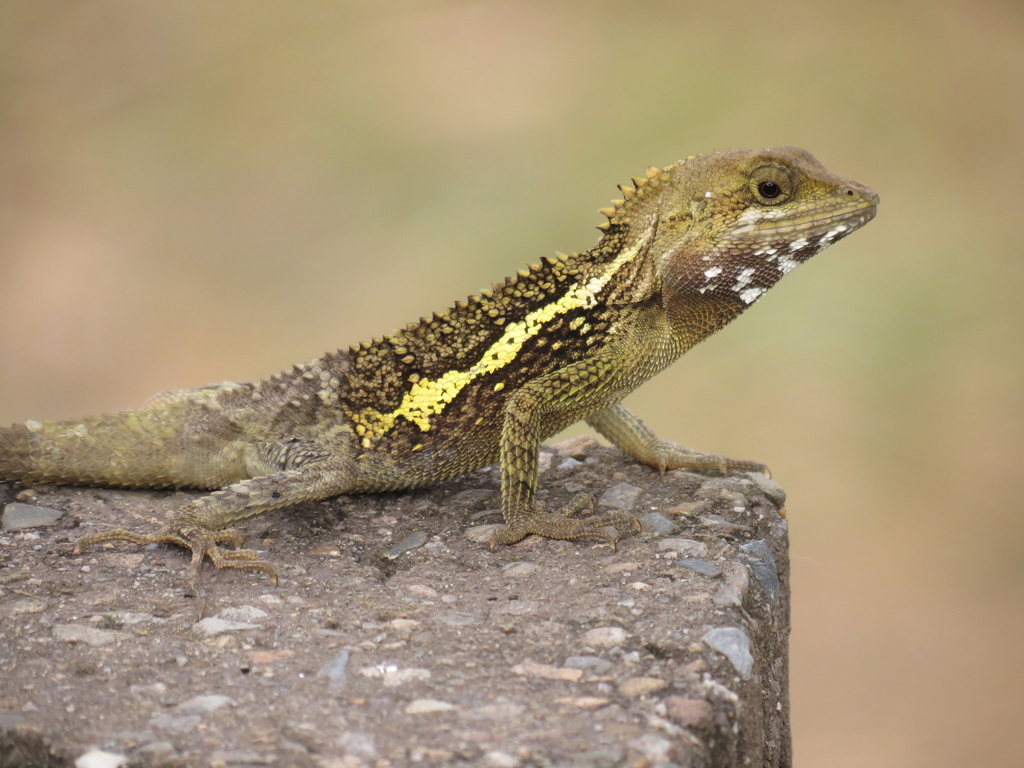
Taiwan Japalure
Diploderma swinhonis
Diploderma swinhonis, also known commonly as the Taiwan japalure, Swinhoe's japalure, Swinhoe's lizard, and Swinhoe's tree lizard (Chinese: 斯文豪氏攀蜥), is a species of draconid lizard native to Taiwan. It is also an invasive alien species in Japan, after likely being introduced from Taiwan. A foraging ambush predator, this lizard preys primarily on arthropods and remains at the bottom of forests. The male D. swinhonis is physically distinct from the female, with its body size being much larger and having a yellow stripe.
From the article Diploderma swinhonis on Wikipedia (CC BY-SA), quoted section by section
Description
Diploderma swinhonis exhibit sexual dimorphism, with regard to both coloration and size. The maximum length, including its tail, of D. swinhonis is approximately 31 cm (12 in), its body is 8 cm (3.1 in) long. The average body mass of immature lizards is approximately 2 g (0.071 oz) while the average body mass of mature lizards is approximately 13.4 g (0.47 oz). The male is also known to be significantly larger than the female, with the snout-to-vent length (SVL) for adult males and females being approximately 73 mm (2.9 in) and 62 mm (2.4 in) respectively. Males also have much larger dewlaps than females. Both sexes have brown backs, but males have a brighter color and a yellow stripe on each side of the body. Some of the female lizards have a brown-red pattern on the dorsal side of the body. Males bodies are laterally compressed while female bodies are more cylindrical. In comparison to other lizards of the same genus, D. swinhonis is unique in that it has enlarged scales that occur irregularly across the dorsal side of the lizard. Also, this tree lizard has relatively long limbs compared to other lizards, but the female has shorter limbs, head, and tail in comparison to the male. It is also important to note that there have been physical differences found amongst D. …
Range & habitat
Diploderma swinhonis is arboreal (or preferential to tree habitats) and lives at low altitudes below 1,500 m (4,900 ft) in lowland forests within Taiwan. The lizard is diurnal and is commonly found in wide-ranging habitats that include forests and urban areas, such as shopping malls. This indicates that the lizard is able to adapt quite well to various environments. Additionally, it is known to reside close to the ground on tree trunks and forage on the ground. Males are typically at greater altitudes on the trees, while females and juveniles reside closer to the ground and near bushes. Male D. swinhonis use aggressive displays to maintain their territory, and the lizard is known to be an opportunistic predator that waits and ambushes their prey. The males have been found to be territorial in order to increase chances of mating rather than protecting a food resource. Larger male lizards have a competitive edge over smaller male lizards in finding mates and maintaining their territory. Therefore, there is competition within the species in order to find mates. The advantage of being larger might be why males are currently so much larger than females. Between two and three females are found within each male's territory, and females primarily dig a nest and guard their eggs, causing them to have comparatively smaller ranges. …
Wikipedia: “Behaviour and habitat”
What it does
Diploderma swinhonis is known to be a sit-and-wait predator that primarily feeds on mobile and clearly visible prey by ambushing them. This foraging behavior of ambushing prey is quite common amongst lizards. Swinhoe's tree lizards feeds on arthropods, primarily ants but also other larger insects such as grasshoppers and crickets. D. swinhonis has also been found to feed on bees and spiders, which are also arthropods. It is also very common for iguanian lizards, like D. swinhonis, to eat a large proportion of ants within their diet. Feeding on arthropods active in the daytime, like bees, grasshoppers and ants, is quite common for diurnal species like D. swinhonis while nocturnal arthropods, like crickets, are less commonly eaten. However, D. swinhonis on Orchid island and found to primarily prey on crickets, so there is some variation with regard to their diets between each of their habitats. Due to this variation, D. swinhonis is regarded as a dietary generalist.
Wikipedia: “Diet”
In human culture
Both the specific name, swinhonis, and some of the common names are in honour of English naturalist Robert Swinhoe. In Latin, its generic name, Diploderma, can be broken down into Diplo-, which means "many", and derma, which means "skin". It is also referred to by the common name japalure, which is an outdated common name used to previously identify lizards of the genus Japalura. The generic name, Japalura, is speculated to have derived from an Indian word.
Wikipedia: “Etymology”
Where it lives
Recorded sightings
—
geo-referenced records in GBIF, from museums, herbaria and field observers.
Drag the globe to turn it. Dots are where records exist, not a range map; darker means more records.
In the stacks
Searching the stacks…
Every page naming Diploderma swinhonis in the Biodiversity Heritage Library →
This page is assembled live from iNaturalist, GBIF, Wikipedia, the Source Library and the Internet Archive. It is not yet part of the hand-edited codex. iNaturalist taxon 797638.