On eBird ↗
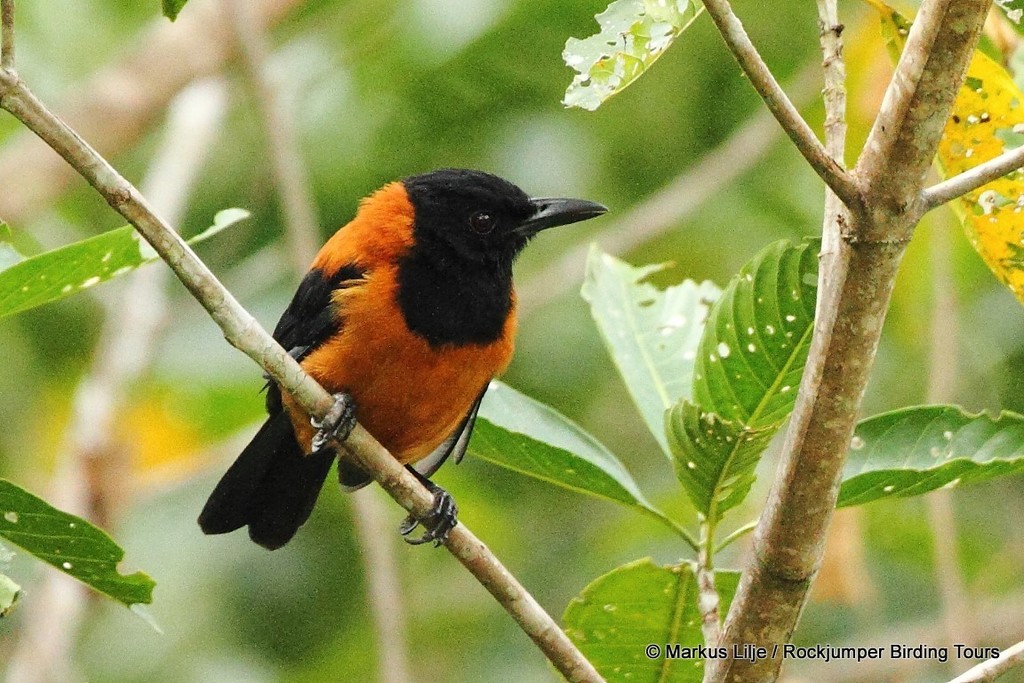
Hooded Pitohui
Live sightings near you, the range map, bar charts of when it is seen, and Macaulay Library photos and recordings.
Hooded Pitohui
Pitohui dichrous
The hooded pitohui (Pitohui dichrous) is a species of bird in the genus Pitohui found in New Guinea. It was long thought to be a whistler (Pachycephalidae) but is now known to be in the Old World oriole family (Oriolidae). Within the oriole family, this species is most closely related to the variable pitohuis in the genus Pitohui, and then the figbirds.
A medium-sized songbird with reddish-brown and black plumage, this species is one of the few known poisonous birds, containing a range of batrachotoxin compounds in its skin, feathers and other tissues. These toxins are thought to be derived from their diet and may function both to deter predators and to protect the bird from parasites. The close resemblance of this species to other unrelated birds also known as pitohuis which are also poisonous is an example of convergent evolution and Müllerian mimicry. Their appearance is also mimicked by unrelated non-poisonous species, a phenomenon known as Batesian mimicry. The toxic nature of this bird is well known to local hunters, who avoid it. It is one of the most poisonous species of pitohui, but the toxicity of individual birds can vary geographically.
From the article Hooded pitohui on Wikipedia (CC BY-SA), quoted section by section
Range & habitat
The hooded pitohui is endemic to the islands of New Guinea. It is found widely across the main island, and also on the nearby island of Yapen. It inhabits rainforest, forest edge habitats and secondary growth, and sometimes mangrove forests. It is most commonly found in hills and low mountains, between 350–1,700 m (1,150–5,580 ft), but is found locally down to sea-level and up to 2,000 m (6,600 ft). It typically occurs at higher elevations than the lowland variable pitohui and lower than the (unrelated) black pitohui, although there is some overlap.
Wikipedia: “Distribution and habitat”
What it does
The function of the toxins to the hooded pitohui has been the source of debate and research since its discovery. The initial suggestion was that the toxins acted as a chemical deterrent to predators. Some researchers cautioned this suggestion was premature, and others noted that the levels of batrachotoxins were three orders of magnitude lower than in the poison dart frogs that do use it in this way. Another explanation for the purpose of the toxins is to mitigate the effects of parasites. In experimental conditions chewing lice were shown to avoid toxic feathers of hooded pitohui in favour of feathers with lower concentrations of toxin or no toxins at all. Additionally lice that did live in the toxic feathers did not live as long as control lice, suggesting that the toxins could lessen both the incidence of infestation and the severity. A comparative study of the tick loads of wild birds in New Guinea would seem to support the idea, as hooded pitohuis had considerably fewer ticks than almost all the 30 genera examined. The batrachotoxins do not seem to have an effect on internal parasites such as Haemoproteus or the malaria-causing Plasmodium.
A number of authors have noted that the two explanations, as a chemical defence against predators and as a chemical defence against ectoparasites, are not mutually exclusive, and evidence for both explanations exists. …
Wikipedia: “Ecology”
Toxicity
In 1990 scientists preparing the skins of the hooded pitohui for museum collections experienced numbness and burning when handling them. It was reported in 1992 that this species and some other pitohuis contained a neurotoxin called homobatrachotoxin, a derivative of batrachotoxin, in their tissues. This led to them being more broadly known outside New Guinea, considered by some to be the first documented poisonous birds, other than some reports of coturnism caused by consuming quail (although toxicity in quails is unusual), and the first bird discovered with toxins in the skin. The same toxin had previously been found only in Central and South American poison dart frogs from the genera Dendrobates, Oophaga and Phyllobates (family Dendrobatidae). The batrachotoxin family of compounds are among the most toxic compounds by weight in nature, being 250 times more toxic than strychnine. Later research found that the hooded pitohui had other batrachotoxins in its skin, including batrachotoxinin-A cis-crotonate, batrachotoxinin-A and batrachotoxinin-A 3′-hydroxypentanoate. Bioassays of their tissue found that the skins and feathers were the most toxic, the heart and liver less toxic, and the skeletal muscles the least toxic parts of the birds. Of the feathers, the toxin is most prevalent in those covering the breast and belly. …
Listen
Looking for field recordings…
Where it lives
Recorded sightings
—
geo-referenced records in GBIF, from museums, herbaria and field observers.
Drag the globe to turn it. Dots are where records exist, not a range map; darker means more records.
In the stacks
Searching the stacks…
Every page naming Pitohui dichrous in the Biodiversity Heritage Library →
This page is assembled live from iNaturalist, GBIF, Wikipedia, the Source Library and the Internet Archive. It is not yet part of the hand-edited codex. iNaturalist taxon 7943.