- Plants
- ›Vascular Plants
- ›flowering plants
- ›Dicots
- ›Legumes, Milkworts, and Allies
- ›Legumes
- ›Faboideae
- ›Trifolieae
- ›Trifolium
- ›Chronosemium
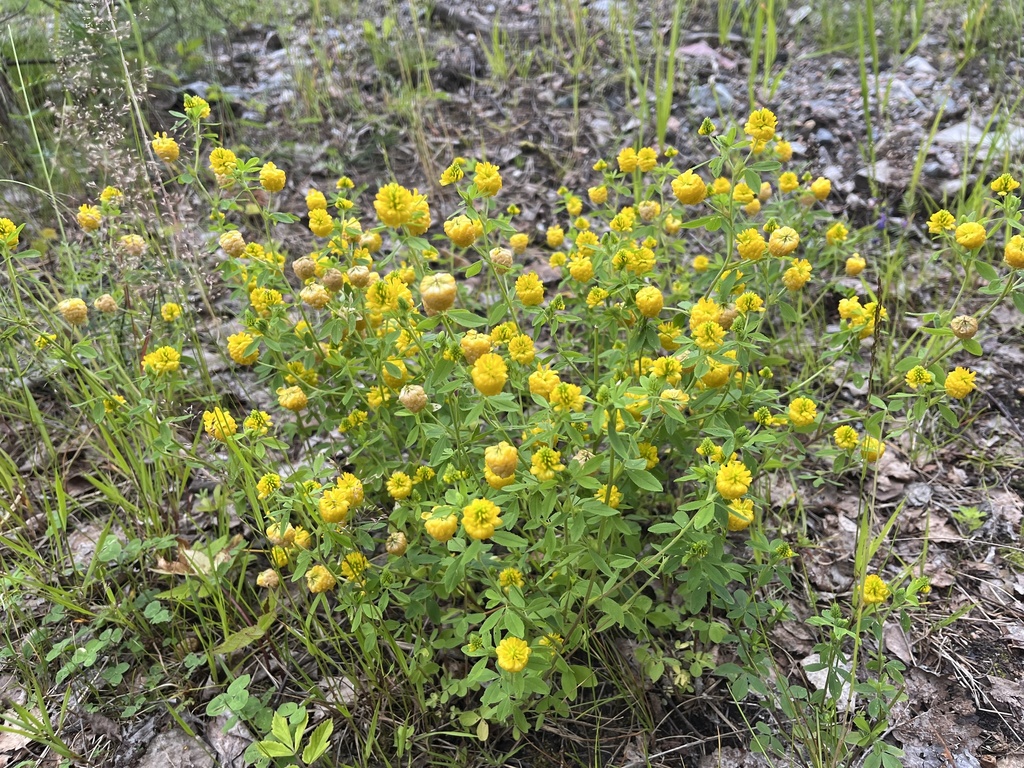
large hop clover
Trifolium aureum
Trifolium aureum, known by the various common names large hop trefoil, large trefoil, large hop clover, golden clover or hop clover, is a species of flowering plant native to much of Eurasia.
From the article Trifolium aureum on Wikipedia (CC BY-SA), quoted section by section
Description
Large hop trefoil is a small erect herbaceous biennial plant growing to 10–30 cm (4–12 in) tall. Like all clovers, it has leaves divided into three sessile leaflets, each leaflet 15–25 mm (5⁄8–1 in) long and 6–9 mm broad. The yellow flowers are arranged into small, elongated round inflorescences 12–20 mm diameter, located at the end of the stem. Each individual flower is decumbent. As they age, the flowers become brown and paper-like. The fruit is a pod usually containing two seeds.
Similar plants. Other plants that have three leaflets and small yellow flowers include T. campestre (hop trefoil, which is shorter with smaller foliage), T. dubium (lesser hop trefoil), Medicago lupulina, and Oxalis stricta.
Range & habitat
Trifolium aureum is native throughout Europe (in Spain only in the northeast), western and northern Asia, and the Middle East (in Ciscaucasia and western Siberia, Armenia, Azerbaijan, Georgia, northern Iran, Lebanon and Turkey). It is also native to the Canary Islands. Trifolium aureum is widely naturalized in North America: it was first introduced to the United States (by way of Pennsylvania) in 1800, where it is now found in the western (as far north as Alaska) and eastern regions of the country, but not in the middle, or very much in the southern states. It is also now found in Canada in all of its southerly provinces (with a possible exception being Manitoba). The plant is very common, and grows well on poor, undisturbed grounds. While it probably has good nutritive values, perennial species are favored as forage.
Wikipedia: “Distribution and habitat”
Where it lives
Recorded sightings
—
geo-referenced records in GBIF, from museums, herbaria and field observers.
Drag the globe to turn it. Dots are where records exist, not a range map; darker means more records.
In the old herbals & bestiaries

Six Groups of the History of Plants
Rembert Dodoens · 1583 · p.590

The Flowering Garden: Winter
Crispijn van de Passe · 1614 · p.19

Herbarium Portatile, Oder Behendes Kräuter- und Gewächs-Buch: Darinn nicht allein 1363. so wol Einheimische als Außländndische Kräuter mit Lateinisch und Deutscher Benennung abgebildet, sondern auch die meisten, so in der Medicin gebräuchlich, kürtzlich erkläret werden
Panckow, Thomas · 1656 · p.110
In the stacks
Searching the stacks…
Every page naming Trifolium aureum in the Biodiversity Heritage Library →
This page is assembled live from iNaturalist, GBIF, Wikipedia, the Source Library and the Internet Archive. It is not yet part of the hand-edited codex. iNaturalist taxon 79409.