- Animals
- ›Arthropods
- ›Hexapods
- ›Insects
- ›Winged and Once-winged Insects
- ›Butterflies and Moths
- ›Flannel, Slug Caterpillar, Leaf Skeletonizer, and Allied Moths
- ›Burnet Moths
- ›Chalcosiinae
- ›Elcysma
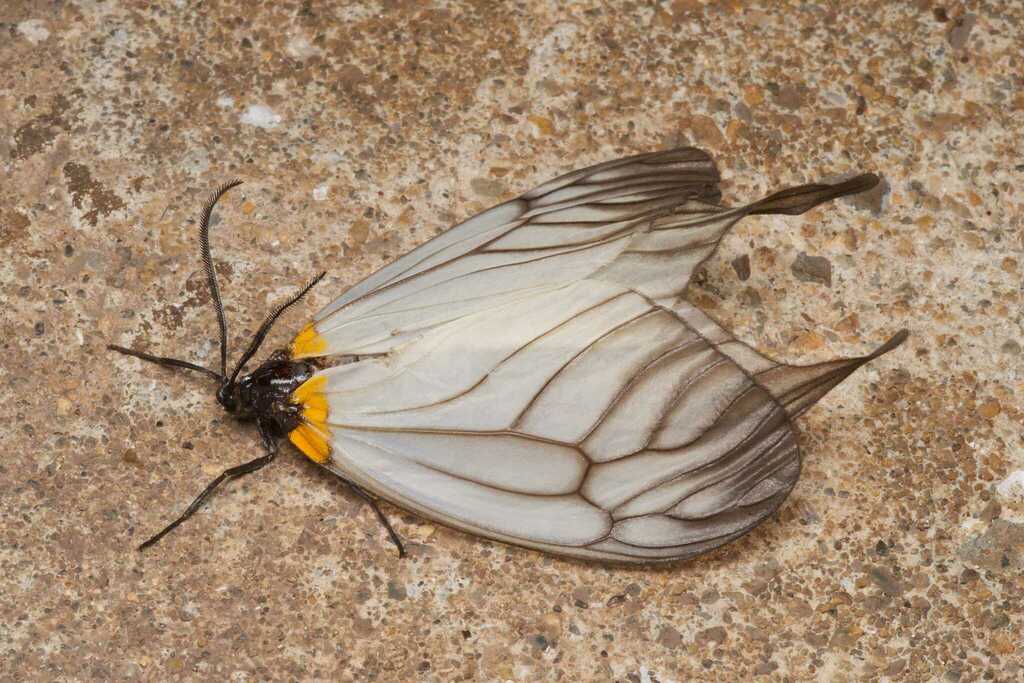
White-tailed zygaenid moth
Elcysma westwoodii
Elcysma westwoodi (often spelled Elcysma westwoodii), commonly known as the white-tailed zygaenid moth, is a species of moth in the burnet moth family Zygaenidae. It has a Palaearctic distribution, being found in Japan, the Korean Peninsula, China, and the Russian Far East. The species was first described by Samuel Constantinus Snellen van Vollenhoven in 1863 as Agalope westwoodii.
The white-tailed zygaenid is particularly known for its status as an agricultural pest for members of the family Rosaceae, and has been described as the most damaging pest for Prunus yedoensis trees. Studies have been conducted on the potential for the use of endoparasites in mitigating the extent of damage on crop trees.
From the article Elcysma westwoodi on Wikipedia (CC BY-SA), quoted section by section
Description
Adults have a wingspan of 60 millimetres (2.4 in). The moths have translucent white wings, with gray veins. The base of the front wing is yellow in color. The adult moth resembles Parnassius glacialis in appearance, and it is often misidentified as a Pierid butterfly, and Limacodidae because of pterothorax morphology. The hindwings have an elongated tail. The tail is formed from the veins between the fourth and seventh vein on the hindwing extending further past the remaining veins. The abdomen is dark brown in color. Adults of Elcysma westwoodi exude noxious substances in the form of a white foam from the head area if distressed. Male moths have a pair of genital claspers that resemble forceps. During mating, male moths grasp the tip of the female's abdomen with the claspers and additionally fluttering their wings to attempt to mate with the female. Of which the female moth can reject attempts to mate. These claspers resemble those found in related moth genera Achelura and Agalope, as well as the related Elcysma dohertyi. Male moths can be externally identified as such by their antennae, which are plumose, meaning they resemble that of a comb. Female moth abdomens in the seventh and eighth abdominal segment of E. westwoodi are sclerotized, or made further robust by the addition of sclerotin. …
Range & habitat
Elcysma westwoodi is found in Japan, China, the Korean Peninsula, and the Russian Far East. In Japan, it is found throughout the islands of Honshu, Shikoku, and Kyushu. It is restricted to the western portion of the Japanese archipelago. Despite its diet of cherry trees, a national symbol of Japan and commonly planted, it is fairly uncommon and the moth is mostly found in the Kansai region. In Korea, it inhabits the central and southern portions of the Korean peninsula. In Russia, it is found in Primorsky Krai. The nominate subspecies westwoodi is found on the Japanese archipelago and the Korean peninsula. The subspecies caudata is found in the Russian Far East.
Wikipedia: “Distribution”
What it does
The larvae of Elcysma westwoodi is considered "the most damaging lepidopteran pest of Prunus yedoensis" trees. Farmers who are impacted by E. westwoodi larvae can use a variety of methods to mitigate crop damage. There is no single way to eradicate the moth larvae, and as a result local governments have found difficulty in mitigating crop damage. Pest control methods include: chemical, biological, and eradication by physical means. Biological control entails using predators and endoparasites to rid trees of larvae, chemical control entails the use of diluted chemicals to kill the larvae, while physical control methods include burning or burying overwintering larvae, or physically removing larvae from the trees. Chemical control methods have proven ineffective, as larvae are only temporarily removed from the host plant and later return. Due to a particularly mild winter and frequent rain in the Ulsan region of Korea, a particularly intense outbreak of the larvae occurred in 2021. The Taehwagang National Garden of Ulsan has been particularly affected by frequent outbreaks of E. westwoodi.
Wikipedia: “Interactions with humans”
In human culture
Elcysma westwoodi display monandrous behavior, females mate with one male at a time. Additionally, Elcysma westwoodi is univoltine, producing one generation of moths yearly. Males search for females during the morning of the breeding season, during which copulation additionally occurs. Females are located through the use of pheromones emitted by the female moth as it rests on a surface. Olfaction is believed to be important during the search for a mate. While performing mating behavior, male moths often gather onto a single female moth. Male gathering behavior tend to attract more males to a single female, of whom can reject other males which congregate in search of a mate. The process of male congregation gives rise to potential sexual selection by the female for ideal traits for a male partner. Mating tends to last several hours, after which females leave to find hostplants to lay their eggs on. Oviposition occurs during the afternoon. Females lay their eggs on the bark or leaves of hostplants in groups of 20 eggs. The female moth will lay a total of around 100 eggs individually. Studies by Koshio et al. found that females preferred males with symmetrical antennae and claspers. E. westwoodi males, in addition to males of a Cerambycid beetle, apparently enjoyed a preference by females on the basis of symmetric antennae. …
Wikipedia: “Life history”
Listen
Looking for field recordings…
Where it lives
Recorded sightings
—
geo-referenced records in GBIF, from museums, herbaria and field observers.
Drag the globe to turn it. Dots are where records exist, not a range map; darker means more records.
In the stacks
Searching the stacks…
Every page naming Elcysma westwoodii in the Biodiversity Heritage Library →
This page is assembled live from iNaturalist, GBIF, Wikipedia, the Source Library and the Internet Archive. It is not yet part of the hand-edited codex. iNaturalist taxon 793926.