- Plants
- ›Vascular Plants
- ›flowering plants
- ›Dicots
- ›Sunflowers, Bellflowers, Fanflowers, and Allies
- ›Sunflowers, Daisies, Asters, and Allies
- ›chicories, dandelions, and allies
- ›Lettuce, Chicory, Dandelion and Salsify Tribe
- ›Scorzonerinae
- ›Tragopogon
- ›Tragopogon
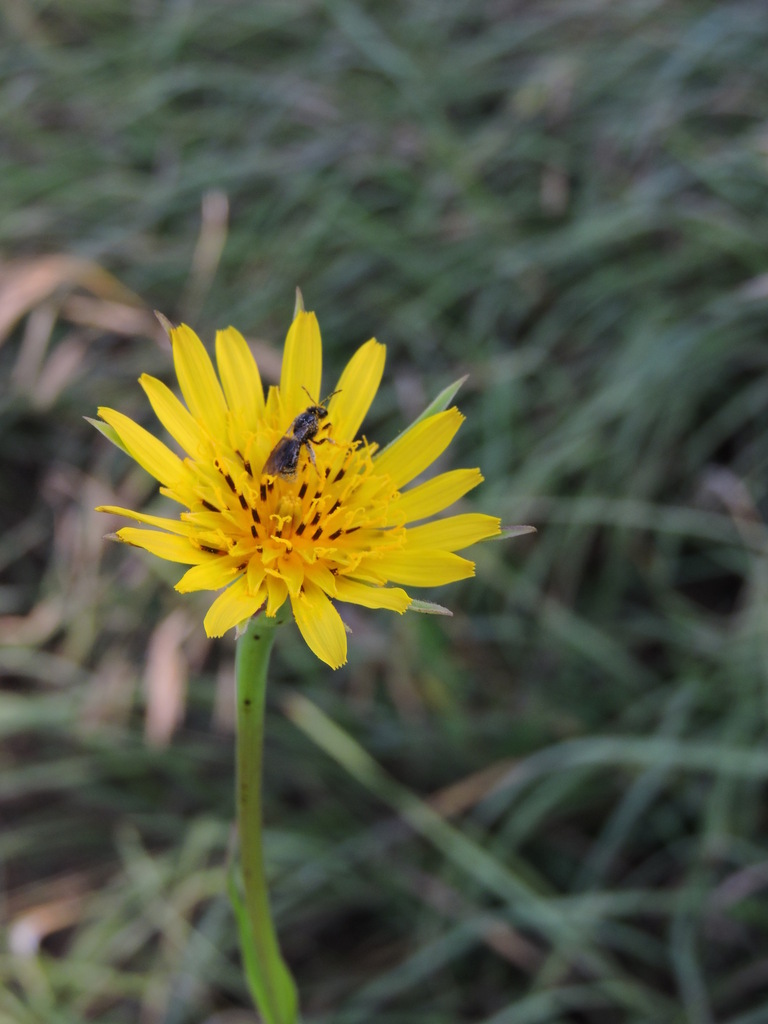
meadow salsify
Tragopogon pratensis
Tragopogon pratensis (common names Jack-go-to-bed-at-noon, meadow salsify, showy goat's-beard or meadow goat's-beard) is a biennial plant in the Asteraceae family, distributed across Europe and North America, commonly growing in fields (hence its name) and on roadsides. It is found in North America from southern Ontario to Massachusetts; most of England; on the eastern and southern edges of Scotland; and central Ireland but not the coastal edges.
From the article Tragopogon pratensis on Wikipedia (CC BY-SA), quoted section by section
Description
The plant grows up to 76 cm (30 in) tall. The lower leaves are 10 to 30 cm long, lanceolate, keeled lengthwise, grey-green, pointed, hairless, with a white midrib. The upper leaves are shorter and more erect. It is the only United Kingdom dandelion-type flower with grasslike leaves. On display between June and October, the flower heads are yellow and 15–25 millimetres (5⁄8–1 in) wide. They only open in the morning sunshine, hence the name 'Jack go to bed at noon'. The achenes are rough, long beaked pappus radiating outwards interwoven like a spider's web of fine white side hairs (referred to as a "blowball").
Similar species. It differs from viper's-grass (Scorzonera humilis) in that viper's-grass has short, pale green bracts, whereas in goat's-beard they are long and pointed.
Range & habitat
It is distributed across Europe and North America, commonly growing in fields (hence its name) and on roadsides. It is found in North America from southern Ontario to Massachusetts; most of England; on the eastern and southern edges of Scotland; and central Ireland but not the coastal edges.
Wikipedia: “Distribution and habitat”
At the table
The roots can be boiled and eaten like potatoes. The fresh stems and buds can be cooked like asparagus and the young leaves can be eaten raw.
Wikipedia: “Uses”
Where it lives
Recorded sightings
—
geo-referenced records in GBIF, from museums, herbaria and field observers.
Drag the globe to turn it. Dots are where records exist, not a range map; darker means more records.
In the stacks
Searching the stacks…
Every page naming Tragopogon pratensis in the Biodiversity Heritage Library →
This page is assembled live from iNaturalist, GBIF, Wikipedia, the Source Library and the Internet Archive. It is not yet part of the hand-edited codex. iNaturalist taxon 79385.