On eBird ↗
Pampas Meadowlark
Live sightings near you, the range map, bar charts of when it is seen, and Macaulay Library photos and recordings.
Pampas Meadowlark
Leistes defilippii
The Pampas meadowlark (Leistes defilippii) is a Vulnerable species of bird in the family Icteridae, the oropendolas, New World orioles, and New World blackbirds. It is found in Argentina and Uruguay.
From the article Pampas meadowlark on Wikipedia (CC BY-SA), quoted section by section
Description
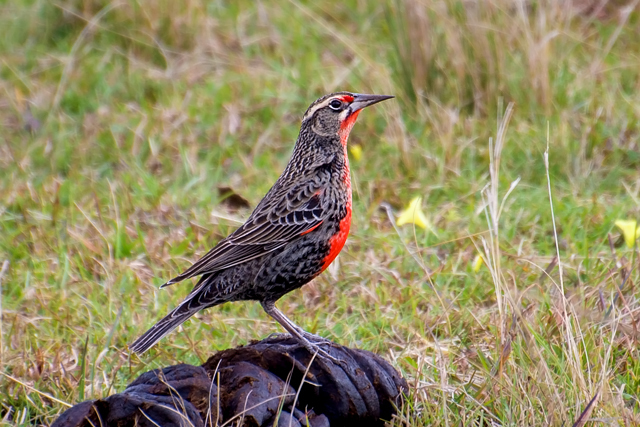
Pampas meadowlark males average 21 cm (8.3 in) long. Males weigh an average of 74 g (2.6 oz) and females 68 g (2.4 oz). Adult males have a mostly black head with a long supercilium that is red from the bill to the eye and white beyond it, a white lower eyelid, and a short white "moustache". Their upperparts and wings are mostly dusky brown with brownish streaks and some barring on the uppertail coverts. A few wing coverts are rosy red and the underwing coverts are black and red. Their tail is blackish with thin olive bars. Their chin, throat, and breast are rosy red with black sides. Their belly, flanks, and vent are black. Adult females have an all-white supercilium. Their upperparts are paler and browner than the male's. Their throat is white, their central belly is pale pink, and the rest of their underparts are heavily streaked like their back. Both sexes have a dark iris, a silver-gray bill with a dark tip, and dark brown legs and feet. Juveniles resemble adult females with little or red on the belly; they have a horn-colored bill.
Range & habitat
The Pampas meadowlark has a highly disjunct distribution. It is found in Uruguay separately in the northern department of Salto and the southwestern department of Flores. In Argentina it is found where Buenos Aires, La Pampa, and Río Negro provinces meet. There are historical records from the Argentinian provinces of Entre Ríos, San Luis, Córdoba, and Corrientes. A population formerly in far southern Brazil's Rio Grande do Sul has been extirpated. The Pampas meadowlark is found almost exclusively in native grasslands and pastures. It also rarely occurs in actively cultivated fields, though those that have been abandoned for five or more years are used. In elevation it ranges from near sea level to 900 m (3,000 ft).
Wikipedia: “Distribution and habitat”
What it does
The Pampas meadowlark feeds on insects and seeds. It forages in flocks that in the non-breeding season may number in the hundreds.
Wikipedia: “Feeding”
Listen
Looking for field recordings…
Where it lives
Recorded sightings
—
geo-referenced records in GBIF, from museums, herbaria and field observers.
Drag the globe to turn it. Dots are where records exist, not a range map; darker means more records.
In the stacks
Searching the stacks…
Every page naming Leistes defilippii in the Biodiversity Heritage Library →
This page is assembled live from iNaturalist, GBIF, Wikipedia, the Source Library and the Internet Archive. It is not yet part of the hand-edited codex. iNaturalist taxon 793312.