On eBird ↗
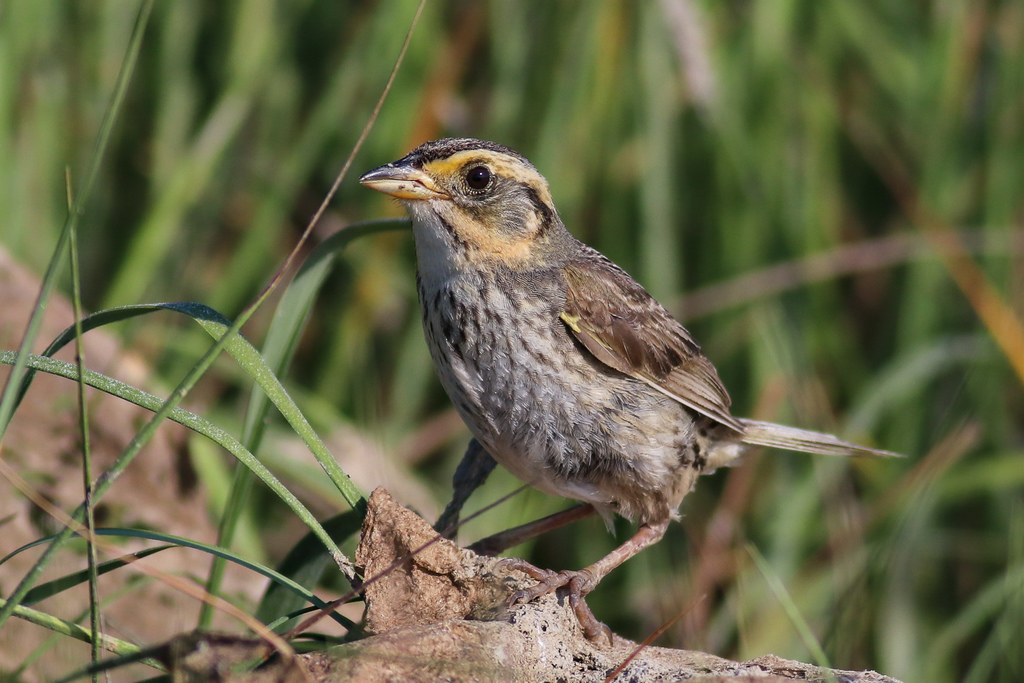
Saltmarsh Sparrow
Live sightings near you, the range map, bar charts of when it is seen, and Macaulay Library photos and recordings.
Saltmarsh Sparrow
Ammospiza caudacuta
The saltmarsh sparrow (Ammospiza caudacuta) is a small New World sparrow found in salt marshes along the Atlantic coast of the United States. At one time, this bird and the Nelson's sparrow (Ammospiza nelsoni) were thought to be a single species, the sharp-tailed sparrow. Because of this, the species was briefly known as the "saltmarsh sharp-tailed sparrow." Saltmarsh sparrow numbers are declining due to habitat loss largely attributed to human activity.
From the article Saltmarsh sparrow on Wikipedia (CC BY-SA), quoted section by section
Description
The saltmarsh sparrow measures 11–14 cm (4.3–5.5 in) in length, has a wingspan of 17.8–21 cm (7.0–8.3 in), and weighs 14–23.1 g (0.49–0.81 oz). Adults have brownish upperparts with a gray nape, white throat and belly, and pale orange breast and sides with brown streaking. The face is orange with gray cheeks, a gray median crown stripe, brown lateral crown stripes, and a brown eyeline. The tail feathers are short and sharply pointed. The subspecies A. c. diversa has more contrasting striping on its back and a darker crown than the nominate A. c. caudacuta. Only males sing. The song is a complex series of raspy, barely audible buzzes, trills, and gurgles. It is distinguishable from that of the Nelson's sparrow, which is a louder, hissing buzz followed by a buzzy chip. The high-pitched contact calls of both species are indistinguishable. Distinguishing this species from closely related sparrows such as the Nelson's sparrow (Ammospiza nelsoni) can be difficult. The inland subspecies of the Nelson's sparrow can be differentiated by its fainter streaking and brighter orange breast and sides, while the coastal subspecies of the Nelson's sparrow can be differentiated by its paler, less-contrasting plumage. The saltmarsh sparrow also has a slightly longer beak than the Nelson's sparrow.
Range & habitat
The saltmarsh sparrow is only found in tidal salt marshes along the Atlantic coast of the United States. It breeds along the northern coast, from Maine to the Chesapeake Bay, and winters along the southern coast, from North Carolina to Florida. The saltmarsh sparrow prefers high marsh habitat, dominated by saltmeadow cordgrass (Sporobolus pumilus) and saltmarsh rush (Juncus gerardii), which does not flood as frequently as low marsh.
Wikipedia: “Distribution and habitat”
What it does
The saltmarsh sparrow forages on the ground along tidal channels or in marsh vegetation, sometimes probing in the mud at low tide. Over 80% of the diet of nestlings consists of flies, amphipods, grasshoppers, and moths, especially larval, pupal, and adult soldier flies. During the winter, adults consume seeds. The saltmarsh sparrow is an opportunistic feeder and food is rarely limiting.
Wikipedia: “Diet”
Listen
Looking for field recordings…
Where it lives
Recorded sightings
—
geo-referenced records in GBIF, from museums, herbaria and field observers.
Drag the globe to turn it. Dots are where records exist, not a range map; darker means more records.
In the stacks
Searching the stacks…
Every page naming Ammospiza caudacuta in the Biodiversity Heritage Library →
This page is assembled live from iNaturalist, GBIF, Wikipedia, the Source Library and the Internet Archive. It is not yet part of the hand-edited codex. iNaturalist taxon 793289.