On eBird ↗
Tristan Thrush
Live sightings near you, the range map, bar charts of when it is seen, and Macaulay Library photos and recordings.
Tristan Thrush
Turdus eremita
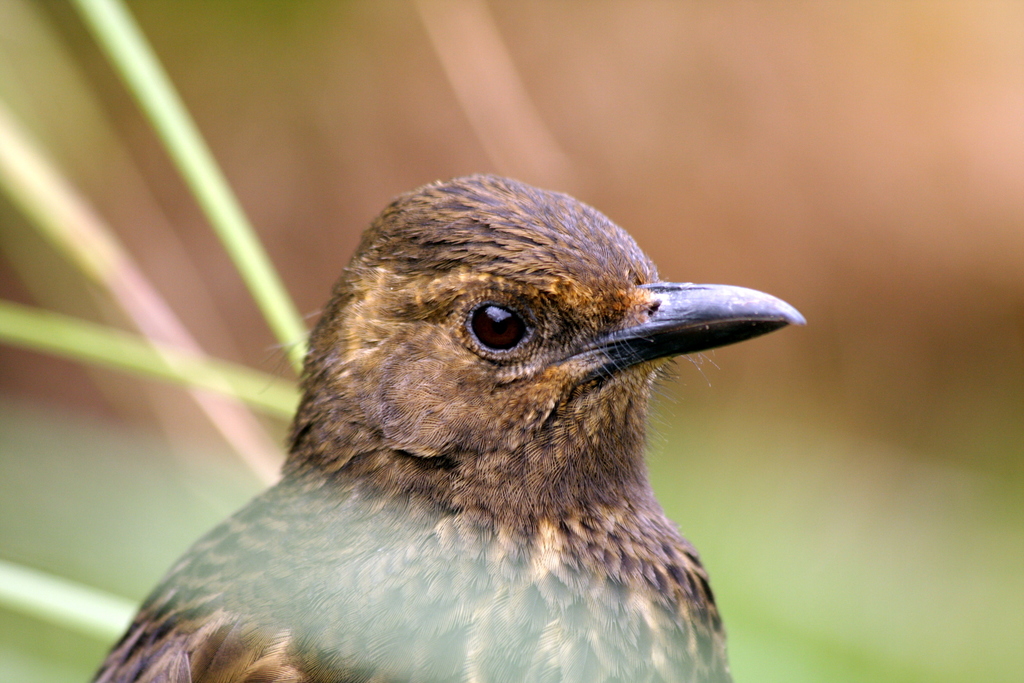
The Tristan thrush (Turdus eremita), also known as the starchy, is a species of bird in the thrush family that is endemic to the British overseas territories of the isolated Tristan da Cunha archipelago in the South Atlantic Ocean.
The isolation of its habitat forced the Tristan thrush to adapt to its current niche: the species is known to scavenge, and also predate on eggs and even other birds of its size class, though it also feeds on more typical fare such as invertebrates and plant matter.
From the article Tristan thrush on Wikipedia (CC BY-SA), quoted section by section
Description
The bird was described by John Gould as being similar in size and appearance to the song thrush, and by Henry Moseley as like a very dark-coloured song thrush. However, it also has the short rounded wings and reduced keel indicative of a reduced need for flight, typical of bird species adapted to life on small islands. This thrush typically has a length of about 22 cm (8.7 in). The nominate subspecies from Tristan differs from that from Nightingale Island, with the Tristan birds being warm dark brown on the upperparts rather than dull sooty-brown, rufous rather than dark fuscous on the sides of the head, and rufous-brown, rather than brownish-black, on the underparts. Birds from Inaccessible Island appear to be intermediate, with the sides of the head of a specimen from there speckled both rufous and fuscous.
Range & habitat
The thrush is found on Tristan, Inaccessible, Nightingale, Middle and Stoltenhoff Islands in the Tristan group. It uses all the natural habitats available on the islands, including rocky shorelines, tussock grassland, fern-dominated shrubland and wet heathland.
Wikipedia: “Distribution and habitat”
What it does
An opportunistic omnivore and scavenger, the thrush feeds on earthworms and other invertebrates of the soil and leaf litter, as well as on carrion, berries, the eggs and fledglings of other birds, and kitchen scraps. A 2010 paper published by Peter Ryan and Rob Ronconi in the journal Ardea reported on the predatory habits of the thrush: they observed Tristan thrushes breaking open an egg of the Atlantic yellow-nosed albatross, and also noted the thrush is a regular predator of eggs and small chicks of the great shearwater, being responsible for almost half of the egg losses by that species during the early incubation period in a colony on Inaccessible Island. They saw evidence that the thrushes remove eggs of the spectacled petrel (a breeding endemic of Inaccessible Island) from their nesting burrows. The thrushes are also known to kill both white-bellied and white-faced storm petrels directly, probably by taking them from their burrows. Furthermore, they have been observed to drink blood from penguins. The thrushes will also prey on chicks and the occasional adults of the Inaccessible Island rail. With the exception of seabirds such as the brown skua and rare vagrant raptors, the Tristan thrush is the largest terrestrial predator on Tristan da Cunha, occupying a unique position in its ecosystem for a songbird.
Wikipedia: “Feeding”
Listen
Looking for field recordings…
Where it lives
Recorded sightings
—
geo-referenced records in GBIF, from museums, herbaria and field observers.
Drag the globe to turn it. Dots are where records exist, not a range map; darker means more records.
In the stacks
Searching the stacks…
Every page naming Turdus eremita in the Biodiversity Heritage Library →
This page is assembled live from iNaturalist, GBIF, Wikipedia, the Source Library and the Internet Archive. It is not yet part of the hand-edited codex. iNaturalist taxon 793265.