On eBird ↗
Rufous-vented Grass Babbler
Live sightings near you, the range map, bar charts of when it is seen, and Macaulay Library photos and recordings.
Rufous-vented Grass Babbler
Laticilla burnesii
The rufous-vented grass babbler or rufous-vented prinia (Laticilla burnesii) is a small warbler in the family Pellorneidae that occurs in Pakistan, northwestern India and Nepal.
From the article Rufous-vented grass babbler on Wikipedia (CC BY-SA), quoted section by section
Description
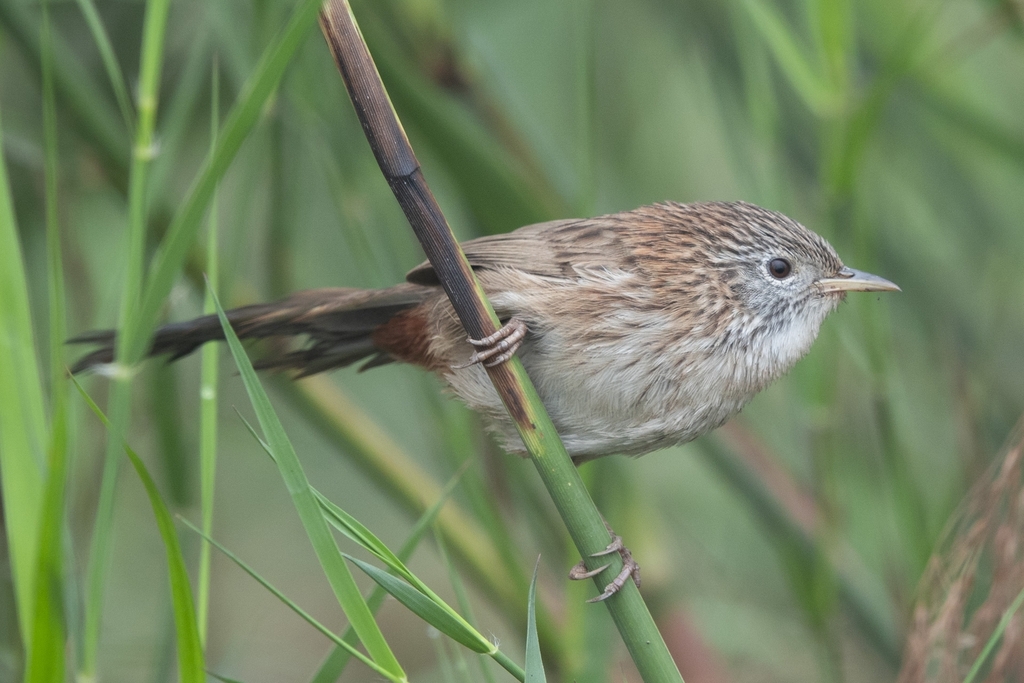
Rufous-vented grass babblers average 17 cm (6.7 in) long with a wing length from the bend to the tip of 5.3 cm (2.1 in) (females) or 5.5 cm (2.2 in) (males) to 5.9 cm (2.3 in). Adults are a cool brown colour above except that a buffy region on the back of the neck and upper back forms a distinct collar. Bold dark streaking starts at the forehead and fades on the back. The underparts are whitish with a tawny hue and dark streaking on the flanks. The undertail coverts are bright rufous or chestnut. The upper surface of the wings has barring formed by the covert feathers and their paler fringes. The wing linings are a faintly tawny off-white. The flight feathers of the wings are greyish brown; when the wing is folded, the primaries barely extend beyond the tertials. Those of the tail may be greyish or olive-brown and have rufous tips. The tail is long 8.7 to 11.5 cm (3.4 to 4.5 in) and strongly graduated, that is, the outermost pair of feathers is only one-third as long as the central pair. The head shows a conspicuous white eye-ring, whitish lores, and dark-streaked whitish cheeks. The upper mandible is horn-brown; the lower, straw-brown or flesh-brown. The eyes are brown, varying a little in lightness. …
Range & habitat
As treated here, this bird is found only in the plains of the Indus in Pakistan and adjacent in Punjab (India). (However, the swamp grass babbler of Assam and Bangladesh is often combined with this species.) It inhabits a variety of long grasslands, notably plains of sarkhan (Saccharum) but also plains of elephant grass and ekra grass, sometimes where mixed with acacias and tamarisks. It can even occur in deserts with scattered patches of tall grass, and reedbeds. It prefers the vicinity of large rivers and their tributaries or swamps.
Wikipedia: “Range and habitat”
What it does
This species skulks low in grass tussocks, hopping and threading its way through, often in small groups, feeding on insects. It usually holds its tail slightly cocked. When it flies, something that is hard to cause, it goes only to a nearby tussock. It is easiest to find in the breeding season, when it sings in the mornings and evenings.
Wikipedia: “Behaviour”
Listen
Looking for field recordings…
Where it lives
Recorded sightings
—
geo-referenced records in GBIF, from museums, herbaria and field observers.
Drag the globe to turn it. Dots are where records exist, not a range map; darker means more records.
In the stacks
Searching the stacks…
Every page naming Laticilla burnesii in the Biodiversity Heritage Library →
This page is assembled live from iNaturalist, GBIF, Wikipedia, the Source Library and the Internet Archive. It is not yet part of the hand-edited codex. iNaturalist taxon 793235.