- Plants
- ›Vascular Plants
- ›flowering plants
- ›Dicots
- ›Sunflowers, Bellflowers, Fanflowers, and Allies
- ›Sunflowers, Daisies, Asters, and Allies
- ›chicories, dandelions, and allies
- ›Lettuce, Chicory, Dandelion and Salsify Tribe
- ›dandelions, hawksbeards, and rattlesnake roots
- ›Taraxacum
- ›Borealia
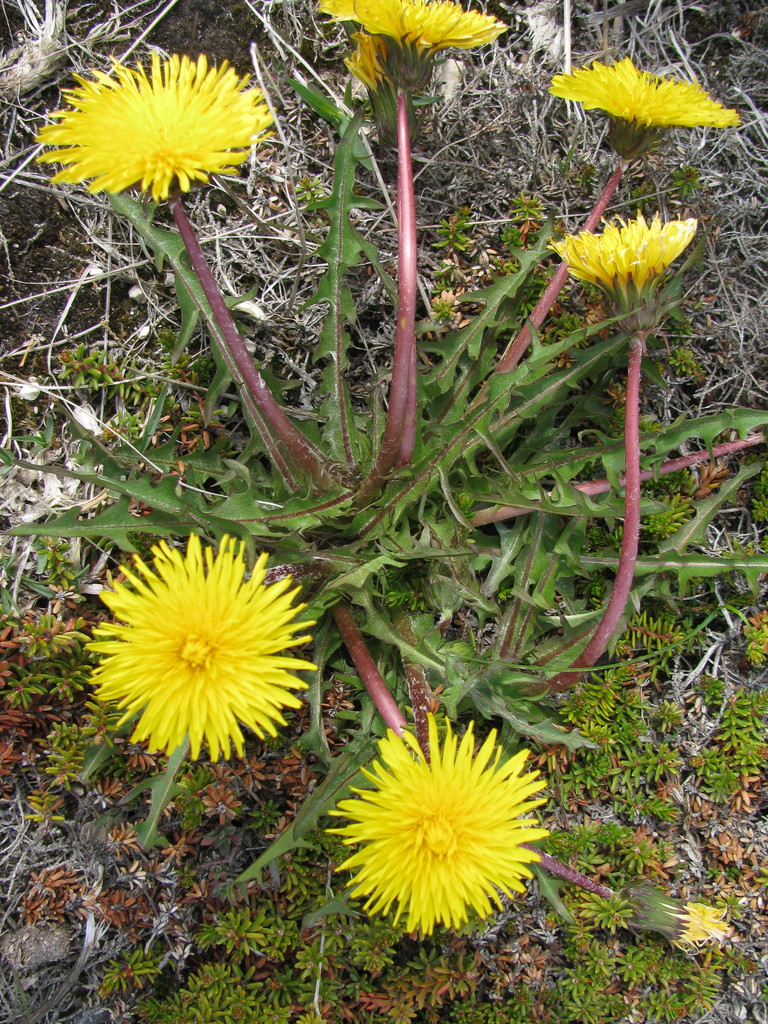
horned dandelion
Taraxacum ceratophorum
Taraxacum ceratophorum, also known as the horned dandelion, is a species of flowering plant within the genus Taraxacum and family Asteraceae. This alpine species has a preference for mountainous habitat, where it can be found growing at elevations up to 3000 meters above sea level. It is native to a large portion of the Northern Hemisphere, inhabiting various countries within Asia, Europe and North America.
From the article Taraxacum ceratophorum on Wikipedia (CC BY-SA), quoted section by section
Description
Taraxacum ceratophorum is a species of herbaceous perennial plant. The species typically reaches heights ranging from 5 to 30 cm tall. The plant possesses a taproot and a caudex, with the caudex measuring approximately 5 to 10 mm in diameter. The species is diploid and exhibits chromosomal polymorphism with a chromosome count of 2n = 16, 18, 28, 32, or 40.
Leaves. The leaves of Taraxacum ceratophorum are primarily basal, with a patent or erect orientation. They are alternate in arrangement and die annually. Petioles may or may not be present, ranging from 0 to 40 (or occasionally up to 70) mm in length. These petioles can be winged, either broadly or narrowly, and are typically glabrous. The leaf blades of this species are simple in structure, with attenuate bases. They measure 50 to 120 mm in length and 7 to 30 mm in width, displaying an oblanceolate shape. The blades are flat and appear to have a single vein or pinnate veins. The adaxial surface of the blade is glabrous, as is the abaxial surface. The blades can be broadly or narrowly lobed, with runcinate and dentate margins. The degree of incision can range from 5% to 95%, and the apices of the lobes are acute. The blade margins may exhibit between 1 and 8 (or occasionally up to 11) teeth on each side, counting both the dentations and tips of the runcinate lobes. …
Range & habitat
Taraxacum ceratophorum has an extensive distribution, being present throughout much of the Northern Hemisphere within temperate Asia, Europe and North America. In Asia, the species can be found within the countries of Russia, Japan, Kazakhstan and Mongolia. In Europe the species is present in Norway, Sweden, Iceland, Great Britain and European Russia. Taraxacum ceratophorum is also native to the United States of America within the states of: Alaska, California, Colorado, Montana, Nevada, New Mexico, Oregon, Utah, Washington and Wyoming. It is also present within Canada, where it can be found in the Canadian provinces of: Alberta, British Columbia, Labrador, Manitoba, Newfoundland, Northwest Territories, Nunavut, Ontario, Québec, Saskatchewan and Yukon.
Wikipedia: “Distribution”
Where it lives
Recorded sightings
—
geo-referenced records in GBIF, from museums, herbaria and field observers.
Drag the globe to turn it. Dots are where records exist, not a range map; darker means more records.
In the stacks
Searching the stacks…
Every page naming Taraxacum ceratophorum in the Biodiversity Heritage Library →
This page is assembled live from iNaturalist, GBIF, Wikipedia, the Source Library and the Internet Archive. It is not yet part of the hand-edited codex. iNaturalist taxon 79316.