On eBird ↗
Japanese Quail
Live sightings near you, the range map, bar charts of when it is seen, and Macaulay Library photos and recordings.
Japanese Quail
Coturnix japonica
The Japanese quail (Coturnix japonica), also known as the coturnix quail, is a species of Old World quail found in East Asia. First considered a subspecies of the common quail, it is now considered as a separate species. The Japanese quail has played an active role in the lives of humanity since the 12th century, and continues to play major roles in industry and scientific research. Where it is found, the species is abundant across most of its range. Currently, there are a few true breeding mutations of the Japanese quail. The varieties currently found in the United States include Pharaoh, Italian, Manchurian, Tibetan, Rosetta, along with the following mutations: sex-linked brown, fee, roux, silver, andalusian, blue/blau, white winged pied, progressive pied, albino, calico, sparkly, as well as non-color mutations such as celadon, which lay blue-tinted eggs.
From the article Japanese quail on Wikipedia (CC BY-SA), quoted section by section
Description
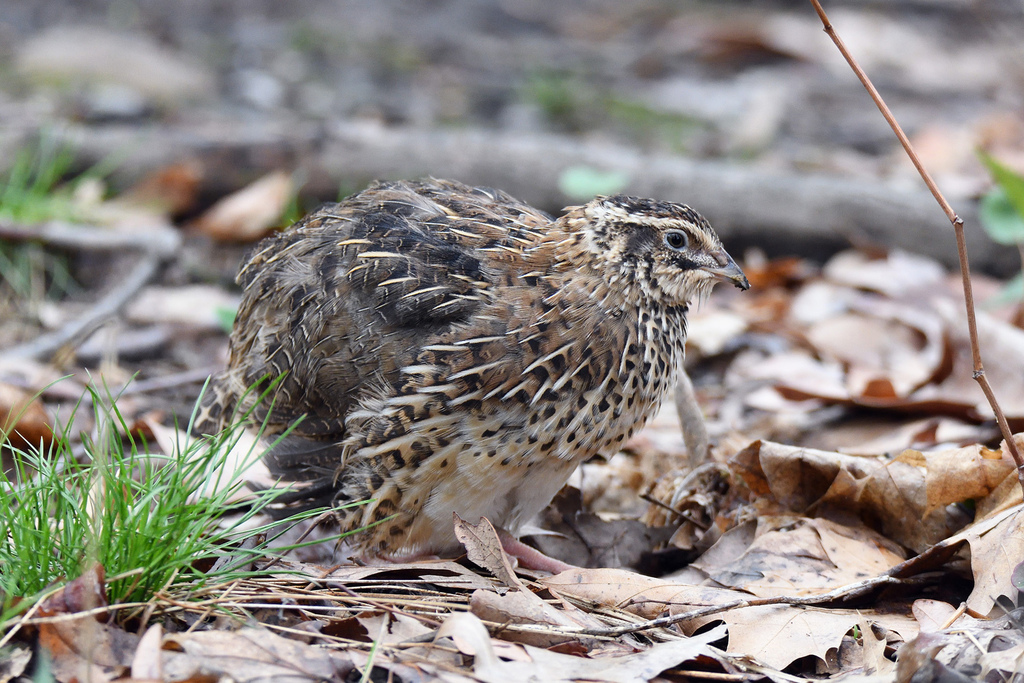
The morphology of the Japanese quail differs depending on its stage in life. As chicks, both male and female individuals exhibit the same kind of plumage and coloring. Their heads are tawny in color, with small black patches littering the area above the beak. The wings and the back of the chick are a pale brown, the back also having four brown stripes running along its length. A pale yellow-brown stripe surrounded by smaller black stripes runs down the top of the head. The plumage of the Japanese quail is sexually dimorphic, allowing for differing sexes to be distinguished from one another. Both male and female adults exhibit predominantly brown plumage. However, markings on the throat and breast, as well as the particular shade of brown of the plumage, can vary quite a bit. The breast feathers of females are littered with dark spots among generally pale feathers. Contrastingly, male breast feathers show off a uniform dark reddish-brown color that is devoid of any dark spots. This reddish-brown coloration also appears in the male cheek, while female cheek feathers are more cream colored. Some males also exhibit the formation of a white collar, whereas this does not occur in any female members of the species. …
Range & habitat
Populations of the Japanese quail are known to mainly inhabit East Asia and Russia. This includes India, Korea, Japan, and China. Though several resident populations of this quail have been shown to winter in Japan, most migrate south to areas such as Vietnam, Cambodia, Laos, and southern China. This quail has also been found to reside in many parts of Africa, including Tanzania, Malawi, Kenya, Namibia, Madagascar, and the area of the Nile River Valley extending from Kenya to Egypt. Breeding sites of the Japanese quail are largely localized to East and Central Asia, in such areas as Manchuria, southeastern Siberia, northern Japan, and the Korean Peninsula. However, it has also been observed to breed in some regions of Europe, as well as Turkey. The Japanese quail is primarily a ground-living species that tends to stay within areas of dense vegetation in order to take cover and evade predation. Thus, its natural habitats include grassy fields, bushes along the banks of rivers, and agricultural fields that have been planted with crops such as oats, rice, and barley. It has also been reported to prefer open habitats such as steppes, meadows, and mountain slopes near a water source.
Wikipedia: “Distribution and habitat”
What it does
Normally, the Japanese quail has been considered to possess an underdeveloped sense of taste, this being evidenced by their inability to distinguish different kinds of carbohydrates presented to them. However, studies have shown that a limited ability to taste is indeed present. Evidence for this includes quail individuals exhibiting preferential choice of sucrose-containing solutions over simple distilled water and the avoidance of salty solutions. Though the Japanese quail possesses an olfactory epithelium, little is known about its ability to sense smell. Despite this, certain studies have revealed that these birds are able to detect certain substances using only their sense of smell. For example, they have been reported to be able to detect the presence of certain pesticides, as well as avoid food containing toxic proteins called lectin, using only the sense of smell. Through nasolateral conversion of the eyes, the Japanese quail is able to achieve frontal overlap of the eye fields. Long distance perception occurs with a binocular field accommodation. In order to maintain focus on a certain object while walking, the quail will exhibit corresponding head movements. The Japanese quail has also been shown to possess color vision, its perception of color being greater than that of form or shape. …
Wikipedia: “Behaviour and ecology”
Listen
Looking for field recordings…
Where it lives
Recorded sightings
—
geo-referenced records in GBIF, from museums, herbaria and field observers.
Drag the globe to turn it. Dots are where records exist, not a range map; darker means more records.
In the stacks
Searching the stacks…
Every page naming Coturnix japonica in the Biodiversity Heritage Library →
This page is assembled live from iNaturalist, GBIF, Wikipedia, the Source Library and the Internet Archive. It is not yet part of the hand-edited codex. iNaturalist taxon 791.