- Plants
- ›Vascular Plants
- ›flowering plants
- ›Dicots
- ›Legumes, Milkworts, and Allies
- ›Legumes
- ›Peacock Flower Subfamily
- ›Cassieae
- ›Cassiinae
- ›Senna
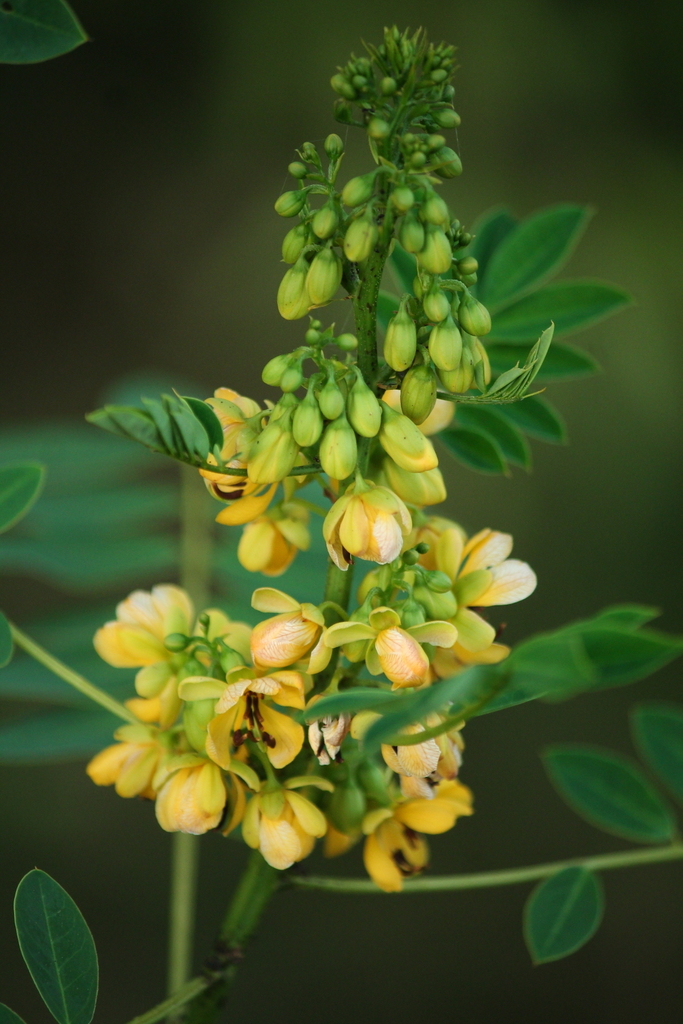
Maryland senna
Senna marilandica
Senna marilandica, commonly known as Maryland senna, Maryland wild senna, and wild senna, is a perennial flowering plant in the pea family (Fabaceae) native to the United States. It blooms in the summer with yellow flowers, followed by long seed pods, and can grow up to 2 m (6 ft) tall. It prefers average to wet soil.
From the article Senna marilandica on Wikipedia (CC BY-SA), quoted section by section
Description
Senna marilandica has green, round, unbranched stems rising from a shallow, fibrous root system, reaching a height of about 2 m (6 ft). The compound leaves are alternate and pinnate with four to eight pairs of opposite leaflets on each leaf. Leaflets are up to 6 cm (2.5 in) long and 2 cm (0.75 in) wide and are ovate to elliptic in shape. The inflorescences are racemes of six to nine yellow flowers, appearing both from the leaf axils (axillary) and at the end of the stems (terminal). The axillary inflorescences are up to 15 cm (6 in) long, and the terminal inflorescence is about 15–30 cm (6–12 in) long. Each flower is about 2 cm (0.75 in) across, with five yellow petals and five greenish yellow sepals. The stamens have prominent brownish anthers. The flowers do not have nectaries. After the flowers are fertilized, drooping pea-like seed pods, up to 8 cm (3 in) long, appear.
Range & habitat
S. marilandica is native in the United States from Nebraska to the west, Florida and Texas to the south, Wisconsin to the north, and New York to the east. It is a species of special concern in Wisconsin. The plant is found in woodland edges, open fields, and thickets, and in moist areas such as riverbanks and moist prairies.
Wikipedia: “Distribution and habitat”
What it does
The flowers bloom from early July through late August, and the seed pods form from early August through late September. Bumblebees, butterflies, and solitary bees visit the flowers. Although the flowers do not have nectaries, extrafloral nectaries are located at the base of the leaves that are higher on the stem, in the inflorescence, and ants, parasitic wasps, and lady beetles feed on the nectar. Unlike many members of the pea family, S. marilandica is not nodulated by nitrogen-fixing bacteria. S. marilandica is a larval host to the cloudless sulphur (Phoebis sennae), orange-barred sulphur (Phoebis philea), sleepy orange (Eurema nicippe), and little sulphur (Eurema lisa) butterflies.
== References ==
Wikipedia: “Ecology”
Where it lives
Recorded sightings
—
geo-referenced records in GBIF, from museums, herbaria and field observers.
Drag the globe to turn it. Dots are where records exist, not a range map; darker means more records.
In the stacks
Searching the stacks…
Every page naming Senna marilandica in the Biodiversity Heritage Library →
This page is assembled live from iNaturalist, GBIF, Wikipedia, the Source Library and the Internet Archive. It is not yet part of the hand-edited codex. iNaturalist taxon 79061.