On eBird ↗
Maroon Oriole
Live sightings near you, the range map, bar charts of when it is seen, and Macaulay Library photos and recordings.
Maroon Oriole
Oriolus traillii
The maroon oriole (Oriolus traillii) is a species of bird in the family Oriolidae. It is found in Southeast Asia.
From the article Maroon oriole on Wikipedia (CC BY-SA), quoted section by section
Description
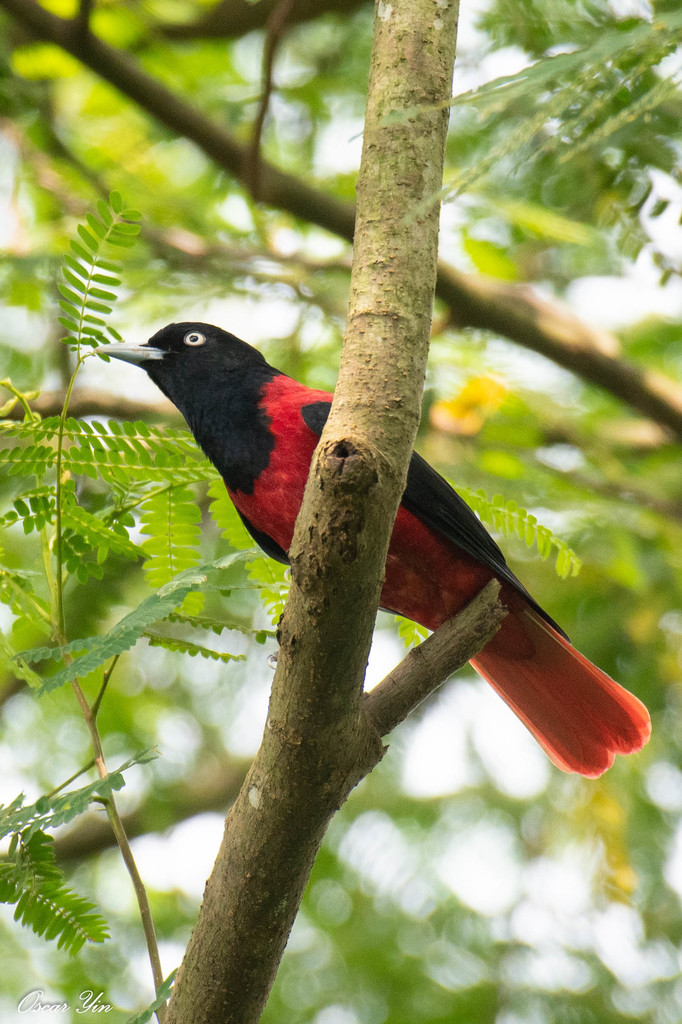
The maroon oriole is 25–28 cm long. Males have maroon and black plumage with a black head, neck and wings with a bluish beak. The females have slightly darker bodies and the juveniles have lighter bodies. The adult male is glossy crimson-maroon, with black head, neck and wings and a chestnut-maroon tail. The females and immature males have a greyish-white underpart with black streaks. The colour varies somewhat across the range, with those in the Indian Subcontinent having duller colours, and those in Southeast Asia having brighter colours, also tending to somewhat reddish tones.
Range & habitat
The maroon oriole is found in Bangladesh, Bhutan, Cambodia, India, Laos, Myanmar, Nepal, Taiwan, Thailand, Tibet, and Vietnam. In India, it is found from Himachal Pradesh east to Arunachal Pradesh and the hills of Manipur. Its natural habitat is subtropical or tropical moist lowland forests.
Wikipedia: “Distribution and habitat”
What it does
The maroon oriole lives alone or in pairs. The nesting season is from April to May. The nest is a deep massive cup of bast fibre that is bound with cobwebs. Both male and female birds share the parental duties.
Diet and feeding. The maroon oriole eats wild figs, berries, insects and nectar.
== References ==
Wikipedia: “Behaviour and ecology”
Listen
Looking for field recordings…
Where it lives
Recorded sightings
—
geo-referenced records in GBIF, from museums, herbaria and field observers.
Drag the globe to turn it. Dots are where records exist, not a range map; darker means more records.
In the stacks
Searching the stacks…
Every page naming Oriolus traillii in the Biodiversity Heritage Library →
This page is assembled live from iNaturalist, GBIF, Wikipedia, the Source Library and the Internet Archive. It is not yet part of the hand-edited codex. iNaturalist taxon 7890.