- Plants
- ›Vascular Plants
- ›flowering plants
- ›Dicots
- ›Sunflowers, Bellflowers, Fanflowers, and Allies
- ›Sunflowers, Daisies, Asters, and Allies
- ›Asteroideae
- ›tarweeds, silverswords, and allies
- ›Raillardella
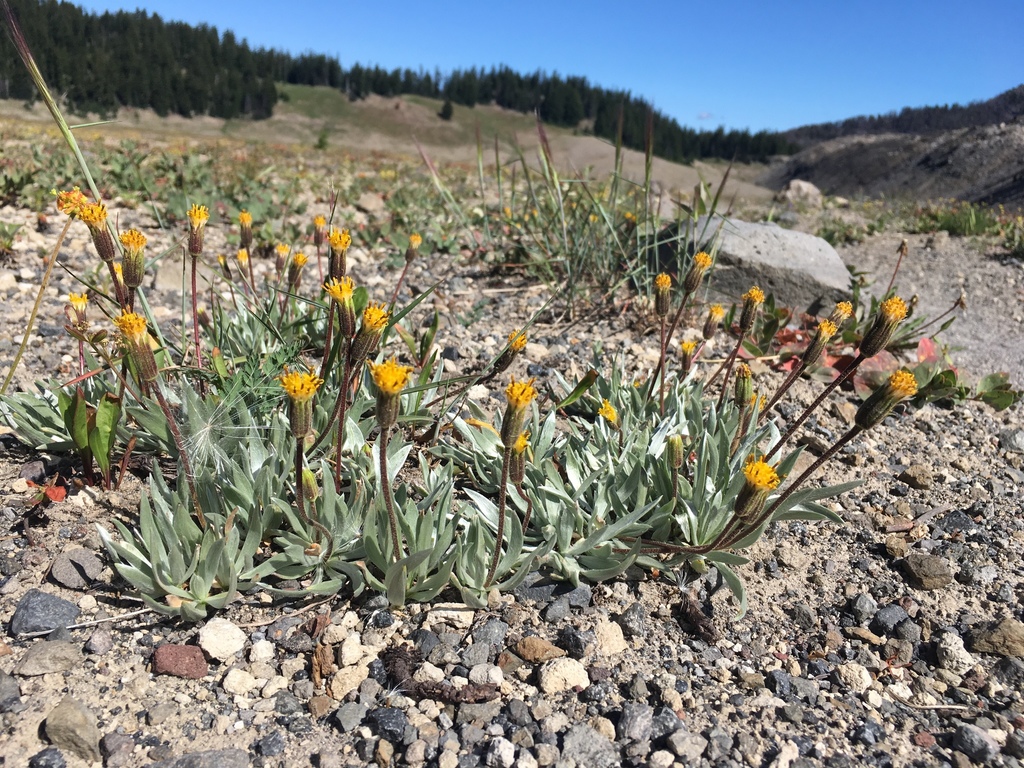
silky raillardella
Raillardella argentea
Raillardella argentea is a species of flowering plant in the family Asteraceae known by the common name silky raillardella. It is native to the Sierra Nevada and nearby mountain ranges of California, with its distribution extending east into Nevada and north along the Cascade Range and Klamath Mountains into Oregon. It grows in many types of dry, open mountain habitat. It is a rhizomatous perennial herb growing in a clump of rosetted basal leaves. The leaves are lance-shaped, up to 8 centimeters long, and coated in silky hairs. The plant produces an inflorescence up to about 15 centimeters tall consisting of a solitary flower head which is cylindrical to somewhat bell-shaped. The head is enclosed in the fused outer scales of the flowers, which look similar to the phyllaries of many other species' flower heads. The head contains many yellow disc florets up to a centimeter long each, and no ray florets. The fruit is a long, narrow achene which may be 2 centimeters in length including its plumelike pappus.
Where it lives
Recorded sightings
—
geo-referenced records in GBIF, from museums, herbaria and field observers.
Drag the globe to turn it. Dots are where records exist, not a range map; darker means more records.
In the stacks
Searching the stacks…
Every page naming Raillardella argentea in the Biodiversity Heritage Library →
This page is assembled live from iNaturalist, GBIF, Wikipedia, the Source Library and the Internet Archive. It is not yet part of the hand-edited codex. iNaturalist taxon 78812.