On eBird ↗
Isabela Oriole
Live sightings near you, the range map, bar charts of when it is seen, and Macaulay Library photos and recordings.
Isabela Oriole
Oriolus isabellae
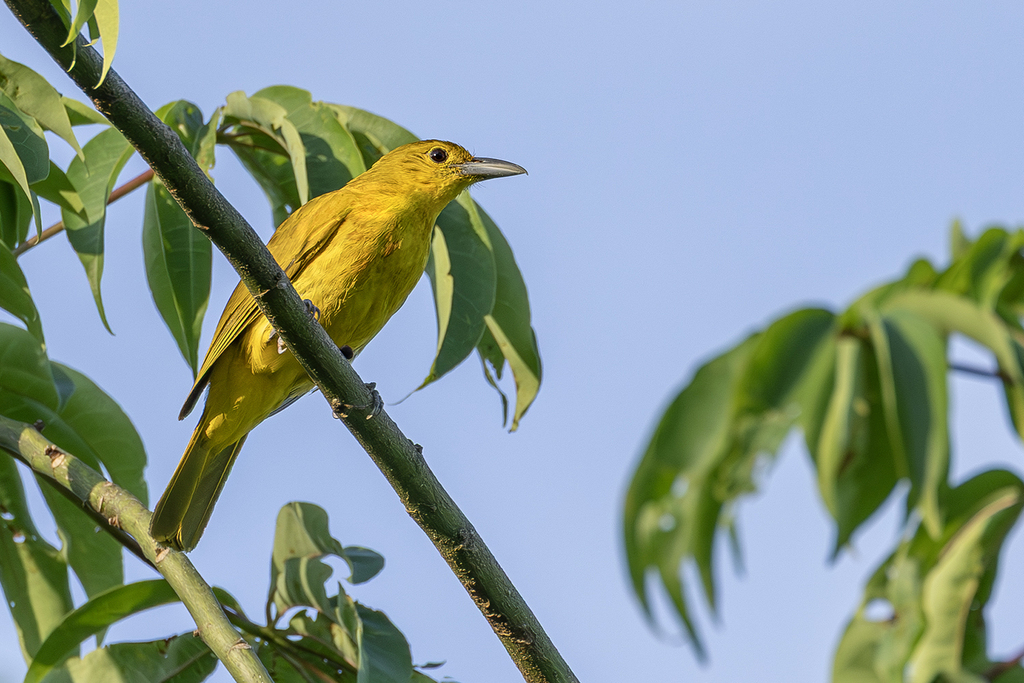
The Isabela oriole (Oriolus isabellae) is a species of the oriole family endemic to Luzon in the Philippines. It is an oriole identified by its yellowish green plumage and a very large gray bill. This species was presumed to be extinct for many years until its rediscovery in December 1993 near Diffun, Quirino, and in Mansarong in September 1994. Additional sightings were made in San Mariano, Isabela. and Baggao, Cagayan Valley It It is found in moist lowland forest up to 440 masl. It is critically endangered with estimates of just 50 to 250 mature individuals remaining. It is threatened by habitat loss and hunting.
From the article Isabela oriole on Wikipedia (CC BY-SA), quoted section by section
Description
It is a medium sized bird of the lowland forest of Northern Luzon. It is primarily yellow with a hint of olive on its upper parts. Its bill is large and silver. This species has multiple class. One call is a repeated whistle with descending first note followed by a quick rising second note. It also has a rattling call. The Isabela oriole is commonly confused with the much more common white-lored orioles and black-naped orioles. It is differentiated by its extremely large grey bill, uniform olive-yellow plumage and lack of white on its lores. The Isabela oriole is most closely related to the white-lored oriole. Both species are closely related to the paraphyletic Philippine oriole. The Isabela oriole is sometimes considered to form a superspecies with the dark-throated oriole and the Philippine oriole. Alternate names for the Isabela oriole include the green-lored oriole and olive-lored oriole.
Wikipedia: “Description and taxonomy”
Range & habitat
The Isabela oriole is now confined to the lowland forests in the Northern Sierra Madre mountain range in Luzon. It is frequently seen in the canopy and middle storeys of forests and also forest edge or patches up to 440 masl. It has not been recorded in Bataan province since 1947 despite an intensive search done in 2014.
Wikipedia: “Distribution and habitat”
What it does
Feeds mostly on fruit but also insects such as larvae and caterpillars. Typically seen alone, in pairs or small groups in the middle storey to the canopy. It is seen in mixed flocks with other birds such as bar-bellied cuckooshrikes, black-and-white trillers, blackish cuckooshrikes and other forest birds. Breeding believed to occur during April to June. In 2022, the first record and photographs of a juvenile were released.
Wikipedia: “Ecology and behavior”
Listen
Looking for field recordings…
Where it lives
Recorded sightings
—
geo-referenced records in GBIF, from museums, herbaria and field observers.
Drag the globe to turn it. Dots are where records exist, not a range map; darker means more records.
In the stacks
Searching the stacks…
Every page naming Oriolus isabellae in the Biodiversity Heritage Library →
This page is assembled live from iNaturalist, GBIF, Wikipedia, the Source Library and the Internet Archive. It is not yet part of the hand-edited codex. iNaturalist taxon 7880.