- Plants
- ›Vascular Plants
- ›flowering plants
- ›Dicots
- ›Sunflowers, Bellflowers, Fanflowers, and Allies
- ›Sunflowers, Daisies, Asters, and Allies
- ›Asteroideae
- ›stinkworts and allies
- ›Inulinae
- ›Pulicaria
- ›Pulicaria arabica
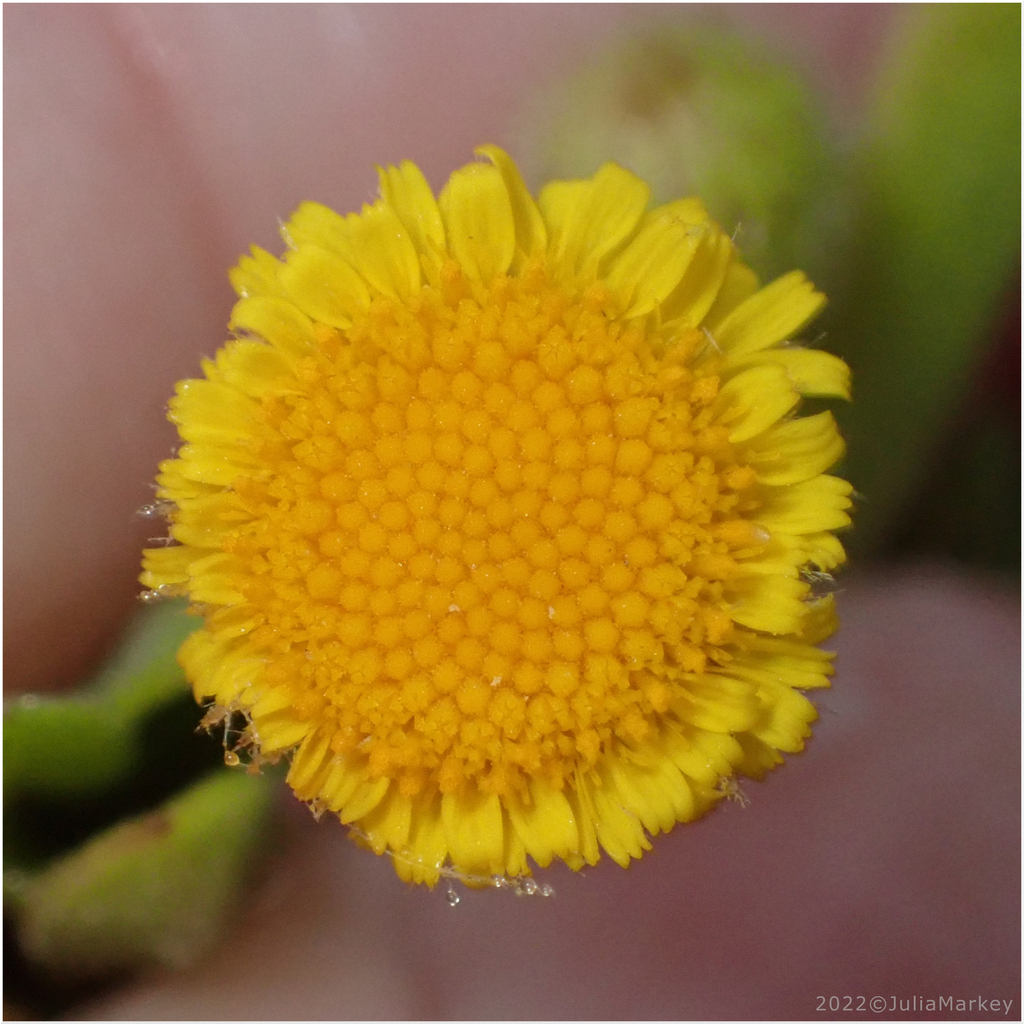
Spanish False Fleabane
Pulicaria paludosa
Pulicaria paludosa is a species of flowering plant in the aster family known by the common name Spanish false fleabane. It is native to Europe, particularly Spain and Portugal, and it is known as an introduced species in California, Arizona, and Clark County, Nevada, where it grows as a weed on roadsides, wetlands, riparian corridors, and other damp, disturbed areas. It is an annual, biennial, or perennial herb growing a few centimeters tall to well over a meter tall from a rhizomatous root system. The leaves are alternately arranged with blades in a variety of shapes from linear to oblong or oval. The herbage is coated in soft hairs. The inflorescence bears many flower heads. Each head has narrow, pointed, hairy phyllaries, a large dense center of many yellow disc florets, and a short fringe of many rectangular yellow ray florets, which are only about 2 millimeters long each. The fruit is an achene tipped with a pappus of bristles.
Where it lives
Recorded sightings
—
geo-referenced records in GBIF, from museums, herbaria and field observers.
Drag the globe to turn it. Dots are where records exist, not a range map; darker means more records.
In the stacks
Searching the stacks…
Every page naming Pulicaria paludosa in the Biodiversity Heritage Library →
This page is assembled live from iNaturalist, GBIF, Wikipedia, the Source Library and the Internet Archive. It is not yet part of the hand-edited codex. iNaturalist taxon 78786.