On eBird ↗
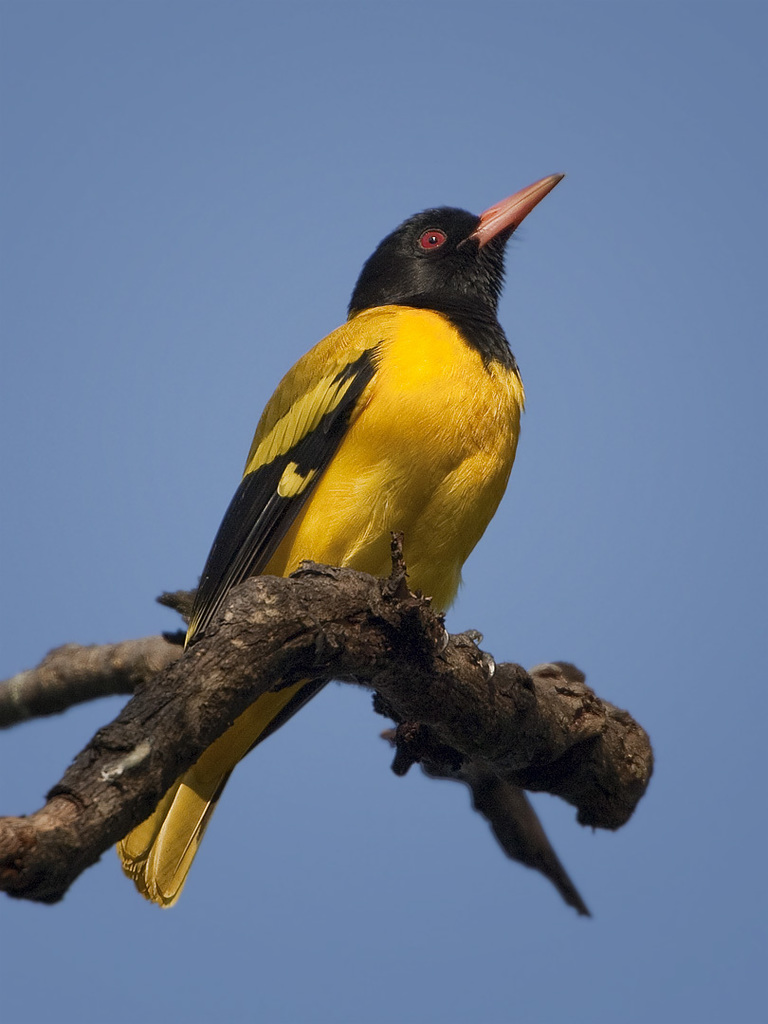
Black-hooded Oriole
Live sightings near you, the range map, bar charts of when it is seen, and Macaulay Library photos and recordings.
Black-hooded Oriole
Oriolus xanthornus
The black-hooded oriole (Oriolus xanthornus) is a member of the oriole family of passerine birds and is a resident breeder in tropical southern Asia from India and Sri Lanka east to Indonesia.
It is a bird of open woodland and cultivation. The nest is built in a tree, and contains two eggs. Its food is insects and fruit, especially figs, found in the tree canopies where they spend much of their time.
From the article Black-hooded oriole on Wikipedia (CC BY-SA), quoted section by section
Description
The male is striking, with the typical oriole black and yellow colouration. The plumage is predominantly yellow, with a solid black hood, and black also in the wings and tail centre. The female black-hooded oriole is a drabber bird with greenish underparts, but still has the black hood. Young birds are like the female, but have dark streaking on the underparts, and their hood is not solidly black, especially on the throat. The black head of this species is an obvious distinction from the Indian golden oriole, which is a summer visitor to northern India. Orioles can be shy, and even the male may be difficult to see in the dappled yellow and green leaves of the canopy. The black-hooded oriole's flight is somewhat like a thrush, strong and direct with some shallow dips over longer distances.
While foraging the species uses foliage-gleening, wood-gleening, or sallying methods.
Listen
Looking for field recordings…
Where it lives
Recorded sightings
—
geo-referenced records in GBIF, from museums, herbaria and field observers.
Drag the globe to turn it. Dots are where records exist, not a range map; darker means more records.
In the stacks
Searching the stacks…
Every page naming Oriolus xanthornus in the Biodiversity Heritage Library →
This page is assembled live from iNaturalist, GBIF, Wikipedia, the Source Library and the Internet Archive. It is not yet part of the hand-edited codex. iNaturalist taxon 7875.