On eBird ↗
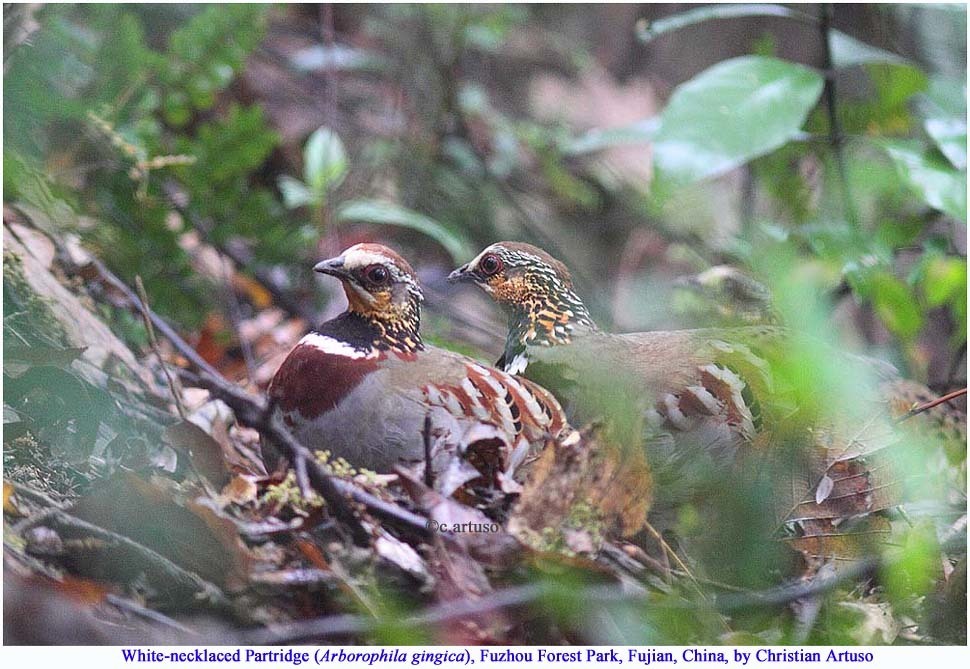
White-necklaced Partridge
Live sightings near you, the range map, bar charts of when it is seen, and Macaulay Library photos and recordings.
White-necklaced Partridge
Arborophila gingica
The white-necklaced partridge (Arborophila gingica), also known as the collared partridge or Rickett's hill-partridge, is a species of bird in the family Phasianidae. It is endemic to southeastern China. It is threatened by habitat loss and hunting, and the IUCN has assessed it as near-threatened.
From the article White-necklaced partridge on Wikipedia (CC BY-SA), quoted section by section
Description
The white-necklaced partridge is 25–30 cm (9.8–11.8 in) long and weighs about 253 g (8.9 oz). The adult's forehead is white (in the nominate subspecies), and there is a long supercilium. The neck-sides and throat are orange-rufous. There are a black gorget and a white band above the chestnut upper chest. The underparts are dark grey, changing to whitish on the belly. The nape and back are reddish-brown, with black spots. The rump is olive-brown and has black spots. The wings range from greyish to buffy-brown. The female is like the male but smaller. The short beak is grey, the eyes are brown, and the legs are red. The juvenile bird has a duller breast.
Range & habitat
The white-necklaced partridge is endemic to southeastern China, in Zhejiang, Jiangxi, Fujian, Guangdong and Guangxi. It lives in forests, bamboo and scrub at elevations of 150–1,900 m (490–6,230 ft).
Wikipedia: “Distribution and habitat”
What it does
This partridge occurs in the undergrowth during the day and roosts in trees. It eats seeds, berries and insects. The territorial call is a repeated plaintive whistle, including wooop and co-qwee. It mostly calls in the early morning and the evening. It breeds from April to May, laying a clutch of five to seven eggs.
Wikipedia: “Behaviour”
Listen
Looking for field recordings…
Where it lives
Recorded sightings
—
geo-referenced records in GBIF, from museums, herbaria and field observers.
Drag the globe to turn it. Dots are where records exist, not a range map; darker means more records.
In the stacks
Searching the stacks…
Every page naming Arborophila gingica in the Biodiversity Heritage Library →
This page is assembled live from iNaturalist, GBIF, Wikipedia, the Source Library and the Internet Archive. It is not yet part of the hand-edited codex. iNaturalist taxon 787.