- Plants
- ›Vascular Plants
- ›flowering plants
- ›Dicots
- ›Sunflowers, Bellflowers, Fanflowers, and Allies
- ›Sunflowers, Daisies, Asters, and Allies
- ›Asteroideae
- ›Tageteae
- ›Pectis
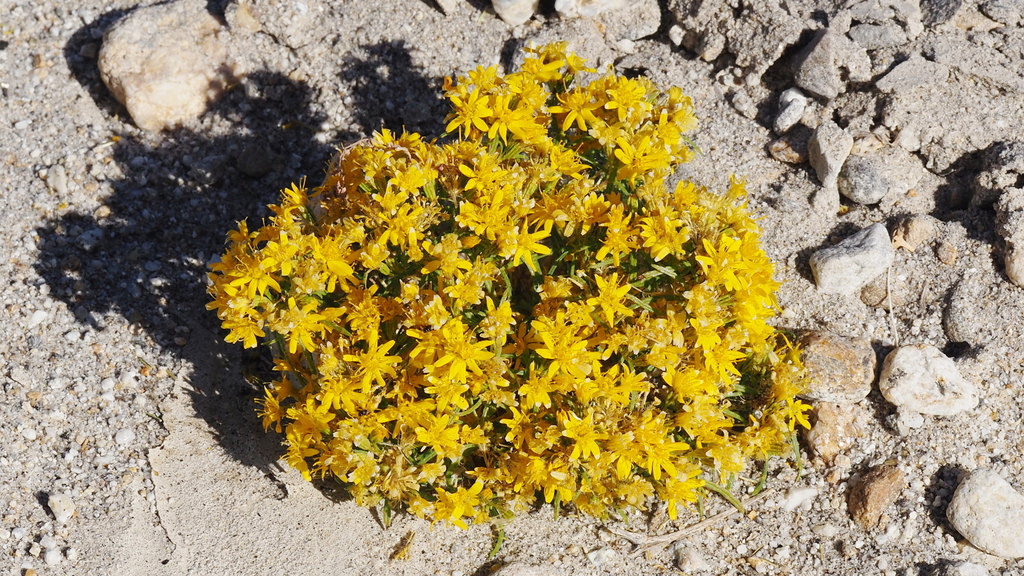
Chinchweed
Pectis papposa
Pectis papposa is species of flowering plant in the aster family, Asteraceae. It is native to North America, where it occurs in the southwestern United States as far east as Texas, and in northern Mexico. Common names include cinchweed, common chinchweed, many-bristle chinchweed, and many-bristle fetid-marigold.
From the article Pectis papposa on Wikipedia (CC BY-SA), quoted section by section
Description
Pectis papposa grows to 5–20 centimetres (2–8 in) in height with branched stems. The leaves are 4 cm (1+1⁄2 in) long and less than 3 millimetres (1⁄8 in) wide. Blooming from July to October, the yellow flower heads are 1.5 cm (1⁄2 in) wide, with 7–9 rays around a small central disk; the bracts have 3–7 glands. The fruit is a narrow seed. Large groups of flowers can produce an odour of lemons.
Similar species. Pectis angustifolia is similar, but its bracts each have only one gland at the tip.
Range & habitat
Pectis papposa is an annual herb that generally flowers following summer monsoon rains in the desert of southwestern United States as far east as Texas and northern Mexico. In favorable years, it becomes an aspect dominant, coloring wide areas of the desert.
Wikipedia: “Distribution and habitat”
At the table
It can be found in Mexican markets sold as limoncillo. It is used in moderation to flavor meat.
Among indigenous peoples. The Seri call the plant casol, casol heecto ("small casol"), casol ihasii tiipe ("fragrant casol"), and cacatajc ("what causes vomiting") and use it medicinally. The Pima use a decoction of the plant or the dried plant itself as a laxative. The Zuni people take an infusion of the whole plant as a carminative, and use an infusion of the flowers as eye drops for snowblindness. They also use the chewed flowers as perfume before dancing in ceremonies of "the secret fraternities". The Havasupai parch and grind the seeds and use them to make mush and soup. They also dip the fresh plant in salt water and eat it with mush or cornmeal as a condiment. The Pueblo use it as a spice.
== References ==
Wikipedia: “Uses”
Where it lives
Recorded sightings
—
geo-referenced records in GBIF, from museums, herbaria and field observers.
Drag the globe to turn it. Dots are where records exist, not a range map; darker means more records.
In the stacks
Searching the stacks…
Every page naming Pectis papposa in the Biodiversity Heritage Library →
This page is assembled live from iNaturalist, GBIF, Wikipedia, the Source Library and the Internet Archive. It is not yet part of the hand-edited codex. iNaturalist taxon 78362.