- Plants
- ›Vascular Plants
- ›flowering plants
- ›Dicots
- ›Sunflowers, Bellflowers, Fanflowers, and Allies
- ›Sunflowers, Daisies, Asters, and Allies
- ›Asteroideae
- ›groundsels and allies
- ›Senecioninae
- ›Packera
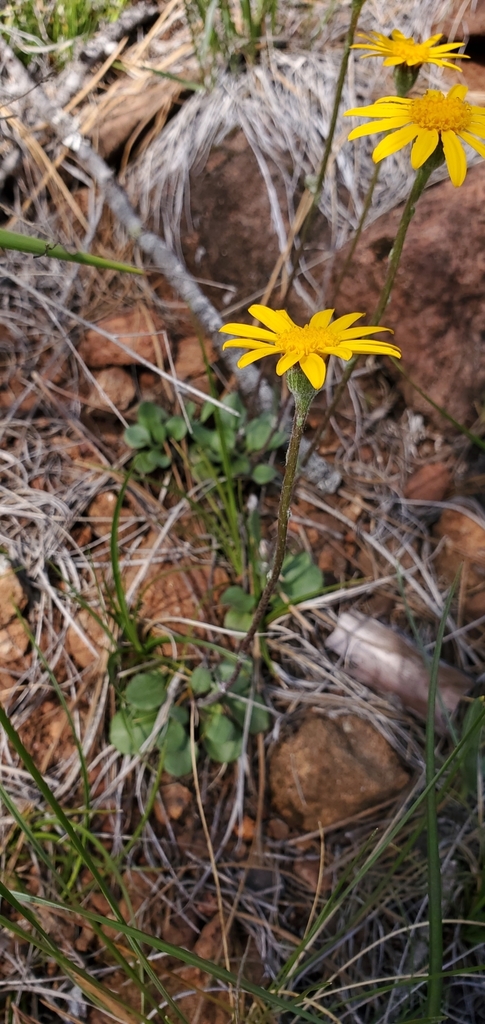
serpentine groundsel
Packera hesperia
Packera hesperia is a flowering plant in the aster family, Asteraceae. Commonly known as western ragwort and as serpentine groundsel, it is endemic to the Siskiyou Mountains, where it grows on serpentine soils. Conservation groups have identified this species as vulnerable, in part due to its limited geographic distribution.
From the article Packera hesperia on Wikipedia (CC BY-SA), quoted section by section
Description
Packera hesperia is a perennial with fibrous roots and a single herbaceous stem 7–15 cm tall, which can be either smooth or sparsely covered by woolly hairs. The basal leaves are 1–3 cm long and 0.5–2 cm wide, petiolate with tapering bases, and have either smooth or toothed margins. Cauline leaves are much smaller, have smooth edges, and clasp the stem.
At the end of the stem, there is a corymb bearing 1–4 flowering heads held on densely-woolly penduncles. Both the phyllaries (whorls of green bracts forming a cup-like structure that holds the flower) and the calyculi (bracts subtending the phyllaries) are green with red tinges or tips. The phyllaries are densely-woolly near their bases. Flowering occurs from mid-April to mid-June. The flower is composite, with 8–13 yellow ray florets 6–10 mm long and 30–50 disc florets. The cypselae (dry fruit holding a single seed) are 1.5–2 mm long. The pappi, which act as parachutes for the seeds during wind dispersal, are 5–6 mm long.
Range & habitat
Packera hesperia is endemic to the Siskiyou Mountains, where it grows at elevations of 500–2500 m. There are at least 5,000 individuals in Josephine and Curry Counties in southwestern Oregon, spread across at least 45 populations. In California, there are 4 known populations, all in Del Norte County. It grows in open woodlands on serpentine soils. Associated species commonly found growing with P. hesperia include the serpentine endemics Pinus jeffreyi and Arctostaphylos viscida.
Wikipedia: “Distribution and habitat”
Where it lives
Recorded sightings
—
geo-referenced records in GBIF, from museums, herbaria and field observers.
Drag the globe to turn it. Dots are where records exist, not a range map; darker means more records.
In the stacks
Searching the stacks…
Every page naming Packera hesperia in the Biodiversity Heritage Library →
This page is assembled live from iNaturalist, GBIF, Wikipedia, the Source Library and the Internet Archive. It is not yet part of the hand-edited codex. iNaturalist taxon 78321.