On eBird ↗
White-browed Treecreeper
Live sightings near you, the range map, bar charts of when it is seen, and Macaulay Library photos and recordings.
White-browed Treecreeper
Climacteris affinis
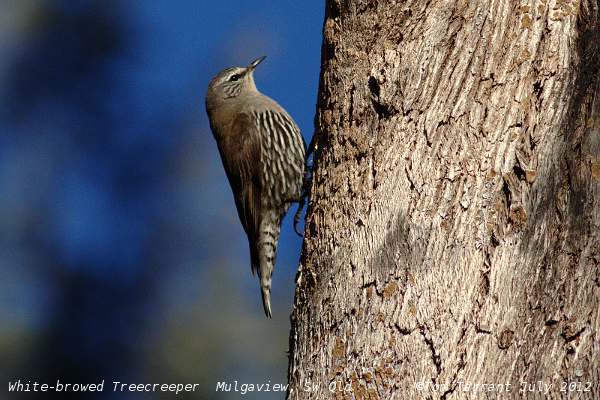
The white-browed treecreeper (Climacteris affinis) is the smallest of the Australo-papuan treecreepers and sole family member adapted to arid environments. The species foraging strategy involves climbing the trunks of trees in search of invertebrate prey on and under bark. Although some populations within the species range have declined, the species IUCN conservation status is of Least Concern.
From the article White-browed treecreeper on Wikipedia (CC BY-SA), quoted section by section
Description
The white-browed treecreeper is 14–16 cm in length, has a wingspan of 22 cm and weighs 21gm. Adult male plumage is mostly dark grey above (crown, neck, rump and uppertail) excluding the mantle and scapulars of which are brown and black sub-terminal tail-band. Facial plumage includes black lores, white tapered eyebrow and black and white streaked ear-coverts. The chin is white and throat brownish grey. The upper breast is grey and lower breast, belly, flanks and vent streaked black and white. Undertail coverts are barred black and white. Females are similar to males but with rufous stripe bordering the upper edge of the eyebrow and dull white streaking, tinged rufous, on the centre of the upper breast. In both sexes the bill is black, around 1.5–2 cm long and is relatively straight and slender. The iris is dark brown and legs and feet black. Juveniles differ from adults with pale grey bill and both facial patterning and ear-covert streaking duller and less distinct. The white-browed treecreeper has moderately long wedge shaped wings and square tail. Flight pattern over longer distances is undulated, involving brief bursts of flapping within long glides, during which a buff wingbar is visible.
Similar species. …
Wikipedia: “Description and field identification”
Range & habitat
White-browed treecreepers inhabit arid and semi-arid regions across southern Australia, excluding Tasmania. The two subspecies ranges do not overlap, C. a. affinis found east of the Spencer Gulf and C. a. superciliosus to the west. White-browed Treecreepers inhabit a range of woodland and shrubland communities, dominated by either Acacia, Casuarina or Callitris species, with both dense and open understory's. White-browed treecreepers are sedentary, pairs or groups actively defending relatively large territories (averaging 8.4 hectares in some regions) throughout the year.
Wikipedia: “Distribution and habitat”
What it does
The white-browed treecreeper is a scansorial (tree-trunk climbing) bark-foraging specialist, feeding upon a range of invertebrates (predominantly ants) gathered from on and beneath the bark of tree trunks and branches. The climbing technique employed by the species is described as 'inching' by which the lower foot is lifted and brought to the level of the upper foot prior to the upper being moved higher. Such a technique differs from some other scansorial birds which lift their feet from the substrate simultaneously in a hopping or hitching fashion. Once white-browed treecreepers reach the uppermost portions of a tree they glide down to a lower position on a nearby tree to recommence climbing. The species also frequently forages on the ground among logs and leaf litter. White-browed treecreepers forage alone, in small family groups or during winter within mixed-species assemblages comprising other insectivores.
Wikipedia: “Feeding”
Listen
Looking for field recordings…
Where it lives
Recorded sightings
—
geo-referenced records in GBIF, from museums, herbaria and field observers.
Drag the globe to turn it. Dots are where records exist, not a range map; darker means more records.
In the stacks
Searching the stacks…
Every page naming Climacteris affinis in the Biodiversity Heritage Library →
This page is assembled live from iNaturalist, GBIF, Wikipedia, the Source Library and the Internet Archive. It is not yet part of the hand-edited codex. iNaturalist taxon 7810.