- Plants
- ›Vascular Plants
- ›flowering plants
- ›Dicots
- ›Legumes, Milkworts, and Allies
- ›Legumes
- ›Faboideae
- ›brooms, lupines, and allies
- ›Lupinus
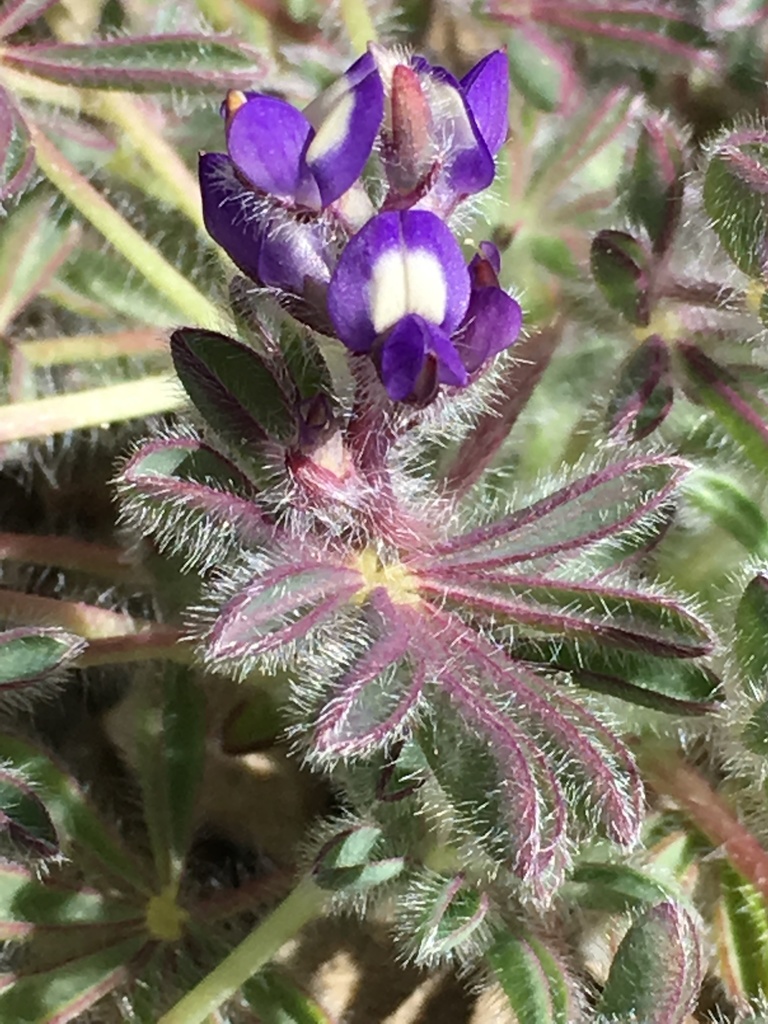
shortstem lupine
Lupinus brevicaulis
Lupinus brevicaulis is a species of lupine known by the common names shortstem lupine and sand lupine. It is native to the southwestern United States and Great Basin area and into northern Mexico, where it grows in many types of sandy habitat. This is a hairy annual herb growing nearly flat in a spread on the ground with a stem just a few centimeters long. An array of leaves encircles the base. Each palmate leaf is...
From the article Lupinus brevicaulis on Wikipedia (CC BY-SA), quoted section by section
Description
This is a hairy annual herb growing nearly flat in a spread on the ground with a stem just a few centimeters long. An array of leaves encircles the base. Each palmate leaf is made up of 6 to 8 leaflets about a centimeter long and a few millimeters in width. The inflorescence is a petite spiral of flowers a few centimeters long just arising past the basal disc of leaves. Each flower is 6 to 8 millimeters long and bright blue in color, generally with a white or yellowish spot on its banner. It ranges from 5 to 10 centimeters in height. It grows from a taproot. The stems are absent. The leaves are in a basal tuft, and on petioles 1 to 7 centimeters long. There are 5 to 8 leaflets per leaf. The flowers are either purple-blue or white in color. They are in dense, nearly spherical clusters about 2 centimeters long. The clusters are held up on peduncles up to 6 centimeters long. The fruit is a hairy legume pod about a centimeter long containing 1 or 2 beanlike seeds. It usually blooms in May and June. in their youth, it is almost impossible to tell apart this species from L. kingii, but as they mature, L. kingii is a lot bigger in every aspect than L. brevicaulis. You can also tell them apart by L. brevicaulis's lack of stem. Another way to tell them apart is the length of the calyx lips. Flowering begins when the peduncle is very short. …
At the table
The crushed leaves are used as a liniment on boils. It is also used in the treatment of sterility.
Wikipedia: “Uses”
Where it lives
Recorded sightings
—
geo-referenced records in GBIF, from museums, herbaria and field observers.
Drag the globe to turn it. Dots are where records exist, not a range map; darker means more records.
In the stacks
Searching the stacks…
Every page naming Lupinus brevicaulis in the Biodiversity Heritage Library →
This page is assembled live from iNaturalist, GBIF, Wikipedia, the Source Library and the Internet Archive. It is not yet part of the hand-edited codex. iNaturalist taxon 77852.