- Plants
- ›Vascular Plants
- ›flowering plants
- ›Dicots
- ›Sunflowers, Bellflowers, Fanflowers, and Allies
- ›Sunflowers, Daisies, Asters, and Allies
- ›Asteroideae
- ›Tageteae
- ›Tagetes
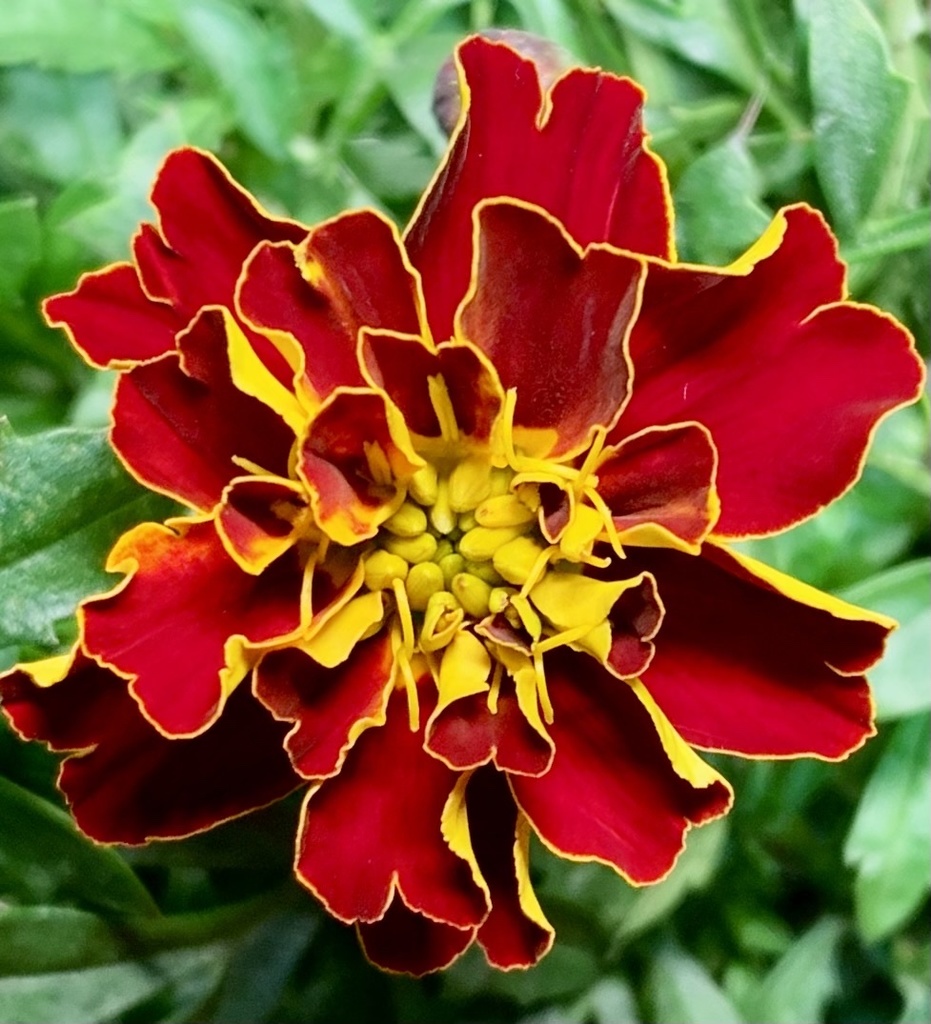
French marigold
Tagetes patula
Tagetes patula, the French marigold, is a species of flowering plant in the family Asteraceae, native to Mexico and Guatemala with several naturalised populations in many other countries. It is widely cultivated as an easily grown bedding plant with hundreds of cultivars, which often have bright yellow to orange flowers.
Some authorities regard Tagetes patula as a synonym of Tagetes erecta, the Mexican marigold.
From the article Tagetes patula on Wikipedia (CC BY-SA), quoted section by section
Description
Tagetes patula is an annual, occasionally reaching 0.5 m (1+1⁄2 ft) tall by 0.3 m (1 ft) wide. In some climates it flowers from July to October. In its native habitat of the highlands of central Mexico, blooms are produced from September to killing frost. Achenes ripen and are shed within two weeks of the start of bloom. The heads contain mostly hermaphrodite (having both male and female organs) florets and are pollinated primarily by beetles in the wild, as well as by tachinid flies and other insects. The leaves of all species of marigold include oil glands. The oils are pungent. It can grow in both sandy and clay soils provided they have good drainage. It requires full sun to partial shade.
At the table
The dried and ground flower petals constitute a popular spice in the Republic of Georgia in the Caucasus, where they are known as imeruli shaphrani (= 'Imeretian Saffron') from their pungency and golden colour and particular popularity in the Western province of Imereti. The spice imparts a unique, rather earthy flavour to Georgian cuisine, in which it is considered especially compatible with the flavours of cinnamon and cloves. It is also an essential ingredient in the spice mixture khmeli suneli (reputedly as significant to Georgian cuisine as garam masala is to that of North India).
Wikipedia: “Culinary”
How it is grown
This plant is valued for its velvet-textured, brightly coloured blooms in shades of yellow, orange and russet in summer. It is shorter, and has a more spreading habit, than its relative the Mexican marigold (Tagetes erecta). It is therefore more suitable as an edging plant in the open border. Moreau et al 2006 attempted to protect Solanum tuberosum (potato) against Leptinotarsa decemlineata (potato beetle) by intercropping with T. patula but instead found it acting as an attractant, resulting in greater infestation and lower yields. (They also found the same for another purported repellent, Armoracia rusticana.) Tagetes patula is frost intolerant, given a Royal Horticultural Society hardiness rating of H2, capable of surviving temperatures of 1–5 °C (34–41 °F) but killed by freezing temperatures. They are grown by gardeners in moderately fertile, but well-drained soil in full sun with evenly moist conditions.
Cultivars. Hundreds of cultivars have been developed, of which the following have gained the Royal Horticultural Society's Award of Garden Merit:-
Wikipedia: “Cultivation”
Where it lives
Recorded sightings
—
geo-referenced records in GBIF, from museums, herbaria and field observers.
Drag the globe to turn it. Dots are where records exist, not a range map; darker means more records.
In the old herbals & bestiaries


In the stacks
Searching the stacks…
Every page naming Tagetes patula in the Biodiversity Heritage Library →
This page is assembled live from iNaturalist, GBIF, Wikipedia, the Source Library and the Internet Archive. It is not yet part of the hand-edited codex. iNaturalist taxon 777243.