- Plants
- ›Vascular Plants
- ›flowering plants
- ›Dicots
- ›Mints, Plantains, Olives, and Allies
- ›Mint Family
- ›Nepetoideae
- ›Mentheae
- ›Melissas and sages
- ›Lepechinia
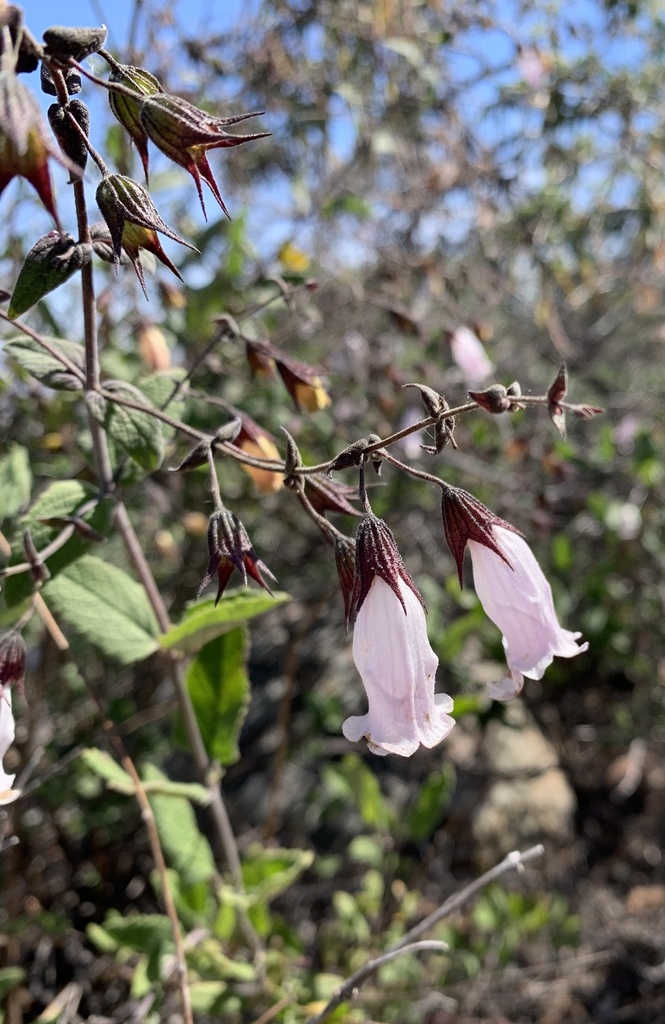
Gander's pitcher sage
Lepechinia ganderi
Lepechinia ganderi is a rare species of perennial shrub in the mint family known by the common name San Diego pitcher sage or Gander's pitcher sage. An aromatic plant with white to lavender flowers, this species is only known from southern San Diego County in California and a small portion of Baja California, occurring on chaparral or coastal sage scrub in metavolcanic soils. Because of its limited range, it is under threat from growing urbanization and increased fire frequency.
From the article Lepechinia ganderi on Wikipedia (CC BY-SA), quoted section by section
Description
Lepechinia ganderi is a short, aromatic shrub with slender branches coated in rough hairs and resin glands. The leaves are lance-shaped (lanceolate) and may have toothed (serrate) edges. The raceme inflorescence bears flowers on pedicels that are 1 to 2 cm long. Each flower has a base of long, pointed sepals below a white to light lavender tubular corolla. The flower is lipped at the mouth. The small, dark, hairless fruit develops attached to the sepals once the corolla falls. The flowers are pollinated by bees and hummingbirds.
Range & habitat
This species is a near-endemic to southern San Diego County, California and the neighboring border region of Baja California. It is known from around 20 occurrences in the United States, many on federal land. The Mexican populations are not well studied. It is distributed throughout the coastal Peninsular Range foothills and mountains in this area, including Otay Mountain and the Jamul Mountains. Plants of this species are typically found growing on rocky, metavolcanic, gabbroic substrates, often in habitats ranging from coastal sage scrub and chaparral to closed-cone coniferous forest, such as Tecate cypress groves, and grasslands, at elevations from 500 to 1060 meters.
Wikipedia: “Distribution and habitat”
Where it lives
Recorded sightings
—
geo-referenced records in GBIF, from museums, herbaria and field observers.
Drag the globe to turn it. Dots are where records exist, not a range map; darker means more records.
In the stacks
Searching the stacks…
Every page naming Lepechinia ganderi in the Biodiversity Heritage Library →
This page is assembled live from iNaturalist, GBIF, Wikipedia, the Source Library and the Internet Archive. It is not yet part of the hand-edited codex. iNaturalist taxon 77659.