- Animals
- ›Chordates
- ›Vertebrates
- ›Birds
- ›Parrots
- ›Old World Parrots
- ›Lories, Lorikeets, Budgerigar and Fig-Parrots
- ›Vini
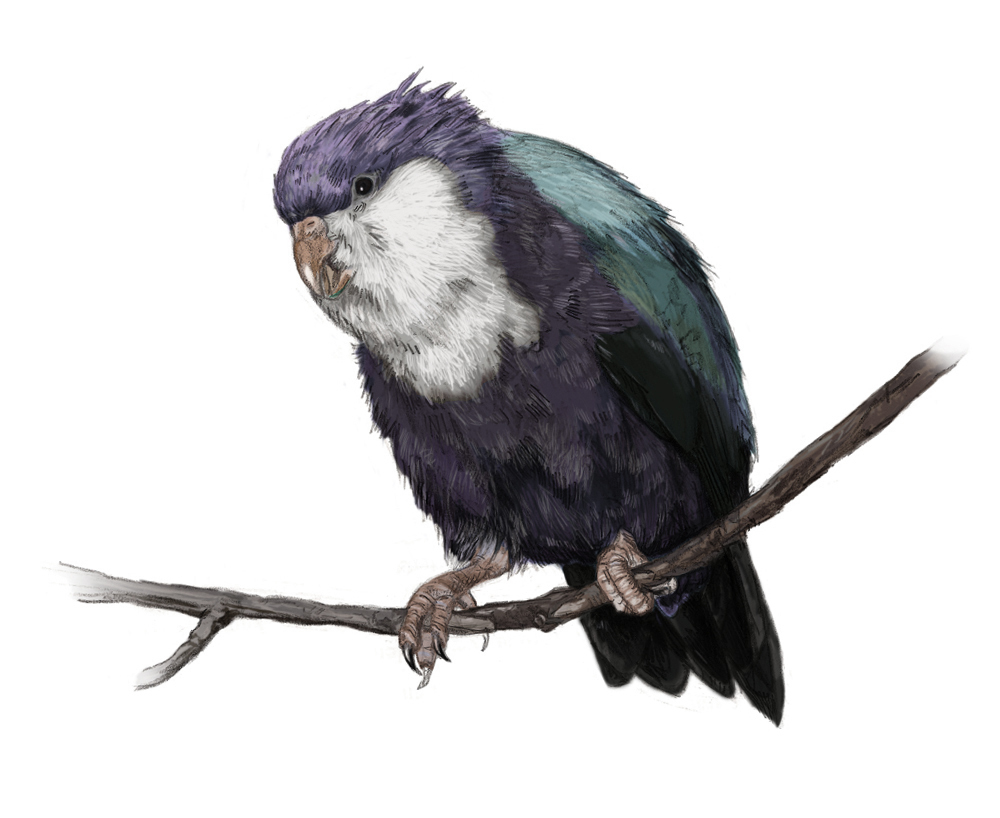
Conquered Lorikeet
Vini vidivici
The conquered lorikeet (Vini vidivici) was a species of parrot that became extinct 700–1300 years ago. It lived in islands of Polynesia. David Steadman and Marie Zarriello wrote its species description in 1987.
It was discovered in the oldest archaeological layer of 1000 AD and not recorded after 1200 AD.
From the article Conquered lorikeet on Wikipedia (CC BY-SA), quoted section by section
Range & habitat
Specimens have been found on Hiva Oa, Nuku Hiva, Ua Huka, and Tahuata (Marquesas Islands); Mangaia (Cook Islands); and Huahine (Society Islands).
Wikipedia: “Distribution”
In human culture
The binomial name is wordplay alluding to "veni, vidi, vici." The authors wrote in the original description:The meaning, "I came, I saw, I conquered," may be projected into the prehistoric situation in the Marquesas and elsewhere in Polynesia, where people came to an island, saw the native parrots, and then conquered them, leaving behind only the bones. The generic name in fact does not come from Latin; René Lesson chose Vini as the name for the genus since vini is the Tahitian word for a local bird.
== References ==
Wikipedia: “Etymology”
Listen
Looking for field recordings…
Where it lives
Recorded sightings
—
geo-referenced records in GBIF, from museums, herbaria and field observers.
Drag the globe to turn it. Dots are where records exist, not a range map; darker means more records.
In the stacks
Searching the stacks…
Every page naming Vini vidivici in the Biodiversity Heritage Library →
This page is assembled live from iNaturalist, GBIF, Wikipedia, the Source Library and the Internet Archive. It is not yet part of the hand-edited codex. iNaturalist taxon 774507.