- Plants
- ›Vascular Plants
- ›flowering plants
- ›Dicots
- ›Legumes, Milkworts, and Allies
- ›Legumes
- ›Peacock Flower Subfamily
- ›Caesalpinieae
- ›Hoffmannseggia
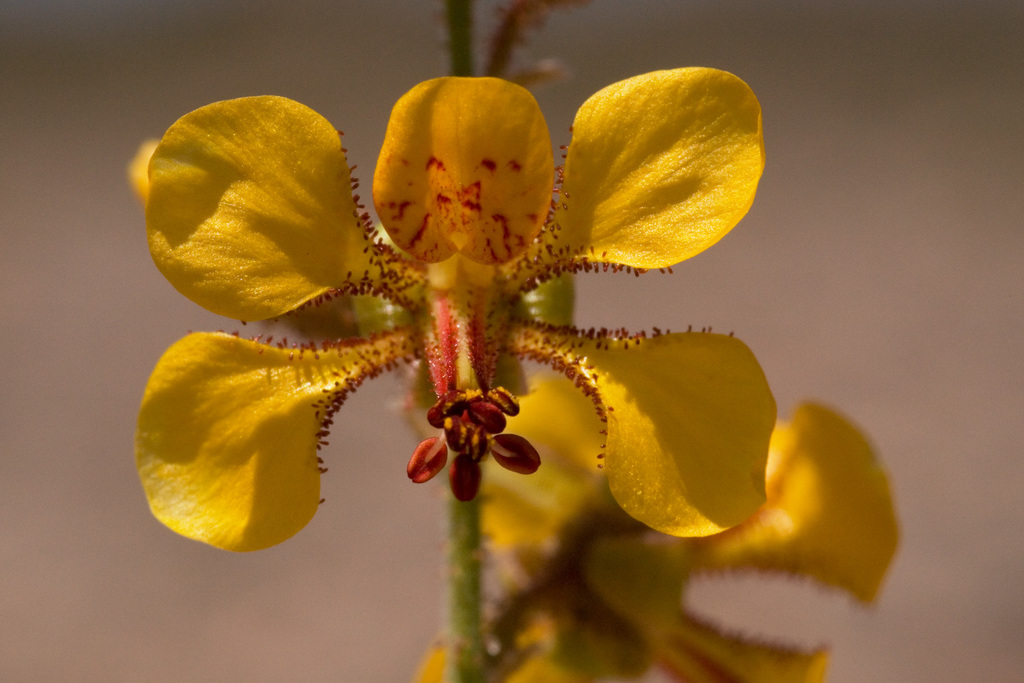
Indian rushpea
Hoffmannseggia glauca
Hoffmannseggia glauca is a dicot found in the legume family, Fabaceae. Its common names include Indian rushpea, hog potato, and pig nut.
It is a California native that prefers alkaline desert flats, creosote bush communities, and disturbed areas. It prefers elevations of less than 900 metres (3,000 ft). Hoffmannseggia glauca is found outside California in Western Nevada, Texas, Mexico, and South America. In California, H. glauca may be found in the San Joaquin Valley, the Southern Coastal Ranges, and the Western Transverse Ranges.
From the article Hoffmannseggia glauca on Wikipedia (CC BY-SA), quoted section by section
Description
Hoffmannseggia glauca is an erect perennial herb that can measure up to 30 cm tall. Branches are slender, growing out from the base of the plant, and have stalked glands. The foliage is composed of compound leaves with primary and secondary leaflets. Primary leaflets (5–20 mm) are odd-pinnate, while secondary leaflets (4–6 mm) are even-pinnate. The inflorescence measures 5–15 cm and is glandular. Flowers are orange-red with spreading petals and are produced between the months of April and June. The fruit that develops is 1.5–4 cm long, glandular, curved, and short-stalked. The fruit may or may not be deciduous. The USDA indicates that Hoffmannseggia glauca is considered a noxious weed in Kansas.
At the table
The Pima, Apache, Cocopa, and Pueblo ate the tubers or bulbs raw, boiled or roasted.
Wikipedia: “Uses”
Where it lives
Recorded sightings
—
geo-referenced records in GBIF, from museums, herbaria and field observers.
Drag the globe to turn it. Dots are where records exist, not a range map; darker means more records.
In the stacks
Searching the stacks…
Every page naming Hoffmannseggia glauca in the Biodiversity Heritage Library →
This page is assembled live from iNaturalist, GBIF, Wikipedia, the Source Library and the Internet Archive. It is not yet part of the hand-edited codex. iNaturalist taxon 77423.