On eBird ↗
Bar-throated Apalis
Live sightings near you, the range map, bar charts of when it is seen, and Macaulay Library photos and recordings.
Bar-throated Apalis
Apalis thoracica
The bar-throated apalis (Apalis thoracica) is a small African passerine bird belonging to the genus Apalis of the family Cisticolidae. It is native to the eastern and southern Afrotropics.
From the article Bar-throated apalis on Wikipedia (CC BY-SA), quoted section by section
Description
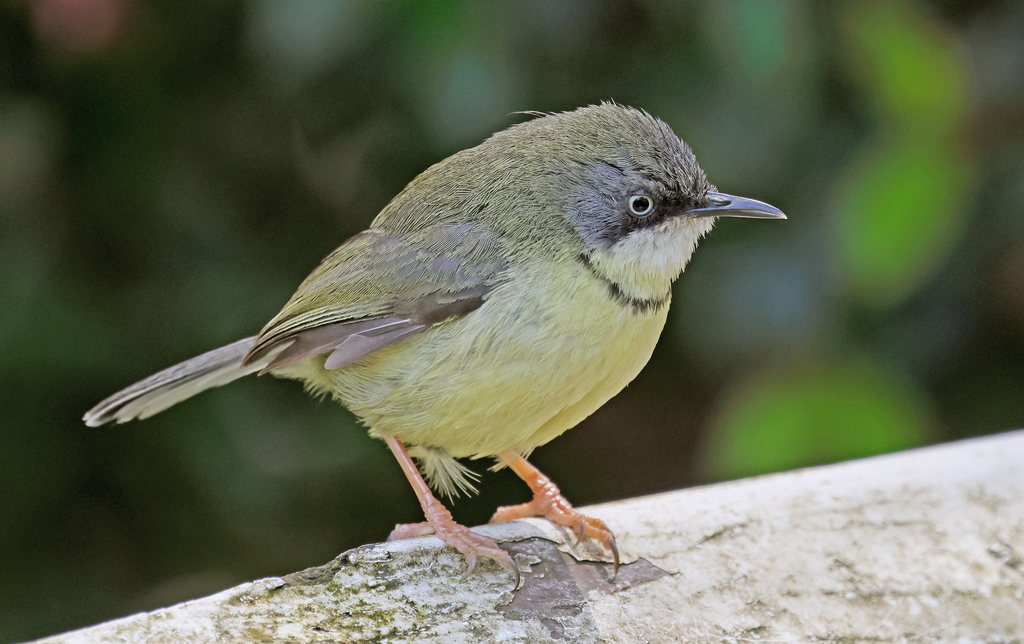
The bar-throated apalis is a slender bird with a long tail and is 11 to 13 cm in length. The plumage varies depending on the subspecies: the upper parts can be grey or green while the underparts are white or pale yellow. All forms have a narrow black band across the breast, white outer tail-feathers and a pale eye. The black bill is fairly long and slender and is slightly curved. Females are similar to males but have a narrower breast band. Juveniles have buffer underparts and may have an incomplete breast band.
Range & habitat
It inhabits forest and scrub in Southern and East Africa from southern and eastern parts of South Africa north as far as the Chyulu Hills in Kenya. In the northern part of is range it is found only in highland areas where there are a number of subspecies restricted to isolated mountain ranges. Some of these may be treated as separate species including the Namuli apalis (A. lynesi) in Mozambique, yellow-throated apalis (A. flavigularis) of Malawi and Taita apalis (A. fascigularis) in Kenya.
Wikipedia: “Range and habitat”
What it does
Pairs sing a duetting song with the female's call being higher-pitched than that of the male. The oval, purse-shaped nest is made mainly of plant material. Three eggs are laid, these are bluish-white with reddish-brown spots. The breeding season lasts from August to January. This species forages for caterpillars and other insects amongst vegetation, often forming mixed-species flocks with other birds.
Wikipedia: “Behaviour”
Listen
Looking for field recordings…
Where it lives
Recorded sightings
—
geo-referenced records in GBIF, from museums, herbaria and field observers.
Drag the globe to turn it. Dots are where records exist, not a range map; darker means more records.
In the stacks
Searching the stacks…
Every page naming Apalis thoracica in the Biodiversity Heritage Library →
This page is assembled live from iNaturalist, GBIF, Wikipedia, the Source Library and the Internet Archive. It is not yet part of the hand-edited codex. iNaturalist taxon 7742.