- Plants
- ›Vascular Plants
- ›flowering plants
- ›Dicots
- ›Sunflowers, Bellflowers, Fanflowers, and Allies
- ›Sunflowers, Daisies, Asters, and Allies
- ›Asteroideae
- ›asters and allies
- ›Chrysopsidinae
- ›Heterotheca
- ›Heterotheca
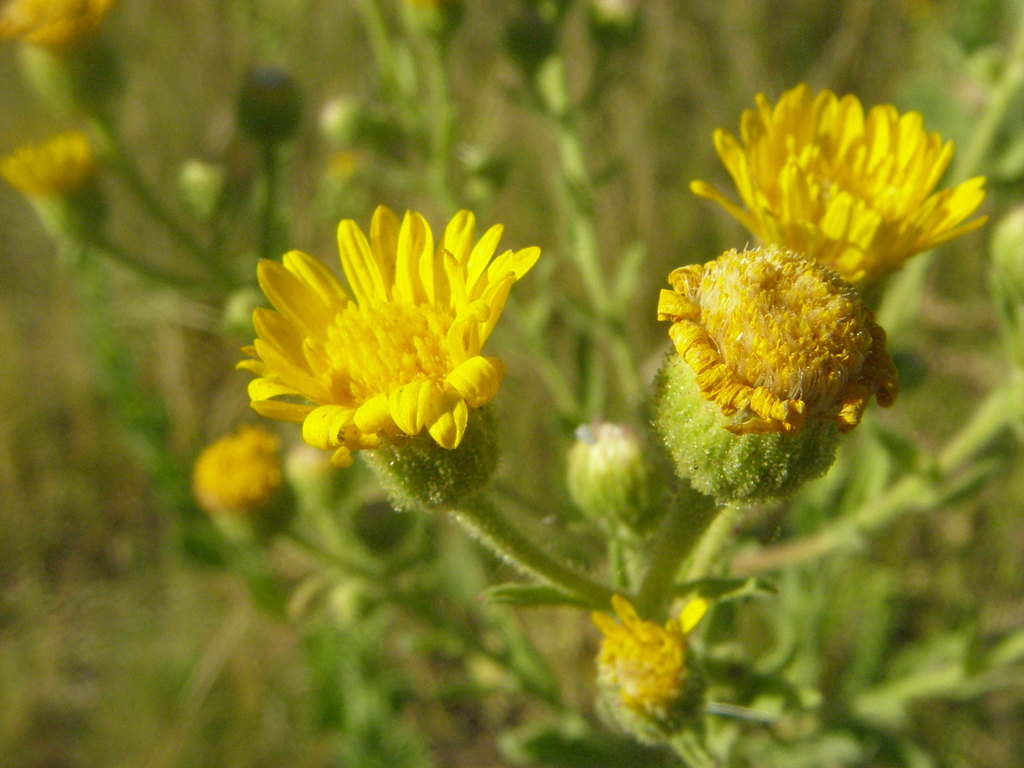
Camphorweed
Heterotheca subaxillaris
Heterotheca subaxillaris, camphorweed, is a North American species of flowering plant in the aster family, common name . It is widespread across much of the United States (from California to Massachusetts) as well as Mexico and Belize.
From the article Heterotheca subaxillaris on Wikipedia (CC BY-SA), quoted section by section
Description
Heterotheca subaxillaris is a perennial, aromatic herb up to 203 centimeters (80 inches or 6 2/3 feet) in height, often with several erect stems. The stems are hairy to bristly. The inflorescence contains 3-180 flower heads in a flat-topped array. Each head contains 15–35; yellow ray florets surrounding 25–60 disc florets at the center.
Range & habitat
It is widespread across much of the United States (from California to Massachusetts) as well as Mexico and Belize. H. subaxillaris may be found in habitats such as upper beaches, longleaf pine-wiregrass savannas, and pine-scrub oak sand ridges.
Wikipedia: “Distribution and habitat”
What it does
Sandy parts are common habitat for H. subaxillaris. They thrive in prairies with high sand content. Human-disturbed areas are also preferred, such as roadsides or waste areas. Camphorweed florets are adapted to suit generalist pollinators to an equal or greater extent than specialists, such as plasterer bees. Other bees are the most common of these generalist visitors, collecting nectar and pollen in exchange for transferal of male gametes between flowers. Larvae of insects such as brown flower moths and agromyzid flies feed on the stems and/or flower heads of the camphorweed.
Wikipedia: “Ecology”
Where it lives
Recorded sightings
—
geo-referenced records in GBIF, from museums, herbaria and field observers.
Drag the globe to turn it. Dots are where records exist, not a range map; darker means more records.
In the stacks
Searching the stacks…
Every page naming Heterotheca subaxillaris in the Biodiversity Heritage Library →
This page is assembled live from iNaturalist, GBIF, Wikipedia, the Source Library and the Internet Archive. It is not yet part of the hand-edited codex. iNaturalist taxon 77398.