- Plants
- ›Vascular Plants
- ›flowering plants
- ›Dicots
- ›Sunflowers, Bellflowers, Fanflowers, and Allies
- ›Sunflowers, Daisies, Asters, and Allies
- ›Asteroideae
- ›paper daisies
- ›cudweeds, everlastings, and pussytoes
- ›Helichrysum
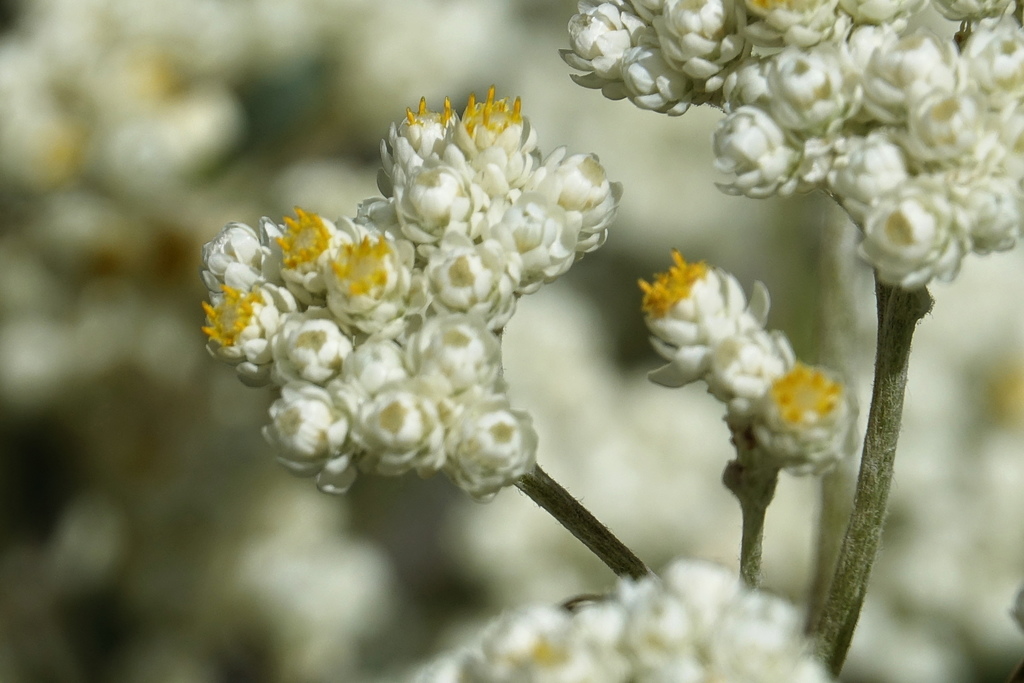
Licorice plant
Helichrysum petiolare
Helichrysum petiolare, the licorice-plant or liquorice plant, is a species of flowering plant in the family Asteraceae. It is a subshrub native to the Cape Provinces of South Africa — where it is known as impepho — and to Angola, Zambia, and Zimbabwe. It is naturalized in parts of Portugal and the United States. Growing to about 45 cm (18 in) high and 150 cm (59 in) broad, it is a trailing evergreen subshrub with furry grey-green leaves and small white flowers. Other common names include silver-bush everlastingflower, trailing dusty miller and kooigoed. The foliage has a faint licorice aroma, but Helichrysum petiolare is not closely related to true liquorice, Glycyrrhiza glabra, from which liquorice candy is made.
From the article Helichrysum petiolare on Wikipedia (CC BY-SA), quoted section by section
At the table
Its Afrikaans common name of kooigoed translates as "bedding stuff" and it is still used to provide a soft and aromatic mattress. The essential oil has been investigated for its anti-microbial, anti-oxidant, and anti-inflammatory properties. In South Africa it forms a component of traditional African medicine. The leaves and twigs are boiled and prepared as a sort of tea to soothe coughs and fever. The leaves are also applied to wounds to prevent infection, and are ceremonially burnt to produce a traditional incense.
Wikipedia: “Uses”
In medicine
In its ritual use, impepho is believed to invoke and placate the ancestors and to drive away malicious spirits; since these are regarded as common causes of illness in African traditional medicine, it is not surprising that imphepho is a very important medicinal plant in this traditional medical field. Apart from its traditional importance, imphepho has been widely researched in recent years. A great deal of scientific and anecdotal evidence seems to support the claims of traditional healers. Impepho is traditionally used as a wound dressing. The plant has proven anti-microbial properties and appears to work effectively as pain relief and as an anti-inflammatory, probably due to various volatile oils and flavanoids. Ash from burnt impepho and fresh or dried aerial parts of the plant are common ingredients in wound dressings; burning the plant causes chemical changes to the plant which affect its healing properties. The oils are said to be of great value in healing scars and acne, imphepho is believed to stimulate cellular regeneration. Impepho is boiled either in water or milk to make a tea, it is used internally to treat coughs, colds, fever, infection, menstrual pain, headaches, insomnia, hypertension and even allergies and diabetes. For pain relief and to treat coughs, colds, bronchitis and other chest infections the plant is burnt and the smoke inhaled. …
Wikipedia: “Medicinal uses”
How it is grown
It is cultivated for its foliage and as groundcover. This plant prefers sun to partial shade with well drained soil, being susceptible to root rot. It is hardy to zones 9–11, in mild or coastal areas where temperatures do not fall below freezing for extended periods. It requires a sheltered position in full sun. Numerous cultivars have been developed, of which the following have gained the Royal Horticultural Society's Award of Garden Merit:-
Wikipedia: “Cultivation”
Where it lives
Recorded sightings
—
geo-referenced records in GBIF, from museums, herbaria and field observers.
Drag the globe to turn it. Dots are where records exist, not a range map; darker means more records.
In the old herbals & bestiaries

Garden of Health (Hortus Sanitatis)
Jacob Meydenbach · 1491 · p.195

The Great Herbary with all the figures of the herbs
1532 · p.186

Book of Herbs
Hieronymus Bock (Tragus) · 1546 · p.738

Notable Commentaries on the History of Plants
Leonhart Fuchs · 1549 · p.224

Commentaries on the Six Books of Dioscorides
Pietro Andrea Mattioli · 1560 · p.469

A New Herbal, or History of Plants
Rembert Dodoens (trans. Henry Lyte) · 1578 · p.718

Bencao Gangmu, Volume Upper-Middle
李時珍 · 1596 · p.5

Illustrated Herbal Primer
Chen Jiamo (陳嘉謨) · 1628 · p.58

Illustrated Investigation of the Names and Realities of Plants, Volume 7
吳其濬 · 1848 · p.14

Collected Illustrations of the Three Realms: Plants
王圻, 王思義 · 1607 · p.12
In the stacks
Searching the stacks…
Every page naming Helichrysum petiolare in the Biodiversity Heritage Library →
This page is assembled live from iNaturalist, GBIF, Wikipedia, the Source Library and the Internet Archive. It is not yet part of the hand-edited codex. iNaturalist taxon 77361.