- Plants
- ›Vascular Plants
- ›flowering plants
- ›Dicots
- ›Sunflowers, Bellflowers, Fanflowers, and Allies
- ›Sunflowers, Daisies, Asters, and Allies
- ›Asteroideae
- ›Helenieae
- ›Gaillardiinae
- ›Helenium
- ›Helenium
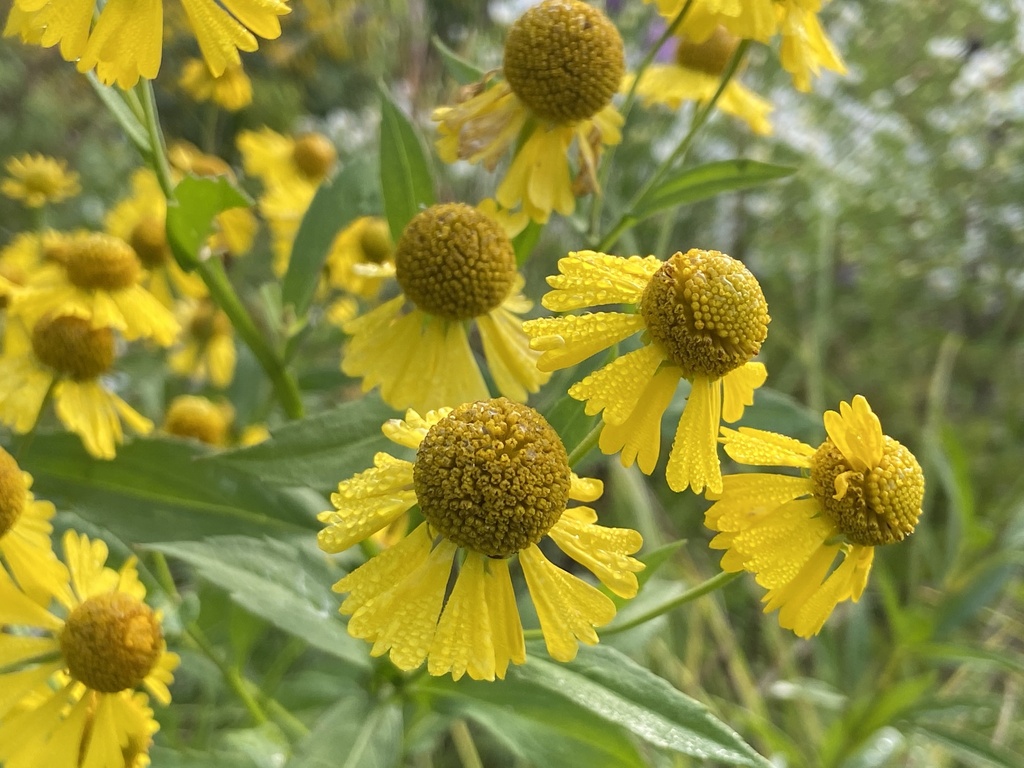
common sneezeweed
Helenium autumnale
Helenium autumnale is a North American species of flowering plants in the family Asteraceae. Common names include common sneezeweed and large-flowered sneezeweed.
From the article Helenium autumnale on Wikipedia (CC BY-SA), quoted section by section
Description
Common sneezeweed is a perennial herb up to 130 cm (51+1⁄3 in; 4+1⁄3 ft) tall. In late summer and fall, one plant can produce as many as 100 yellow flower heads in a branching array. Each head has yellow 11–21 ray florets surrounding sometimes as many as 800 yellow disc florets. Leaves are dark green, alternate, and lance-shaped. The Latin specific epithet autumnale is in reference to the plant's autumn flowering.
Range & habitat
This plant is widespread across much of the United States and Canada, from Northwest Territories as far south as far northern California, Arizona, Louisiana, and Florida. It has not been found in southern or central California, nor in the four Atlantic Provinces of Canada. It grows in moist, open areas along streams and ponds as well as wet meadows.
Wikipedia: “Distribution and habitat”
What it does
The flowers attract various pollinators, including bees, butterflies, and wasps. Because the plant is pollinated by insects, not wind pollinated, it does not cause seasonal allergies or sneezing, despite its common name. The plant is poisonous to ruminants.
Wikipedia: “Ecology”
How it is grown
Common sneezeweed is cultivated as a garden perennial. There are multiple named varieties varying in color and height. 'Pumilum Magnificum' is a yellow variety about two feet tall. 'Bruno', a reddish-brown cultivar, 'Kupfersprudel', which is yellow/orange, and 'Butterpat', which is golden, all grow 3 to 3.5 feet (91 to 107 centimetres) tall. 'Chippersfield Orange' is up to 0.91 metres (3 ft) tall and is orange streaked with gold.
Wikipedia: “Cultivation”
Where it lives
Recorded sightings
—
geo-referenced records in GBIF, from museums, herbaria and field observers.
Drag the globe to turn it. Dots are where records exist, not a range map; darker means more records.
In the stacks
Searching the stacks…
Every page naming Helenium autumnale in the Biodiversity Heritage Library →
This page is assembled live from iNaturalist, GBIF, Wikipedia, the Source Library and the Internet Archive. It is not yet part of the hand-edited codex. iNaturalist taxon 77349.