- Plants
- ›Vascular Plants
- ›flowering plants
- ›Dicots
- ›Sunflowers, Bellflowers, Fanflowers, and Allies
- ›Sunflowers, Daisies, Asters, and Allies
- ›Asteroideae
- ›asters and allies
- ›Gutierreziinae
- ›Gutierrezia
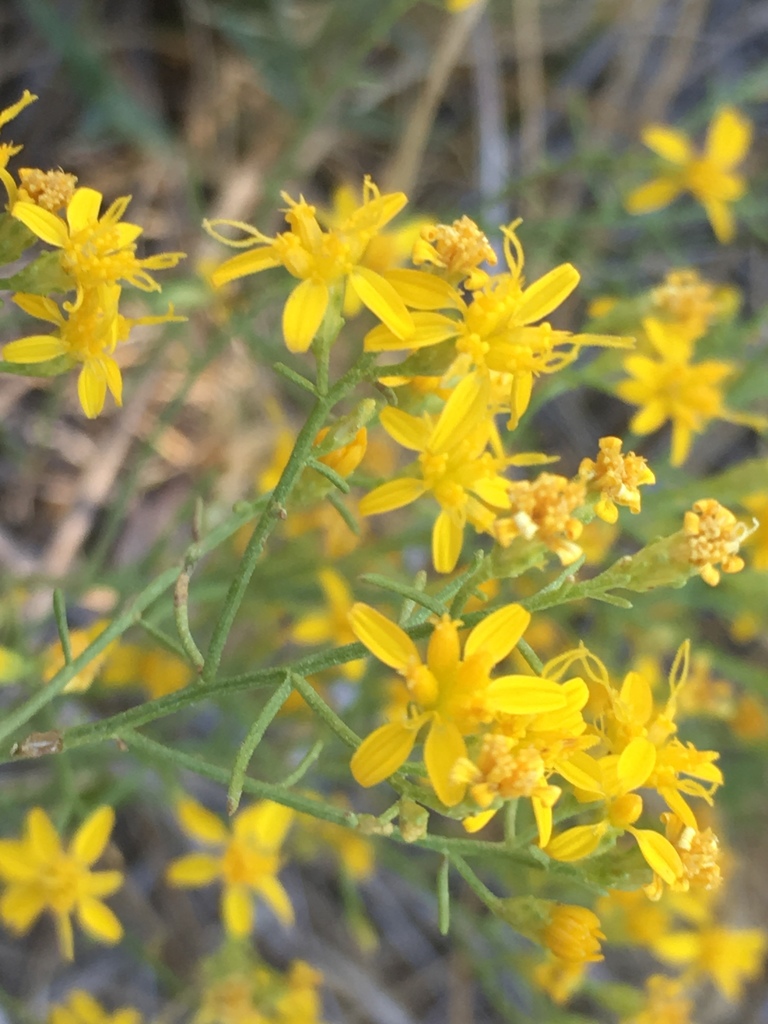
Broom Snakeweed
Gutierrezia sarothrae
Gutierrezia sarothrae is a species of flowering plant in the family Asteraceae known by the common names broom snakeweed, broomweed, snakeweed, and matchweed. It is a subshrub native to much of the western half of North America, from western Canada to northern Mexico, and can be found in a number of arid, grassland, and mountain habitats. It can be toxic to livestock in large quantities, due mainly to the presence of saponins.
The species was utilized by various Native American groups for medicinal and other purposes.
From the article Gutierrezia sarothrae on Wikipedia (CC BY-SA), quoted section by section
Description
Gutierrezia sarothrae is a perennial subshrub that is typically 10 to 60 centimeters (4 to 24 in) in height, but can sometimes reach as much as 100 cm (39 in). Its stems are brown at their base and are green to tan in color higher up on the plant. They branch freely from the woody caudex at the base forming a rounded shape. The stems die back during dormancy, giving the plant its broom-like appearance. They range from smooth to having some short hairs, and may be resinous and therefore sticky when touched. As the stems are about the same length, this causes the plant to often appear domed or fan-shaped when flowering. The leaves are alternate and linear, and 5 to 63 millimetres (1⁄4 to 2+1⁄2 in) long and 1 to 3 mm (1⁄16 to 1⁄8 in) wide. The lower leaves are usually shed before the plant flowers. During its first year of growth, the plant produces a long, woody taproot, and numerous lateral roots as the plant matures.
Dense clusters of 3–7 small, yellow ray and 2–6 tiny disk flowers form in clusters, 3–6 mm (1⁄8–1⁄4 in) in length, at the end of the stems from mid-July to September. The flowers are pollinated by various insects, resulting in an oval fruit covered with chaffy scales. The plant reproduces from seeds, which are light, densely hairy, and wind-dispersed. …
Range & habitat
A native North American plant, G. sarothrae is found throughout west-central Canada (the Prairie Provinces, the western and central United States (the Great Plains and regions to the west), and northern Mexico as far south as Zacatecas and Baja California Sur. Due to its efficient water use and drought tolerance, it is able to survive in arid and semi-arid sites, such as rocky plains, dry foothills, ridgetops, mountain slopes, and in semi-desert valleys. The species is very adaptable, and can be found in a variety of ecoregions, including pinyon–juniper woodlands, desert shrublands, and sagebrush-grasslands. It can survive in a wide variety of soil types with full sun and good drainage, but growth is reportedly best in clay loams of alluvial slopes, and shallow, rocky, or sandy soil, and is poor in saline or alkaline soils.
Wikipedia: “Distribution and habitat”
What it does
G. sarothrae is a poor quality browse for most large ungulates. It is important to pronghorn antelope in some areas, especially during spring and summer, and can comprise up to 28% of the pronghorn antelope's diet. The plant is of little value to cattle and horses, but can be a fair quality winter browse for domestic sheep when there is little access to green forage. Under natural conditions, G. sarothrae quickly invades disturbed areas, and can minimize soil erosion; for example, it is reportedly able to stabilize loose windblown soils in mesquite sand dunes. It has been rated by the U.S. Fish and Wildlife Service as low to medium for erosion control potential, low for short-term revegetation potential, and low to medium for long-term revegetation potential.
Management. G. sarothrae is one of the most widespread and damaging rangeland weeds, and can displace desirable vegetation if not properly managed. This displacement may be caused by livestock grazing, drought, or fire suppression. The plant quickly invades overgrazed rangeland, as cattle often leave it untouched while overgrazing grasses. Because of this, an abundance of G. sarothrae is considered to be an indicator of rangeland deterioration. It is a fire-intolerant species, and is severely harmed or killed by fire; immediately after a fire it may be completely removed from an area. …
Wikipedia: “Ecology”
At the table
G. sarothrae was used by the Native Americans of the Great Plains for various purposes. The Comanche bound the stems together to make brooms. The Blackfoot used the roots in an herbal steam as a treatment for respiratory ailments. A decoction of the plant was used by the Lakota to treat colds, coughs, and dizziness, while a concentrate made from the flowers was used by the Dakota as a laxative for horses. The Navajo rubbed the ashes of the plant on their bodies to treat headaches and dizziness, and also applied the chewed plant to wounds, snakebites, and areas swollen by insect bites and stings. The Zuni used an infusion of the blossoms as a diuretic and to "make one strong in the limbs and muscles", and an infusion of the whole plant was used topically for muscle aches.
Cultivation. Broom snakeweed is used as a garden plant in xeriscaping for its showy late season blooms. Plants are propagated by seed and do not require cold stratification. Due to being unpalatable to herbivores it is resistant to damage by deer.
Wikipedia: “Uses”
Toxicity
G. sarothrae can be toxic to domestic sheep, goats, and cattle when consumed in large quantities, although domestic goats are moderately resistant to its effects. Its toxicity is due primarily to saponins, which can cause illness, death, or abortion, as well as to alkaloids, terpenes, and flavonols in the plant. The species is also a facultative absorber of selenium, which can cause illness or death in large amounts. As little as 9 kilograms (20 pounds) of fresh G. sarothrae consumed by cattle in seven days can cause miscarriages, and in cattle, sheep, and goats consuming ten to 20% of their body weight in two weeks can cause death. Toxicity is generally higher during periods of rapid growth, such as early leaf development, and when grown on sandy rather than on calcareous or clay soils.
In human culture
The genus name, Gutierrezia, was selected by Lagasca, but he did not specify who was being honored. According to research by Kathleen H. Keeler, a likely person associated with the Royal Botanical Garden of Madrid during the time period was Pedro Gutiérrez Bueno (1745-1826). The species name, sarothrae, is related to sarothron, "broom", and sarein, "to sweep", describing the numerous herbaceous branches of this plant. The common name matchweed refers to the appearance of the stems and flower heads to matches, whereas broomweed refers to its use as a broom and snakeweed refers to its medicinal use to treat snakebites. A related name, sheep weed, is for its folk use as a treatment for sheep bitten by rattlesnakes. It is likewise known as yerba de la vibora, rattlesnake weed, by Spanish speakers. It has also been called turpentine weed due to its odor. An occasional common name for the species is golden broomweed.
Wikipedia: “Etymology”
Where it lives
Recorded sightings
—
geo-referenced records in GBIF, from museums, herbaria and field observers.
Drag the globe to turn it. Dots are where records exist, not a range map; darker means more records.
In the stacks
Searching the stacks…
Every page naming Gutierrezia sarothrae in the Biodiversity Heritage Library →
This page is assembled live from iNaturalist, GBIF, Wikipedia, the Source Library and the Internet Archive. It is not yet part of the hand-edited codex. iNaturalist taxon 77312.