- Plants
- ›Vascular Plants
- ›flowering plants
- ›Dicots
- ›Sunflowers, Bellflowers, Fanflowers, and Allies
- ›Sunflowers, Daisies, Asters, and Allies
- ›Asteroideae
- ›asters and allies
- ›Pentachaetinae
- ›Ericameria
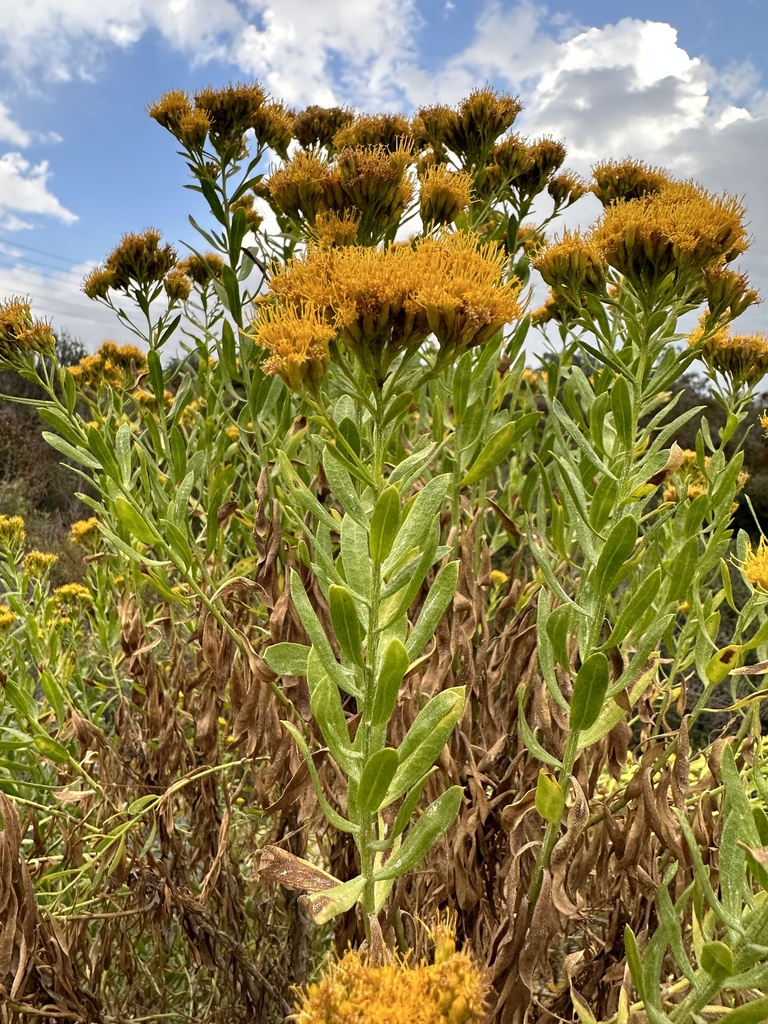
Parish's Rabbitbrush
Ericameria parishii
Ericameria parishii, or Parish's rabbitbrush, is a western North American species of flowering plants in the family Asteraceae.
From the article Ericameria parishii on Wikipedia (CC BY-SA), quoted section by section
Description
Ericameria parishii is a shrub or small tree up to 12 feet (3.7 m) tall. It has lance-shaped leaves up to 2 inches (5 cm) long. One plant can produce many small flower heads, each with up to 12 golden yellow disc florets but no ray florets.
Varieties. Varieties include:
Ericameria parishii var. parishii - northern Baja California; California in the mountains from San Diego County north to eastern Ventura County and southwestern San Bernardino County Ericameria parishii var. peninsularis (Moran) G.L.Nesom — Peninsular Ranges of northern Baja California state.
Range & habitat
The plant is native to southern Southern California in the United States and to the State of Baja California in Mexico. It is found in the San Gabriel Mountains, Verdugo Mountains, eastern Santa Monica Mountains, and San Bernardino Mountains of the Transverse Ranges; and in the Peninsular Ranges.
Wikipedia: “Distribution”
Where it lives
Recorded sightings
—
geo-referenced records in GBIF, from museums, herbaria and field observers.
Drag the globe to turn it. Dots are where records exist, not a range map; darker means more records.
In the stacks
Searching the stacks…
Every page naming Ericameria parishii in the Biodiversity Heritage Library →
This page is assembled live from iNaturalist, GBIF, Wikipedia, the Source Library and the Internet Archive. It is not yet part of the hand-edited codex. iNaturalist taxon 76890.