- Plants
- ›Vascular Plants
- ›flowering plants
- ›monocots
- ›grasses, sedges, cattails, and allies
- ›grasses
- ›Chloridoideae
- ›Eragrostideae
- ›Lovegrasses and Allies
- ›Eragrostis
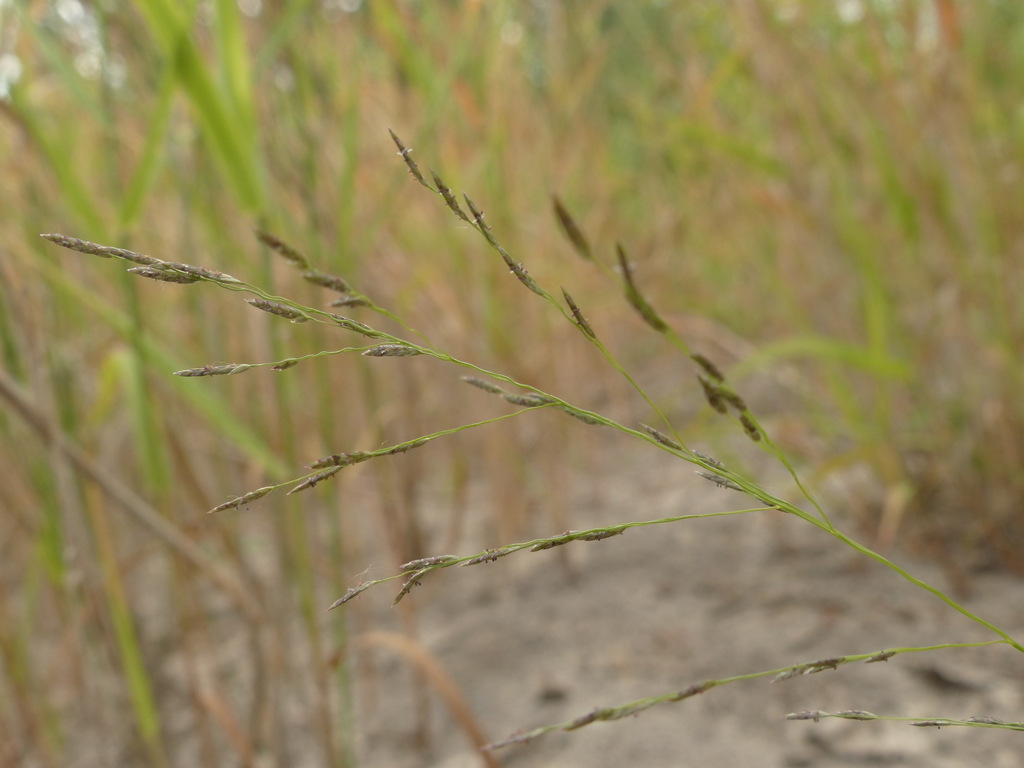
carolina lovegrass
Eragrostis pectinacea
Eragrostis pectinacea is a species of grass known by the common names tufted lovegrass and Carolina lovegrass. This plant is native to the Americas from Canada to Argentina. It is widespread, growing in most open spaces at varying elevations and habitats, including in disturbed areas and roadsides.
From the article Eragrostis pectinacea on Wikipedia (CC BY-SA), quoted section by section
Description
Eragrostis pectinacea is an annual tuft-forming bunchgrass, reaching maximum heights of anywhere from 10 to 80 centimeters. It is mostly hairless except for a fringe of hairs near where the leaf blade meets the sheath. The inflorescence is open with spreading branches holding yellowish to purplish spikelets, each just under centimeter long. Each narrow spikelet has up to 15 or 20 tiny florets.
Range & habitat
Eragrostis pectinacea is widely distributed in the Americas, from Canada through the United States to Mexico in northern America, in Central America and the Caribbean, and in parts of South America. It has been introduced into Europe and further south than its native range in South America, in northeast Argentina and Uruguay.
Wikipedia: “Distribution”
Where it lives
Recorded sightings
—
geo-referenced records in GBIF, from museums, herbaria and field observers.
Drag the globe to turn it. Dots are where records exist, not a range map; darker means more records.
In the stacks
Searching the stacks…
Every page naming Eragrostis pectinacea in the Biodiversity Heritage Library →
This page is assembled live from iNaturalist, GBIF, Wikipedia, the Source Library and the Internet Archive. It is not yet part of the hand-edited codex. iNaturalist taxon 76856.