- Plants
- ›Vascular Plants
- ›flowering plants
- ›Dicots
- ›Sunflowers, Bellflowers, Fanflowers, and Allies
- ›Sunflowers, Daisies, Asters, and Allies
- ›Asteroideae
- ›Sunflowers and Allies
- ›Ecliptinae
- ›Eclipta
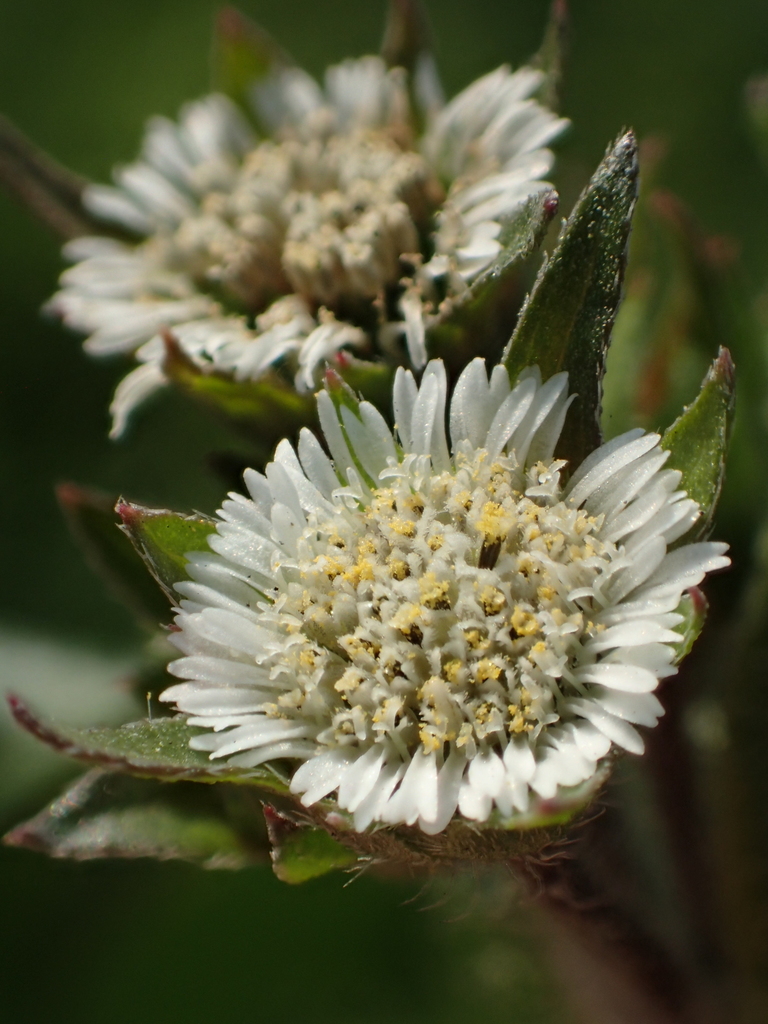
False Daisy
Eclipta prostrata
Eclipta prostrata, the false daisy or tattoo plant, is a species of plant in the family Asteraceae. It is widespread across much of the world.
This species is native to North and South America. It also grows commonly in moist places in warm temperate to tropical areas worldwide. It can be found in habitats such as on marsh edges, along lake shores and river banks, and in brackish marshes and cypress depression swamps. It is considered to be a weed.
From the article Eclipta prostrata on Wikipedia (CC BY-SA), quoted section by section
Description
This plant has fibrous cylindrical, grayish roots from a shallow taproot. Solid, circular, purplish stems with white fine hairs, and grows between 0.3 and 1.5 m in height. Leaves arranged in opposite pairs, hairy in two-sided, lanceolate, serrated 2–12.5 cm long, 5–35 mm wide. The solitary perfect flower heads are 6–8 mm (0.24–0.31 in) in diameter, with white florets. The bumpy achenes are compressed and narrowly winged with the papus attached at the apex, as well as an inconspicuous tuft of small trichomes.
At the table
The plant has traditional uses in Ayurveda. In Hindi speaking regions of India, it is known as bhangra or bhringaraj. Wedelia calendulacea is known by the same names, so the white-flowered E. alba is called white bhangra and the yellow-flowered W. calendulacea is called yellow bhangra. In Southeast Asia, the dried whole plant is used in traditional medicine, although there is no high-quality clinical research to indicate such uses are effective. The Balinese cook it as a vegetable, the Javanese consume this herb (orang-aring or urang-aring) as part of their lalap, they also infuse it with coconut oil as a kind of hair oil popular until the 1970s Its leaves are extracted as a black hair dye, and in tattooing.
Wikipedia: “Traditional uses”
In medicine
Eclipta prostrata contains various phytochemicals, such as coumestans, polypeptides, polyacetylenes, thiophene derivatives, steroids, sterols, triterpenes, and flavonoids.
Wikipedia: “Phytochemistry”
Where it lives
Recorded sightings
—
geo-referenced records in GBIF, from museums, herbaria and field observers.
Drag the globe to turn it. Dots are where records exist, not a range map; darker means more records.
In the old herbals & bestiaries


In the stacks
Searching the stacks…
Every page naming Eclipta prostrata in the Biodiversity Heritage Library →
This page is assembled live from iNaturalist, GBIF, Wikipedia, the Source Library and the Internet Archive. It is not yet part of the hand-edited codex. iNaturalist taxon 76765.