On eBird ↗
Levaillant's Cisticola
Live sightings near you, the range map, bar charts of when it is seen, and Macaulay Library photos and recordings.
Levaillant's Cisticola
Cisticola tinniens
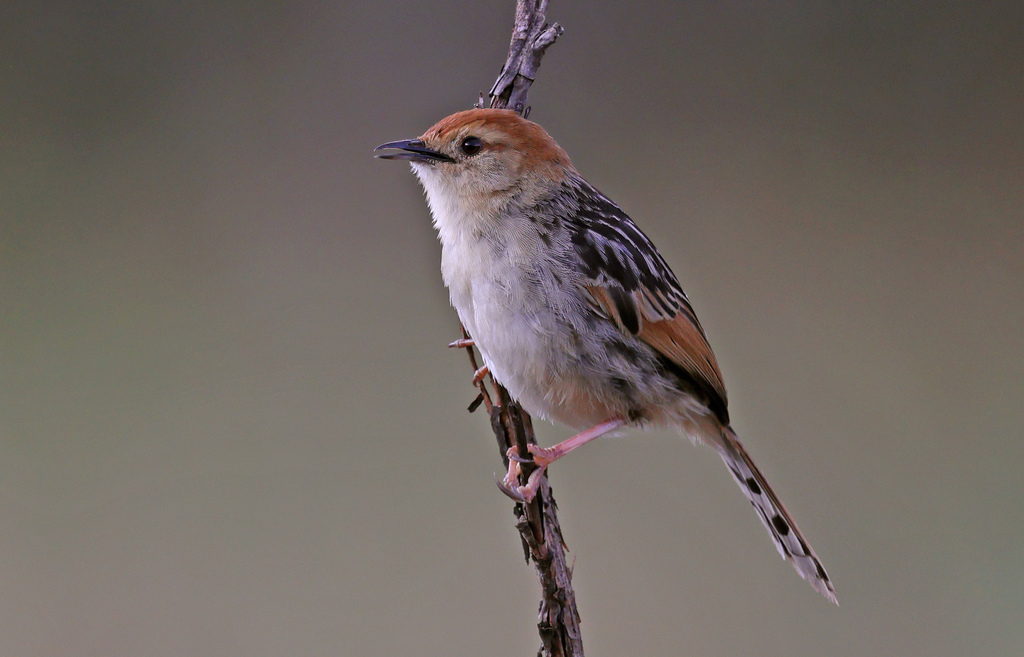
Levaillant's cisticola (Cisticola tinniens), also known as the tinkling cisticola, is a small passerine bird which is native to marshlands in the uplands of Africa, southwards of the equator.
From the article Levaillant's cisticola on Wikipedia (CC BY-SA), quoted section by section
Description
Levaillant's cisticola is a small, 12–15 cm long, dull-coloured bird with a longish tail and a reddish cap. The upperparts of the breeding adult are grey, heavily streaked with black, and with a rufous panel in the folded wing. The supercilium, face and underparts are buffy white and the tail is russet brown. The short straight bill is blackish-brown with a pinkish base, and the feet and legs are pinkish-brown. The eye is light brown. Non-breeding adults are browner-backed, and juvenile birds have yellower underparts. The calls include a musical chrip-trrrup-trreee, a wailing tee tee tee and harsh alarm notes.
Range & habitat
The cisticola is a resident breeder in eastern Africa from Kenya to eastern South Africa. It is common in reedbeds, sedges, rank grass, and similar wet habitats usually near rivers or dams.
Wikipedia: “Distribution and habitat”
What it does
Levaillant's cisticola is usually seen in pairs, singly, or in small family parties. Flitting through the grass as it forages for small insects. It is vocal and conspicuous, perching on the top of tall grass stems and reeds and making its alarm call.
Breeding. The cisticola builds a ball-shaped nest with a side entrance from dry grass, cobwebs and felted plant down. It is usually placed in a tuft of grass or weeds, which are standing in, or hanging over water. Nesting occurs from August to October.
Wikipedia: “Behaviour”
Listen
Looking for field recordings…
Where it lives
Recorded sightings
—
geo-referenced records in GBIF, from museums, herbaria and field observers.
Drag the globe to turn it. Dots are where records exist, not a range map; darker means more records.
In the stacks
Searching the stacks…
Every page naming Cisticola tinniens in the Biodiversity Heritage Library →
This page is assembled live from iNaturalist, GBIF, Wikipedia, the Source Library and the Internet Archive. It is not yet part of the hand-edited codex. iNaturalist taxon 7660.