- Animals
- ›Chordates
- ›Vertebrates
- ›Mammals
- ›Therians
- ›Placental Mammals
- ›Ungulates, Carnivorans, and Allies
- ›Bats
- ›Yinpterochiroptera
- ›Pteropodoidea
- ›Old World Fruit Bats
- ›Flying-foxes, Monkey-faced Bats and allies
- ›Flying-foxes and allies
- ›Pteropus
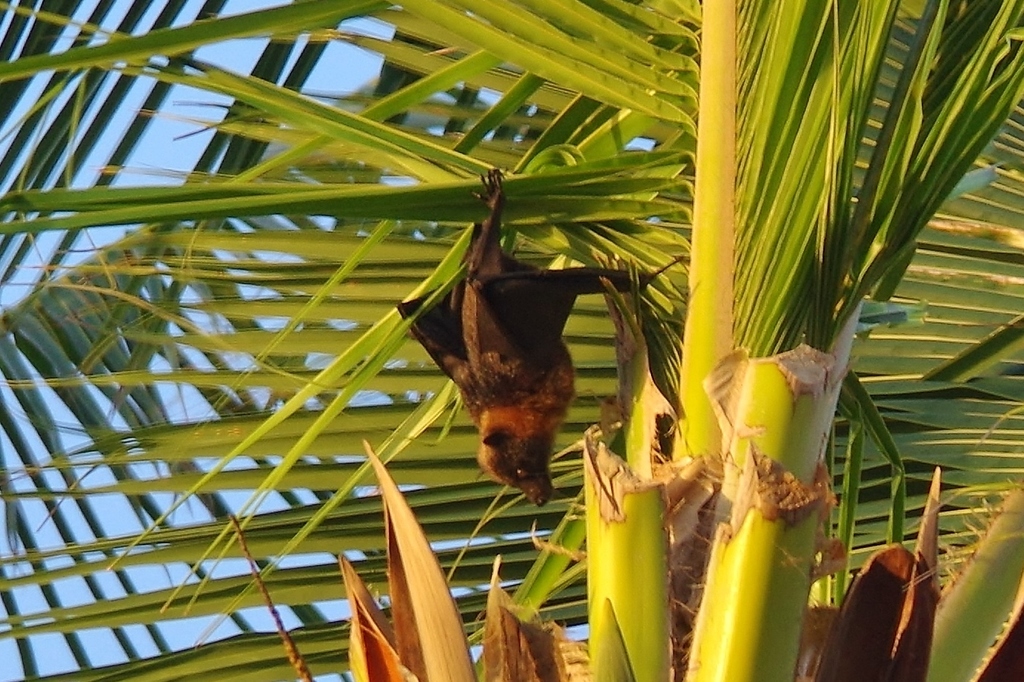
Chuuk Flying-fox
Pteropus pelagicus
Pteropus pelagicus is a species of fruit bat in the family Pteropodidae. It includes two subspecies that were formerly recognized as full species— Pteropus insularis (Chuuk flying fox) and Pteropus phaeocephalus (Mortlock flying fox). It is endemic to Micronesia. It is threatened by habitat loss.
From the article Pteropus pelagicus on Wikipedia (CC BY-SA), quoted section by section
Description
The heads of the adults are creamy white, buff, or tawny in adults. The heads of the juveniles are grayish brown, lacking red or yellow highlights. The back and rump are dark brown, with lighter hairs interspersed throughout. Their faces are dark brown to almost black, while the tops of the heads are brown or grayish brown. Their throats and chests are light brown or reddish brown, while their lower abdomen is darker brown. Many individuals have a large white patch on their bellies. Individual hairs are 14.7–16 mm (0.58–0.63 in) long. P. p. pelagicus has more contrast in its coloration than P. p. insularis, and they also tend to have larger abdominal white patches. Their forearms are 101–108.7 mm (3.98–4.28 in) long. They weigh 148–190 g (5.2–6.7 oz).
Range & habitat
P. pelagicus is located on the Nomoi Islands, Chuuk Lagoon, and Namonuito Atoll. All three locations are within the Federated States of Micronesia. P. p. pelagicus is found on the Nomoi islands, while P. p. insularis is located on the other two sites. The range of the two subspecies is separated by 171 km (106 mi). The entire range of P. p. pelagicus is only 11.9 km2 (4.6 mi2), with 75% of the population occurring on Satawan and Lukunor atolls.
Wikipedia: “Range and habitat”
In human culture
The species was described by German naturalist Heinrich von Kittlitz in 1836. He gave it the species name pelagicus from Ancient Greek πελαγικός 'of the open sea'. In 2013, a study was published that challenged the status of the Chuuk flying fox and the Mortlock flying fox as species. The study stated that the Chuuk flying fox was not significantly different from the Mortlock flying fox, and that they represent two subspecies of the same species, which should be called Pteropus pelagicus. They proposed that the Chuuk flying fox be referred to as P. p. insularis, and the Mortlock flying fox be referred to as P. p. pelagicus. The study also concluded that the closest relative of P. pelagicus is the Guam flying fox, based on morphology. A 2014 study that used genetics also concluded that the Guam flying fox was the sister taxon to P. pelagicus. There are currently two recognized subspecies of Pteropus pelagicus, both of which were formerly recognized as distinct species.
P. p. pelagicus Kittlitz, 1836 (Nomoi Islands) P. p. insularis Hombron and Jacquinot, 1842 (Islands of Chuuk Lagoon and Namonuito Atoll) The authors of the 2013 study suggested that the common name of Chuuk flying fox be retained to refer to Pteropus pelagicus. …
Wikipedia: “Etymology and taxonomy”
Listen
Looking for field recordings…
Where it lives
Recorded sightings
—
geo-referenced records in GBIF, from museums, herbaria and field observers.
Drag the globe to turn it. Dots are where records exist, not a range map; darker means more records.
In the stacks
Searching the stacks…
Every page naming Pteropus pelagicus in the Biodiversity Heritage Library →
This page is assembled live from iNaturalist, GBIF, Wikipedia, the Source Library and the Internet Archive. It is not yet part of the hand-edited codex. iNaturalist taxon 765574.