- Plants
- ›Vascular Plants
- ›flowering plants
- ›Dicots
- ›Sunflowers, Bellflowers, Fanflowers, and Allies
- ›Sunflowers, Daisies, Asters, and Allies
- ›chicories, dandelions, and allies
- ›Lettuce, Chicory, Dandelion and Salsify Tribe
- ›dandelions, hawksbeards, and rattlesnake roots
- ›Crepis
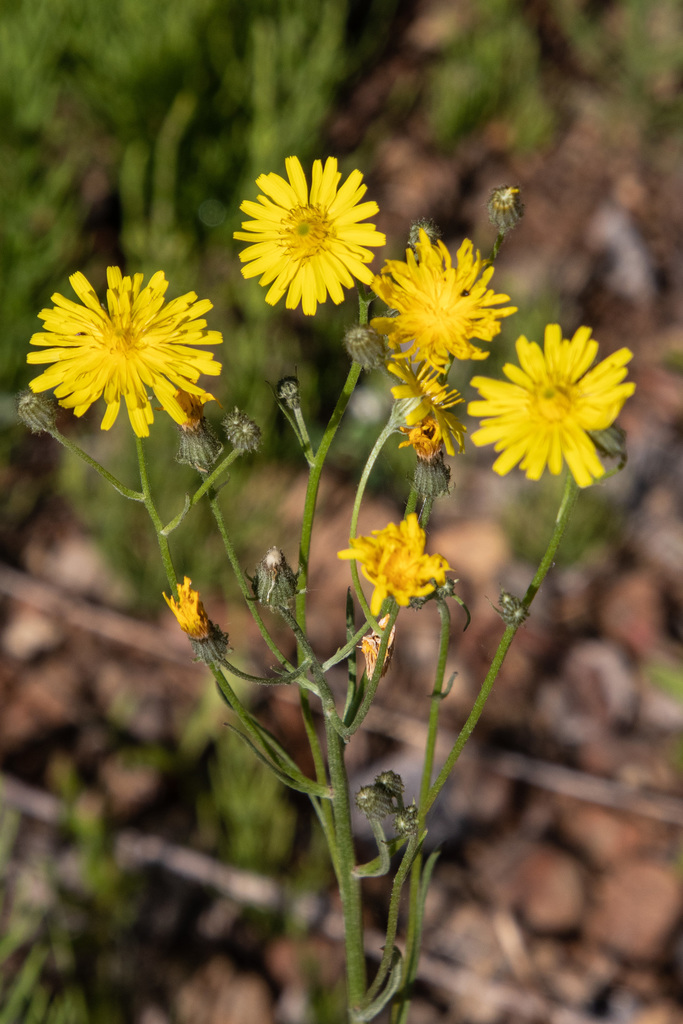
narrow-leaved hawksbeard
Crepis tectorum
Crepis tectorum, commonly referred to as the narrowleaf hawksbeard or narrow-leaved hawk's-beard, is an annual or winter annual plant between 30 and 100 centimetres in height. Originating in Siberia before being introduced to Canada in 1890, the narrowleaf hawksbeard is an invasive species. It has one branched, hairless and leafy stem during maturity, and yellow leaves which are less than 0.5 inches (13 mm) wide and arranged in an alternate manner.
The narrowleaf hawksbeard's scientific name 'Crepis tectorum' originates from the Greek word krepis meaning sandal or slipper, which refers to the shape of the seed.
From the article Crepis tectorum on Wikipedia (CC BY-SA), quoted section by section
Description
Individuals of this species are usually approximately 3 feet (0.91 m) tall, single-stemmed, yellow petals on flowers, and produce 30–70 yellow ray florets.
Wikipedia: “Morphology”
Range & habitat
Crepis tectorum is native to most of Europe, as well as northern and central Asia (Russia, Kazakhstan, Mongolia, and parts of China (Inner Mongolia, Heilongjiang, Xinjiang)). The species is now naturalized in much of Canada, Greenland, and northern parts of the United States including Alaska. Narrowleaf hawksbeard is now commonly found in the parkland zone of Alberta, Saskatchewan and Manitoba. Crepis tectorum is found in waste areas, conventional tillage, reduced tillage, forage and hay fields, and roadsides.
Wikipedia: “Distribution”
What it does
Crepis tectorum is an annual weed that grows in cultivated fields and roadsides. It is very invasive so it can take over a field and lead to serious ecological impacts for the surrounding. Crepis tectorum is able to grow in calcareous soil as well as soil that does not contain lime. However, it grows best in nutrient rich soils containing clays and loams. It also thrives in dry, coarse soil. It grows with other species in the wild however, it becomes infectious if not controlled by humans. It can easily be removed by hand, although it can be controlled better by chemical means. The presence of the narrowleaf hawksbeard is damaging to the soil and other species of plants nearby as it generally takes over the area. The temperature range for germination is 2–4 °C (36–39 °F), with an optimum depth of 3–4 cm (1.2–1.6 in).
Wikipedia: “Habitat and ecology”
Where it lives
Recorded sightings
—
geo-referenced records in GBIF, from museums, herbaria and field observers.
Drag the globe to turn it. Dots are where records exist, not a range map; darker means more records.
In the stacks
Searching the stacks…
Every page naming Crepis tectorum in the Biodiversity Heritage Library →
This page is assembled live from iNaturalist, GBIF, Wikipedia, the Source Library and the Internet Archive. It is not yet part of the hand-edited codex. iNaturalist taxon 76480.