- Plants
- ›Vascular Plants
- ›flowering plants
- ›Dicots
- ›Sunflowers, Bellflowers, Fanflowers, and Allies
- ›Sunflowers, Daisies, Asters, and Allies
- ›Asteroideae
- ›Coreopsis and allies
- ›Coreopsis
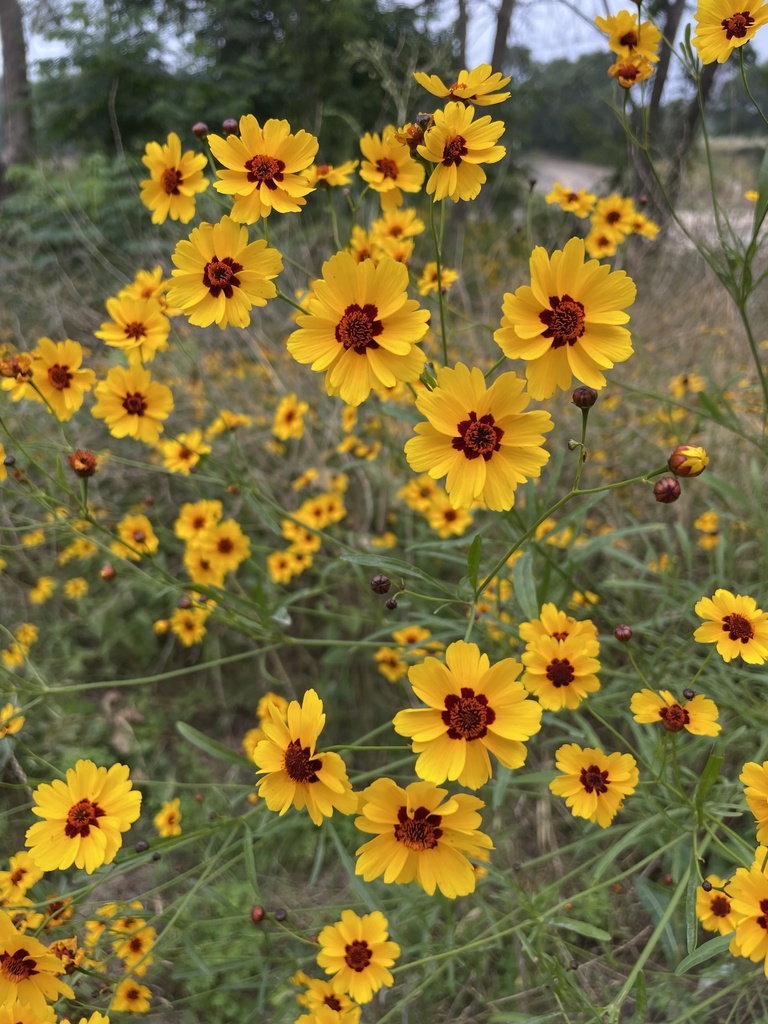
plains coreopsis
Coreopsis tinctoria
Coreopsis tinctoria, commonly known as plains coreopsis, garden tickseed, golden tickseed, or calliopsis, is an annual forb in the Asteraceae family. The species is common in Canada (from Quebec to British Columbia), northeast Mexico (Coahuila, Nuevo León, Tamaulipas), and most of the United States, especially the Great Plains and Southern States. It has been introduced and naturalized into many parts of Europe and Asia.
It often grows in disturbed areas such as roadsides and cultivated fields.
From the article Plains coreopsis on Wikipedia (CC BY-SA), quoted section by section
Description
Growing quickly, Coreopsis tinctoria attains heights of 30–100 cm (12–40 in). Its leaves are pinnately-divided, glabrous and tend to thin at the top of the plant where numerous 25–40 mm (1–1+1⁄2 in) flower heads sit atop slender stems. Flower heads are brilliant yellow with maroon or brown disc florets of various sizes. Flowering typically occurs in mid-summer. The small, slender seeds germinate in fall (overwintering as a low rosette) or early spring. Ray florets have notched tips.
Range & habitat
Coreopsis tinctoria is native to most of the central United States. Within North America, it is thought to be introduced in the western and eastern United States and eastern Canada. The species is widely grown residentially and commercially, and has become naturalized in China, and has been recorded as introduced into much of Europe, parts of Asia, and in Mozambique.
Habitat. In its native habitat, this species typically prefers to grow in moist, sandy (or clay) soil in habitats such as prairies, savannas, and plains at elevations of 0–2,000 m (0–6,562 ft) above sea level. Plants will readily grow in human-disturbed areas such as roadsides, ditches, and agricultural pastures.
Wikipedia: “Distribution and habitat”
What it does
Coreopsis tinctoria is pollinated by a wide variety of insects, including long-tongued bees, short-tongued bees, wasps, flies, butterflies and beetles. Coreopsis tinctoria serves as a larval host plant for various insects, such as Synchlora aerata, Tornos scolopacinarius and Calligrapha californica.
Wikipedia: “Ecology”
At the table
The Zuni people traditionally use the blossoms of the tinctoria variety to make a mahogany red dye for yarn, and, until the introduction of coffee by traders, to make a hot beverage. Women also used an infusion of the whole plant of this variety, except for the root, if they desired a female child.
Cultivation. Plains coreopsis is cultivated as an ornamental plant for gardens, and as a native plant for wildlife gardens and natural landscaping. It grows well in many types of soil, but seems to prefer sandy or well-drained loam soils. Although somewhat drought-tolerant, naturally growing plants are usually found in areas with regular rainfall. Preferring full sun, it will also grow in partial shade. Though plains coreopsis is often described as an annual some plants will behave more like biannuals growing larger and blooming more in their second year.
Cultivars Because of its easy growing habits and the bright, showy flowers of cultivars such as 'Roulette' (tiger stripes of gold on a deep mahogany ground), plains coreopsis is increasingly used for landscape beautification and in flower gardens.
Wikipedia: “Uses”
In human culture
The specific epithet tinctoria refers to the plant's use in dyeing. In English, this species is commonly known as plains coreopsis, garden coreopsis, golden coreopsis, and calliopsis. In French, this species is known as Coréopsis des teinturiers.
Wikipedia: “Etymology”
Where it lives
Recorded sightings
—
geo-referenced records in GBIF, from museums, herbaria and field observers.
Drag the globe to turn it. Dots are where records exist, not a range map; darker means more records.
In the stacks
Searching the stacks…
Every page naming Coreopsis tinctoria in the Biodiversity Heritage Library →
This page is assembled live from iNaturalist, GBIF, Wikipedia, the Source Library and the Internet Archive. It is not yet part of the hand-edited codex. iNaturalist taxon 76445.