On eBird ↗
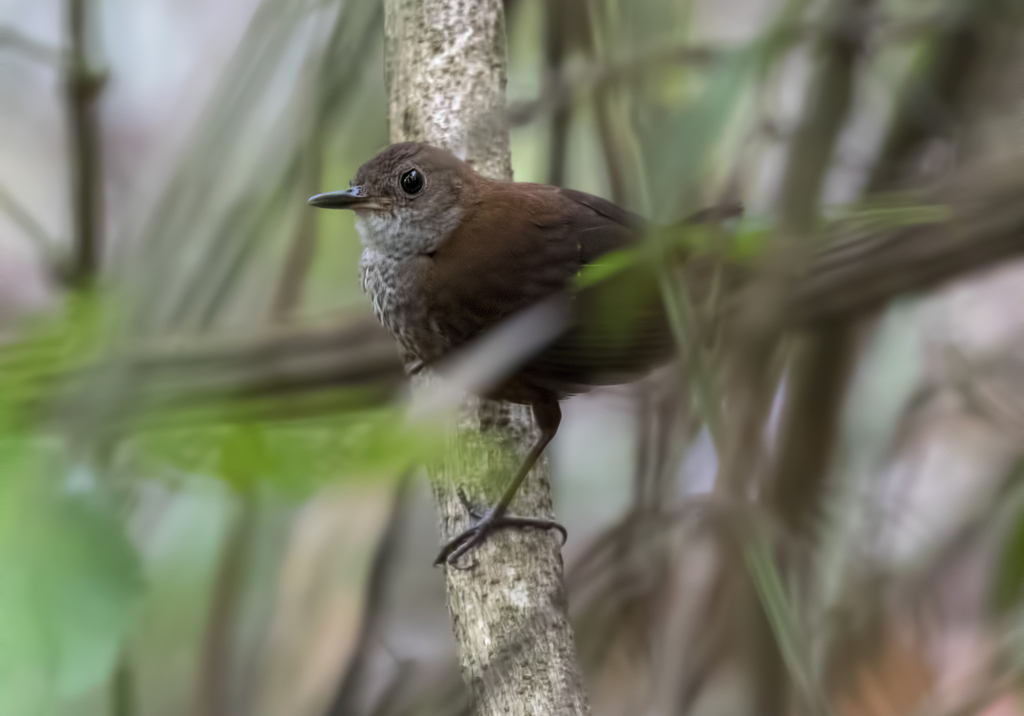
Scaly-breasted Wren
Live sightings near you, the range map, bar charts of when it is seen, and Macaulay Library photos and recordings.
Scaly-breasted Wren
Microcerculus marginatus
The southern nightingale-wren (Microcerculus marginatus), also known as the scaly-breasted wren, is a species of bird in the family Troglodytidae. It is found in Bolivia, Brazil, Colombia, Costa Rica, Ecuador, Panama, Peru, and Venezuela.
From the article Southern nightingale-wren on Wikipedia (CC BY-SA), quoted section by section
Description
The southern nightingale-wren is 11 cm (4.3 in) long; males weigh 18.2 to 22 g (0.64 to 0.78 oz) and females 17 to 18 g (0.60 to 0.63 oz). Adults of the nominate subspecies have a dull gray-brown face and deep chocolate-brown crown and upperparts with a reddish tinge on the rump. They have a very short dark chocolate tail. Their chin, chest, and upper belly are white with some black scalloping on the sides of the chest. The lower flanks and lower belly are dark chocolate. The juvenile is similar with the addition of darkish barring on the crown and back and dark brown feather tips on the underside. M. m. squamulatus is similar to the nominate but has scaly markings on the underparts. M. m. taeniatus also has scaly underparts and a more extensive reddish tinge on the upperparts and blackish barring below. M. m. corrasus is also similar to the nominate, but is a purer white below with narrow dark bars. M. m. occidentalis has a longer and thinner bill, darker upperparts and flanks, and broad dark bars on its abdomen. M. m. luscinia's throat is pale gray that becomes brownish gray on the breast and belly.
Range & habitat
The subspecies of southern nightingale-wren are found thus:
M. m. luscinia, central Costa Rica to Panama's eastern Darién Province M. m. corrasus, Santa Marta region of northern Colombia M. m. squamulatus, northern Colombia except Santa Marta into northern Venezuela M. m. occidentalis, western Colombia and northwestern Ecuador M. m. taeniatus, western Ecuador M. m. marginatus, throughout Amazonia, from Venezuela, Ecuador, Colombia, Peru, and Bolivia to near the mouth of the river in Brazil The southern nightingale-wren inhabits the lower levels of dense humid tropical forest. It has been recorded from sea level to 1,700 m (5,600 ft) in Costa Rica, to 1,400 m (4,600 ft) in Colombia, and to 1,800 m (5,900 ft) in Venezuela. There is also one record in Panama at 3,100 m (10,200 ft).
Wikipedia: “Distribution and habitat”
What it does
The southern nightingale-wren usually forages alone, on the ground and low in the understory. Little is known about its diet. It has been observed following army ant swarms in Central America but apparently does not do so routinely.
Wikipedia: “Feeding”
Listen
Looking for field recordings…
Where it lives
Recorded sightings
—
geo-referenced records in GBIF, from museums, herbaria and field observers.
Drag the globe to turn it. Dots are where records exist, not a range map; darker means more records.
In the stacks
Searching the stacks…
Every page naming Microcerculus marginatus in the Biodiversity Heritage Library →
This page is assembled live from iNaturalist, GBIF, Wikipedia, the Source Library and the Internet Archive. It is not yet part of the hand-edited codex. iNaturalist taxon 7638.