- Plants
- ›Vascular Plants
- ›flowering plants
- ›monocots
- ›grasses, sedges, cattails, and allies
- ›grasses
- ›Chloridoideae
- ›Cynodonteae
- ›Eleusininae
- ›Chloris
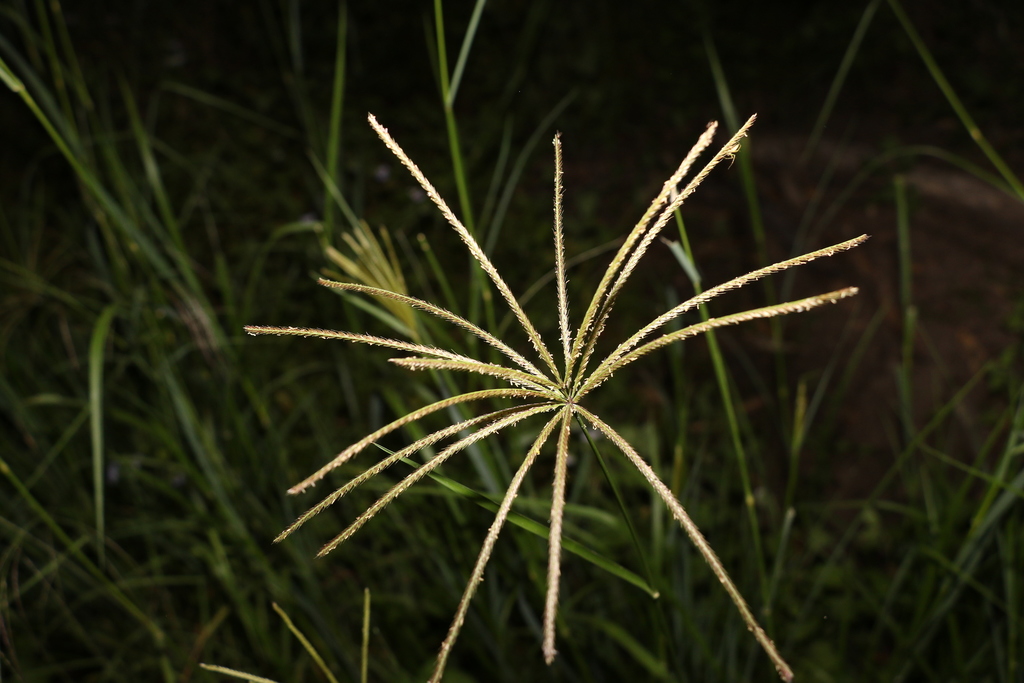
Rhodes Grass
Chloris gayana
Chloris gayana is a species of grass known by the common name Rhodes grass. It is native to Africa but it can be found throughout the tropical and subtropical world as a naturalized species.
It can grow in many types of habitat. It is also cultivated in some areas as a palatable graze for animals and a groundcover to reduce erosion and quickly revegetate denuded soil. It is tolerant of moderately saline and alkaline soils and irrigation.
From the article Chloris gayana on Wikipedia (CC BY-SA), quoted section by section
Description
This is a perennial grass which can reach one half to nearly three meters in height and spreads via stolons. It forms tufts and can spread into wide monotypic stands. The inflorescence is a single or double whorl of fingerlike racemes up to 15 centimeters long. Each spikelet in the raceme is a few millimeters long and contains one or two fertile florets and up to four sterile florets.
How it is grown
Its seasonal growth is in the spring and summer and its rainfall requirement is 600–750 mm per year. This low rainfall requirement means that this grass can survive in drier places. Rhodes grass can grow in a variety of soil conditions. Its ideal soil would be anything greater than a 4.3 pH level in terms of acidity. In addition to this, Chloris gayana has a moderate aluminum tolerance. The fact that this type of grass survives on little rainfall, can grow in low pH soils, and has a moderate tolerance to aluminum means that it may be beneficial to poor farmers in the sub-tropics. Less work is required to maintain this grass which means that the farmers can focus on other priorities. It is also beneficial to farmers who own land with poor soil. Benefits from Chloris gayana can also be found in the plant's growth. The seed germinates quickly (1–7 days) depending on temperature. and it often achieves full ground cover within three months of sowing. This too is good for farmers when it comes to covering bare soil. The fact that Chloris gayana can grow quickly means that farmers could use it to protect the soil from eroding.
Wikipedia: “Growing conditions”
Where it lives
Recorded sightings
—
geo-referenced records in GBIF, from museums, herbaria and field observers.
Drag the globe to turn it. Dots are where records exist, not a range map; darker means more records.
In the stacks
Searching the stacks…
Every page naming Chloris gayana in the Biodiversity Heritage Library →
This page is assembled live from iNaturalist, GBIF, Wikipedia, the Source Library and the Internet Archive. It is not yet part of the hand-edited codex. iNaturalist taxon 76292.