- Plants
- ›Vascular Plants
- ›flowering plants
- ›Dicots
- ›Legumes, Milkworts, and Allies
- ›Legumes
- ›Acacias, Mimosas, Mesquites, and Allies
- ›Ingeae
- ›Calliandra
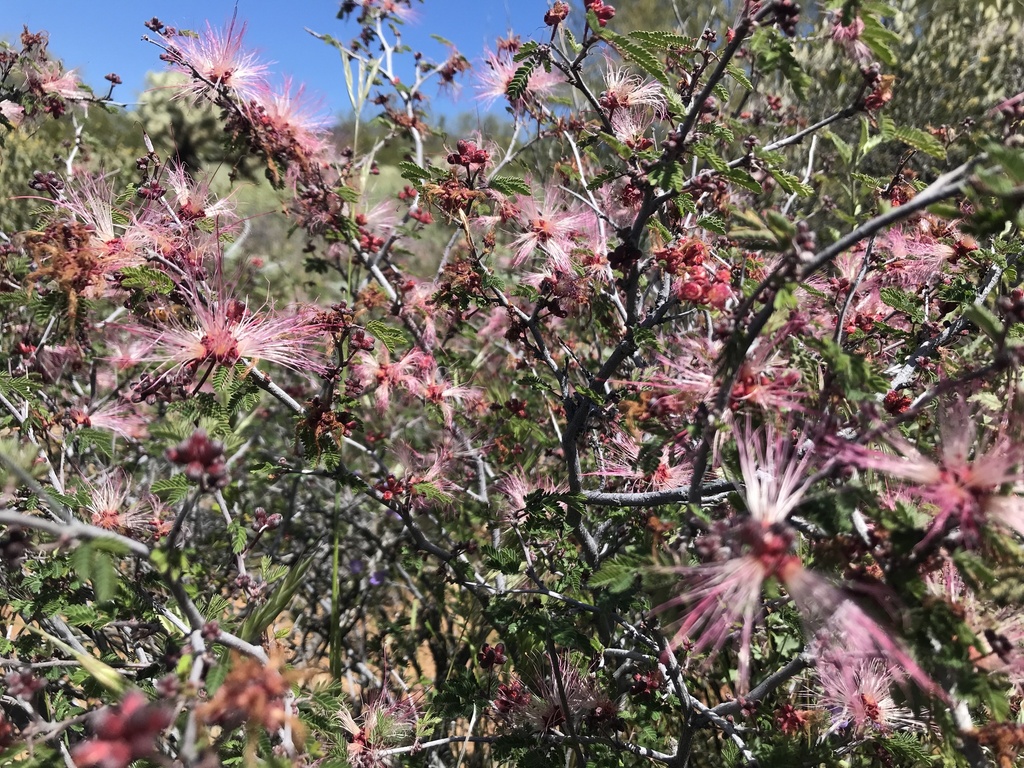
pink fairy-duster
Calliandra eriophylla
Calliandra eriophylla, commonly known as fairy duster, is a low spreading shrub which is native to deserts and arid grasslands in California, Arizona, New Mexico, Texas, and Mexico.
The flowers, which appear between late winter and late spring, have dense clusters of pale to deep pink stamens and are about 5 cm (2 in) wide.
From the article Calliandra eriophylla on Wikipedia (CC BY-SA), quoted section by section
Description
The Calliandra genus has over 250 species, with only three being native to the southwest. Found in regions such as Northern Mexico Sonoran and Chihuahuan deserts along with Southern California and Southwestern New Mexico. This spectacular plant gets its name as a reference to its "showy appearance". The Calliandra plants thrive in the heat and once established can endure extreme droughts. They can survive being watered as little as once to twice a week.
Range & habitat
Calliandra eriophylla usually grows in dry areas. The fairy duster can survive with little water, and with varied amounts of exposure to the sun. However, the plant blooms more when it is exposed to the sun than when it has little exposure to the sun. The fairy duster depends on soil that is dry, contains gravel, and its naturally alkaline. It is usually found on open hillsides and desert washes and slopes that fall below 5,000 feet (1,500 m). These plants can grow to be up to 2 to 4 feet (60 to 120 cm) wide and 1 to 3 feet tall. During the spring and summer the plant begins to bloom pale to vibrant pink flowers.
Wikipedia: “Habitat- growth habitat”
What it does
The Calliandra eriophylla is fairly common in the deserts of the southwestern United States. Therefore, it has a number of different pollinators. Some of the primary pollinators are bees, flies, butterflies, and hummingbirds. The fairy duster is able to attract these pollinators because it produces a considerable amount of nectar of about 2.17 mg of sugar per flower. The pollination allows the seed pods to begin to grow. Eventually when they reach maturity the pods, which are dehiscent, will break open and launch the seeds in an attempt to propagate the plant. One of the main threats to the seeds is that many animals eat the seeds before they can develop including small birds like quails which may even pry open unpopped pods.
Wikipedia: “Seeding and pollination”
Where it lives
Recorded sightings
—
geo-referenced records in GBIF, from museums, herbaria and field observers.
Drag the globe to turn it. Dots are where records exist, not a range map; darker means more records.
In the stacks
Searching the stacks…
Every page naming Calliandra eriophylla in the Biodiversity Heritage Library →
This page is assembled live from iNaturalist, GBIF, Wikipedia, the Source Library and the Internet Archive. It is not yet part of the hand-edited codex. iNaturalist taxon 75933.