On eBird ↗
Southern Chestnut-breasted Wren
Live sightings near you, the range map, bar charts of when it is seen, and Macaulay Library photos and recordings.
Southern Chestnut-breasted Wren
Cyphorhinus thoracicus
The southern chestnut-breasted wren (Cyphorhinus thoracicus) is a species of passerine bird in the wren family Troglodytidae that is found in southern Peru and the extreme northwest of Bolivia. It was formerly considered to be conspecific with the northern chestnut-breasted wren (Cyphorhinus dichrous) with the English name "chestnut-breasted wren".
From the article Southern chestnut-breasted wren on Wikipedia (CC BY-SA), quoted section by section
Description
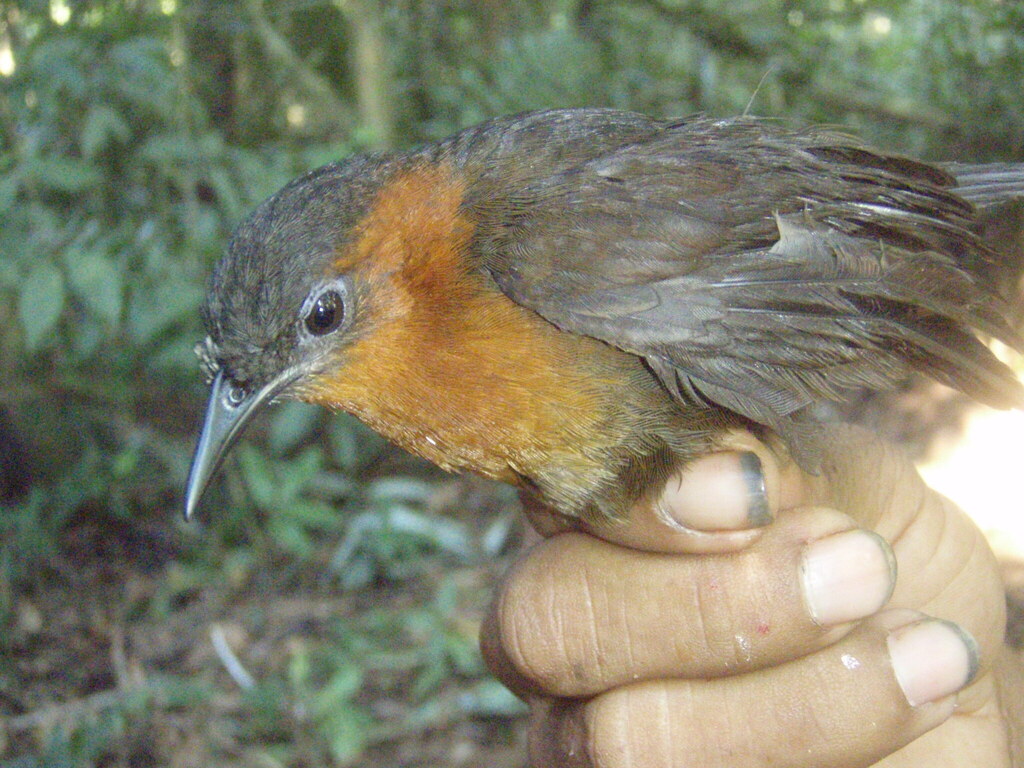
The southern chestnut-breasted wren is 11.5 to 15 cm (4.5 to 5.9 in) long and weighs 26.5 to 41 g (0.93 to 1.45 oz). It has a sooty black crown, a rich dark brown back and rump, and a dark brown tail. It has a deep orange-brown face, throat, and upper belly and dark brown flanks and lower belly. The juvenile differs from the adult in having a paler lower belly.
Range & habitat
The southern chestnut-breasted wren is found in central Peru and western Bolivia. It inhabits wet montane forest including cloud forest with abundant epiphytes and moss. It is mostly found between 1,200 and 2,700 m (3,900 and 8,900 ft) but down to 800 m (2,600 ft) in Peru's Manú Province.
Wikipedia: “Distribution and habitat”
What it does
The chestnut-breasted wren typically remains within 1 m (3.3 ft) of the ground, foraging in leaf litter for invertebrates such as beetles and spiders. It hunts alone, in pairs, or in what are assumed to be small family groups. It only rarely joins mixed-species foraging flocks.
Wikipedia: “Feeding”
Listen
Looking for field recordings…
Where it lives
Recorded sightings
—
geo-referenced records in GBIF, from museums, herbaria and field observers.
Drag the globe to turn it. Dots are where records exist, not a range map; darker means more records.
In the stacks
Searching the stacks…
Every page naming Cyphorhinus thoracicus in the Biodiversity Heritage Library →
This page is assembled live from iNaturalist, GBIF, Wikipedia, the Source Library and the Internet Archive. It is not yet part of the hand-edited codex. iNaturalist taxon 7572.